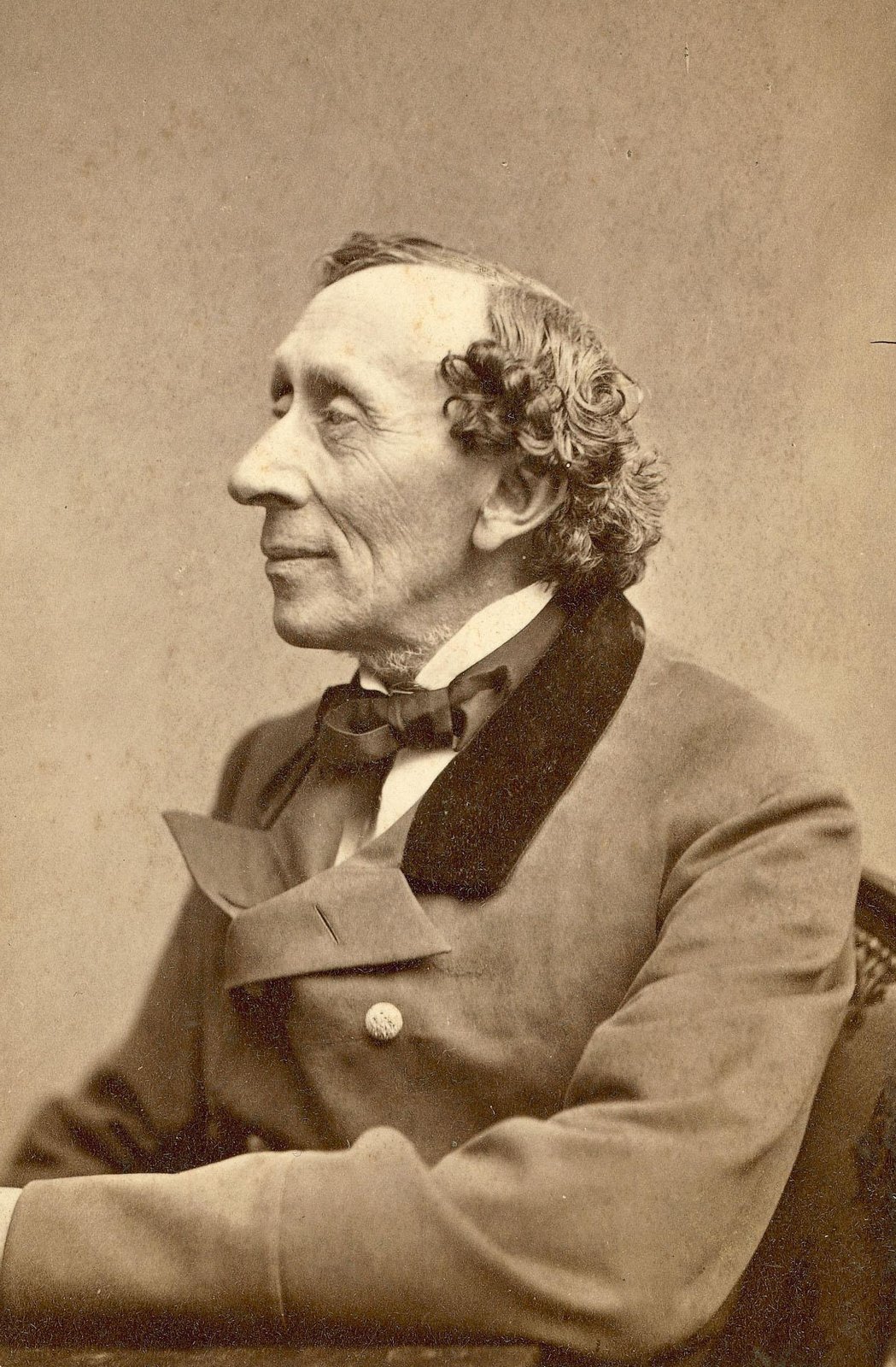

Thora Hallager, Hans Christian Andersen, 1869; public domain (photographer d. 1884); downscaled · Thora Hallager, photograph of Hans Christian Andersen, Copenhagen, October 1869, via Wikimedia Commons (source given there as museum.odense.dk, Odense City Museums) · Public domain
Trait Constellation
Key Achievements
Andersen published his first booklet of tales 'told for children' in 1835 and went on issuing new collections, titled New Fairy Tales from 1843 and Stories from 1852, until 1872. His versions of folk tales and his own inventions include "The Little Mermaid", "The Emperor's New Clothes" and "The Ugly Duckling". In an 1869 essay the Danish critic Georg Brandes analysed how their prose reproduces the spoken language used with children.
Besides the tales he wrote novels, among them The Improvisatore (1835), O.T. (1836) and Only a Fiddler (1837), which were translated into German soon after they appeared. He also wrote travel books, from A Walking Tour from Holmen's Canal to the East Point of Amager (1829) to A Poet's Bazaar (1842) and In Spain (1863).
Andersen wrote or adapted about thirty works for the stage, including revues, vaudevilles, the drama The Mulatto (1840) and plays for Copenhagen's Casino theatre. His libretto for J. P. E. Hartmann's opera Little Kirsten (1846) became, in the words of the Andersen scholar Johan de Mylius, a sort of Danish national opera, and he persuaded Franz Liszt to stage it at Weimar in 1856.
Moments That Reveal Them
In his memoirs, quoted by the biographer R. Nisbet Bain, the poet and folklorist J. M. Thiele recalled how, around 1821, an unknown, shabbily dressed youth knocked, came into his study unannounced, bowed and asked to recite a poem of his own about the stage. Without waiting for an answer he performed it, then scenes from several plays, taking all the parts, and left. Thiele learned only that evening that the visitor was Hans Christian Andersen.
Walking uninvited into a writer's study and taking the floor there offers one early example of the forwardness reflected in the profile's social assertiveness, a forwardness that also drew ridicule in these years. Social Assertiveness
Andersen believed the Royal Theatre's censor judged his name rather than his plays, so he submitted the one-act drama The King Dreams in November 1843, and the comedy The New Lying-in Room in January 1845, without his name. Both were accepted and staged. According to his biographer R. Nisbet Bain, few people guessed the author of the comedy, and Andersen kept the secret while it ran.
Finding a way around a route he saw as blocked, rather than simply pressing the same case again, is consistent with the profile's resourcefulness score. Resourcefulness
Turning Points
By mid-1822 the Royal Theatre had dropped Andersen from its singing school and returned one play of his as unfit to perform. He sent in another, Alfsol. The director K. L. Rahbek judged it unsuitable for the stage but proposed that its author be helped to get an education, and Jonas Collin put the case to King Frederick VI. That autumn Andersen was sent to the grammar school at Slagelse at public expense, with Collin as his guardian.
Sending in a fresh play straight after a rejection sits alongside the profile's persistence score; the turn itself came from the directors' and Collin's decision, which moved him from chasing a place on the stage to formal schooling. Persistence
Similar People
People whose overall profiles resemble theirs.

Pablo Picasso

Frida Kahlo

Maya Angelou

Charles Dickens

Sigmund Freud
Sources
- Hans Christian Andersen (English Wikipedia) -- orientation only; not used as support for any scored row.
- Hans Christian Andersen (Q5673) -- verified live via wbgetentities (2026-09-26): en label 'Hans Christian Andersen', description 'Danish writer and poet (1805–1875)', da label 'H.C. Andersen', ko label '한스 크리스티안 안데르센', born 1805-04-02, died 1875-08-04, citizenship Q756617 (Kingdom of Denmark), P18 'Hans Christian Andersen by Thora Hallager 1869.jpg', kowiki '한스 크리스티안 안데르센'. Orientation only.
- Hans Christian Andersen, The True Story of My Life: A Sketch, translated by Mary Howitt (London: Longman, 1847), archive.org OCR full text (truestoryofmylif00ande) -- SELF, one perspective, notoriously self-mythologising (Bain and Edvard Collin both warn against its account of critics); never sole support for a row. Read: the 1819-22 Copenhagen chapter (Siboni, Guldberg, Thiele, the anonymous first play) and the 1844 passage on the rejection of Lykkens Blomst and his letter to and conversation with J. L. Heiberg (pp. 229-232). Also opened for cross-checking but not cited: The Story of My Life (Hurd & Houghton 'Author's Edition', 1871; storyofmylife00ande_0).
- R. Nisbet Bain, Hans Christian Andersen: A Biography (London: Lawrence & Bullen, 1895), archive.org OCR full text (hanschristianand00bainiala) -- SCHOLAR perspective (British Museum librarian, 20 years after Andersen's death), built mainly on the Danish letter editions (Bille & Bøgh, Breve fra / Breve til H. C. Andersen, 1877-78) and Edvard Collin, H. C. Andersen og det Collinske Hus (1882), which prints the Royal Theatre directors' reports, censors' reports (Molbech, Holstein, Heiberg) and Meisling's reports; Bain states the autobiography must be used 'with the utmost caution' and repeatedly corrects it. Read in full: Introduction; ch. II (Copenhagen 1819-22, incl. J. M. Thiele's own account of their first meeting from his memoirs and Admiral Wulff's account); ch. III (Slagelse/Elsinore 1822-27); ch. VI (first tales 1835, Danish reviews, 1838 pension, Marmier); ch. VII (vaudevilles 1835-39, The Mulatto and Molbech/Holstein reports 1839-40, The Moorish Girl and Heiberg's report 1840, H. P. Holst's letter on the unsent epistle 1841, W. F. Ainsworth's 1841 account from the Literary Gazette); ch. VIII (anonymous submissions of 1843 and 1845, Heiberg's rejection of Lykkens Blomst 1844, Edvard Collin's letter on Herr Rasmussen 1846, Grimm 1844). Skimmed for specific passages: ch. IX (England, Dickens), ch. XII (Dr Bloch's recollection of his readings), ch. XIV (finances). Bain's own motive readings (vanity, 'morbid' sensitivity) are NOT used as evidence; only the dated acts and documents he reports.
- Johan de Mylius, The Hans Christian Andersen Centre, University of Southern Denmark (andersen.sdu.dk) -- SCHOLAR perspective, independent of Bain (modern Danish Andersen scholar). Read: 'Hans Christian Andersen - a short biography' (full page); the short biography sub-pages 'Theatre' and 'Fairy Tales'; and entries of de Mylius's day-by-day biography 'The Life of Hans Christian Andersen. Day By Day' (the online Timetable) for 1838, Feb. 1844 (The King Dreams, submitted anonymously), Jan.-Mar. 1845 (Lykkens Blomst performed; Den nye Barselstue first performed 26 Mar.), 1851 and July 1863 (paper-cuttings), Jan. 1860 (Workers' Association reading), 1856 (Liden Kirsten in Weimar), 13 Mar. and 12 June 1868 (Scudder). Timetable entries on his private life and health were seen and deliberately NOT used.
- Georg Brandes, 'Hans Christian Andersen' (1869), in Eminent Authors of the Nineteenth Century: Literary Portraits, trans. Rasmus B. Anderson (New York: Crowell, 1886), pp. 61-73, archive.org OCR full text (cu31924027150519) -- NON-SELF CONTEMPORARY CRITIC perspective (Danish critic writing in Andersen's lifetime). Read: the opening analysis of the tales' spoken, child-directed prose and the worked comparison of Juan Manuel's Count Lucanor ch. VII with 'The Emperor's New Clothes'.
- Edmund Gosse, Two Visits to Denmark, 1872, 1874 (London: Smith, Elder, 1911), archive.org OCR full text (twovisitstodenma00gossuoft) -- NON-SELF EYEWITNESS (English critic who met Andersen at Rolighed in July 1872 and at Nyhavn in June 1874). Read: ch. on the 1872 visit to Rolighed (pp. 95-103), the two Andersen letters to Gosse of 30 Dec. 1872 and 20 Jan. 1874 quoted on pp. 137-140 (SELF, quoted), and the June 1874 visit (pp. 237-241). Most of the 1874 material concerns illness and is NOT used.