Warren Buffett
94% Profile Match
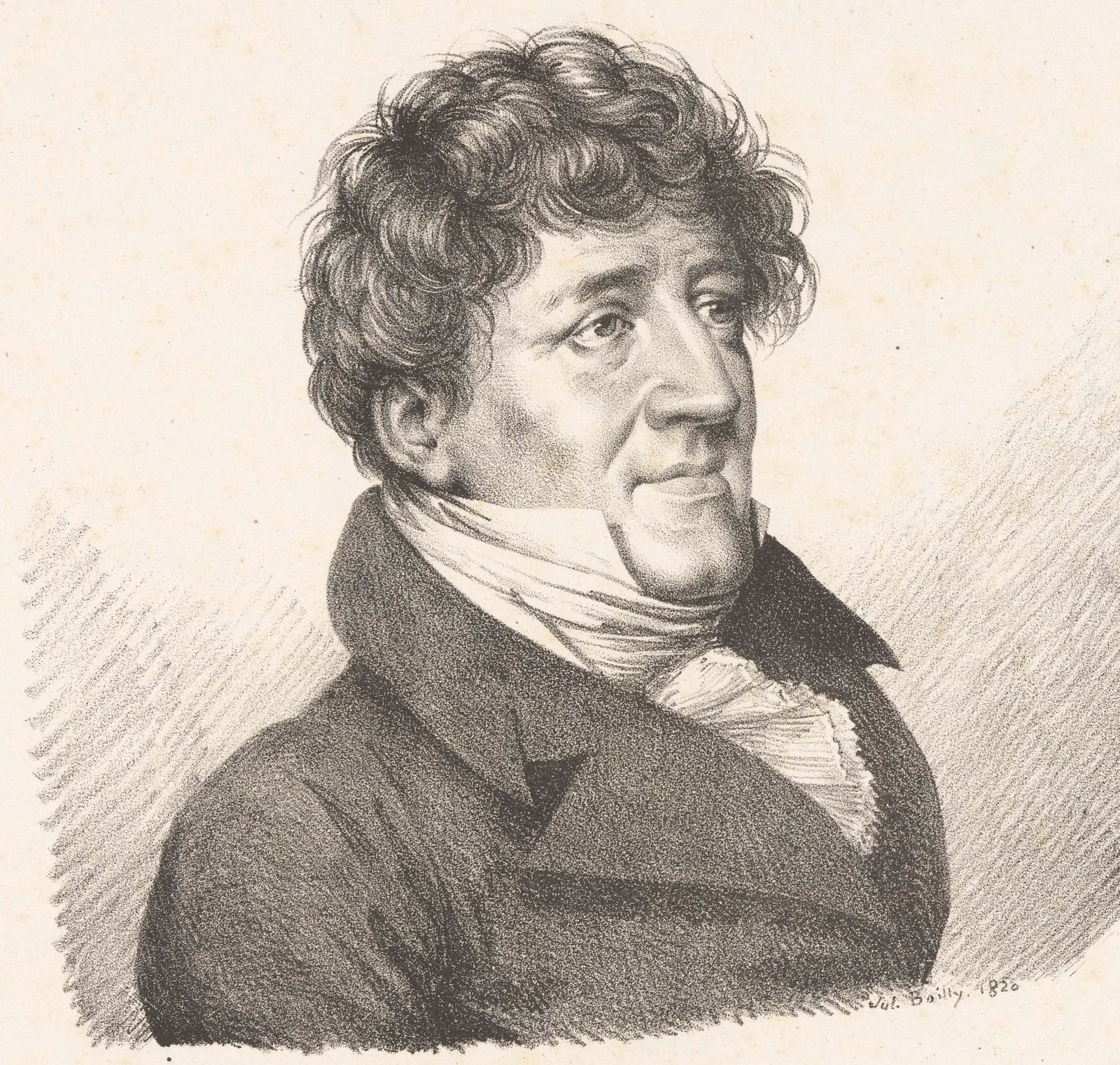
Julien-Léopold Boilly, lithograph portrait of Baron Cuvier, 1820, Rijksmuseum, Amsterdam (object number RP-P-1911-948); cropped to the portrait, without the caption text · Rijksmuseum, Amsterdam, print RP-P-1911-948, lithograph 'Le Baron Cuvier' from the series Iconographie de l'Institut royal de France; signed and dated 'Jul. Boilly 1820' on the stone · Public domain (nineteenth-century print, published in France in or after 1820; the Rijksmuseum item page gives its copyright status as public domain and the museum's reproduction is released under the CC0 public domain dedication)
naturalist · 19th Century
1769–1832
Not yet included in personality matching — the documented evidence doesn't yet cover enough of the personality model. Everything else on this page is fully available.
In April 1796 Cuvier read the Institut national a paper comparing the skulls and teeth of living and fossil elephants. He showed that the elephants of Ceylon and the Cape of Good Hope were two distinct species, and that the mammoth and the 'Ohio animal' (which he later named Mastodon) differed from both. He concluded that such bones came from animals no longer alive, part of a world destroyed by some kind of catastrophe. In the same year he described a giant fossil from Paraguay and named it Megatherium. Reference accounts such as the Embryo Project Encyclopedia describe the elephant paper as proving that extinction was real.
Cuvier treated a fossil skeleton as a problem governed by the correlation of parts: because each organ of an animal has to fit the rest, a few bones could point to the whole creature. He applied this to the fossil mammals of the gypsum quarries of Montmartre and of other deposits, and in 1812 collected his papers as the four-volume Recherches sur les ossemens fossiles, prefaced by a Preliminary Discourse that Rudwick calls immensely influential in the nineteenth century. With the geologist Alexandre Brongniart he also described the alternating marine and freshwater beds of the Paris region (a report of 1808, enlarged in 1811), putting the fossils at the centre of the stratigraphy.
Appointed in 1795 to assist the professor of comparative anatomy at the Museum in Paris, Cuvier built up its comparative-anatomy collection and, with Duméril and later Duvernoy, published the Leçons d'anatomie comparée (1800-05). By ranking organs by importance and comparing nervous systems, he divided the animal kingdom into four basic plans, or embranchements: vertebrates, molluscs, articulates and radiates. His Le Règne animal (1817) set out the scheme, and he also published a series of detailed memoirs on the anatomy of molluscs.
In 1830 the Académie des sciences heard Geoffroy Saint-Hilaire report on a memoir that compared the organs of cephalopods with those of vertebrates, and conclude that nobody could now escape 'unity of composition'. According to Flourens, who knew both men and sides with Cuvier, Cuvier had often praised Geoffroy's earlier discoveries and spoke only when the claim was extended across the separate plans of animals. Cuvier asked what 'unity of plan' and 'unity of composition' were meant to mean, and argued that in the ordinary sense of identity they were refuted by opening a bird and a fish. Goethe, who followed the dispute from Weimar, took Geoffroy's side and thought Cuvier's analytic method left out the unity of living nature.
Pressing an opponent to define his terms and answering with what an anatomist finds on the table is consistent with analytical rigor; Goethe's verdict shows that critics saw the same method as too narrow. Analytical Rigour
A paper on fossil quadrupeds that Cuvier signed in December 1800 ended with an appeal. The Institut had it printed as a separate booklet so it could reach naturalists, and in it Cuvier asked savants and collectors across Europe for specimens and information. He named those already helping him, among them quarry workers around Paris and the owners of private collections, and told readers that he already had more than three hundred drawings, fifty of them engraved as plates. Rudwick reads the text both as an appeal for collaboration and as a quiet discouragement to anyone thinking of competing.
Asking for help across Europe is consistent with collaboration, while showing how far his work had already advanced also protected his lead; Rudwick's reading is that both aims were present. Collaboration
Cuvier spent the Revolution years as a tutor to a Protestant noble family in Normandy, dissecting marine animals with few books at hand. Through the agronomist Tessier, who was sheltering nearby, he sent his observations to Paris naturalists including Geoffroy Saint-Hilaire, and in spring 1795 he accepted their invitation to come to the capital. He joined the Muséum as assistant to the ageing professor of comparative anatomy, Mertrud, and within a year he had read his elephant paper to the Institut.
Sending observations to distant specialists from an isolated post, then taking the opening in Paris when it came, is consistent with proactive agency. Proactive Agency
People whose overall profiles resemble theirs.