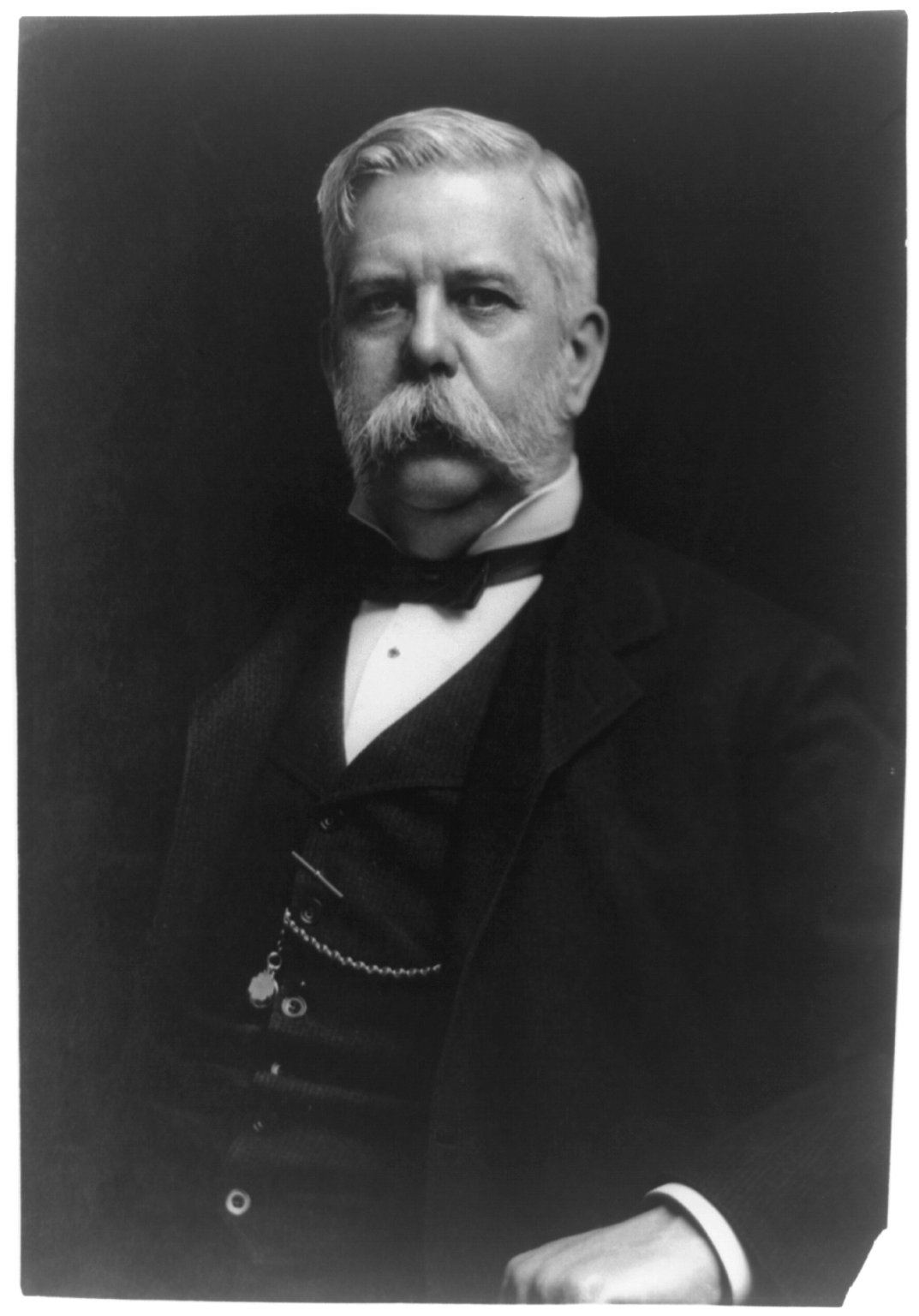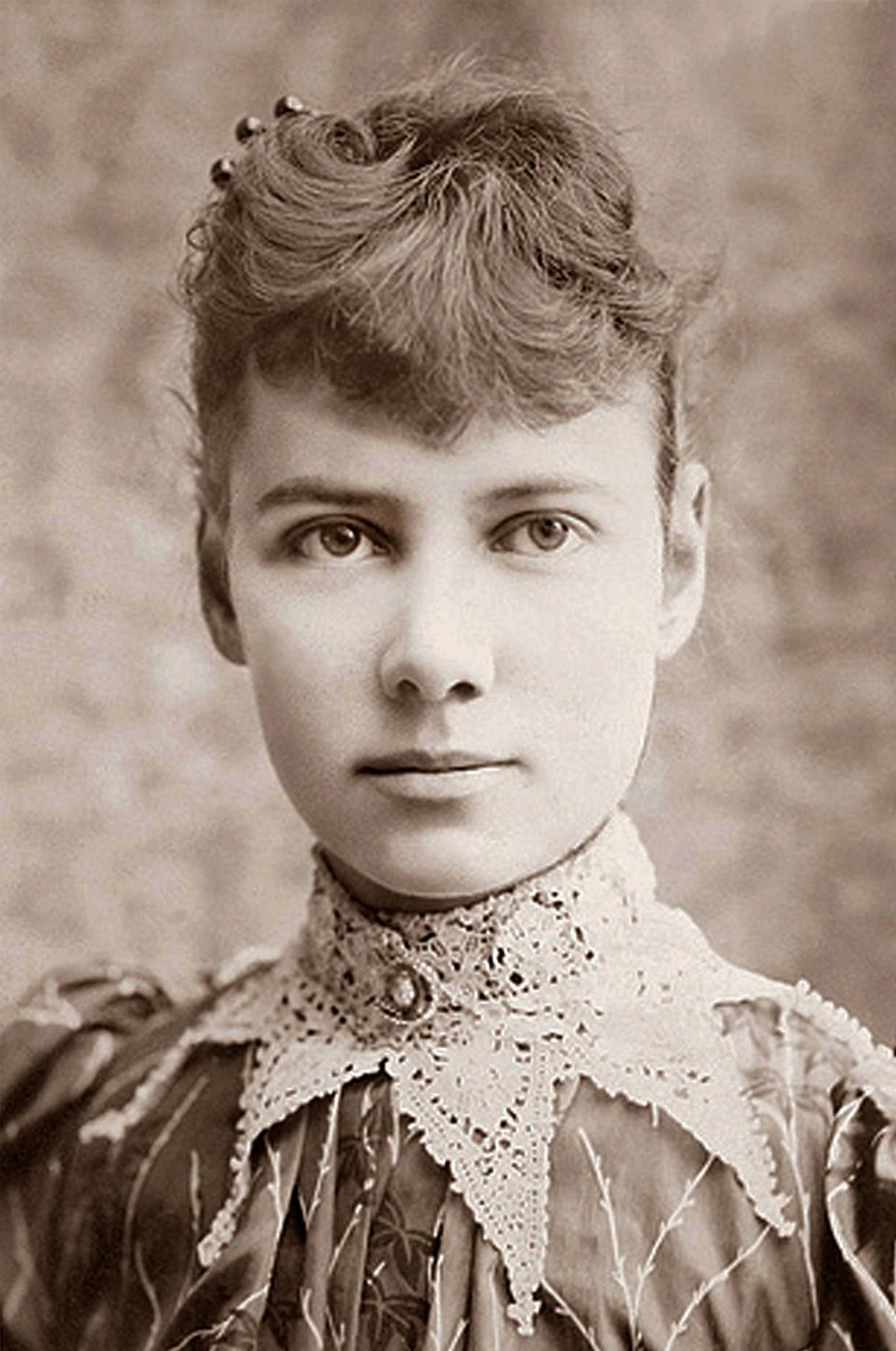

Joseph G. Gessford, 'George Westinghouse, half-length portrait, facing front', photographic print, between 1900 and 1914; Library of Congress Prints and Photographs Division (LC-USZ62-93492), no known restrictions on publication · Library of Congress Prints and Photographs Division, BIOG FILE - Westinghouse, George, 1846-1914 (LC-USZ62-93492; hdl.loc.gov/loc.pnp/cph.3b39671), via Wikimedia Commons 'George Westinghouse.jpg' · Public domain
Trait Constellation
Key Achievements
From 1885 George Westinghouse bought European transformer patents and had his engineers turn them into a working alternating-current lighting system, put into commercial service in Buffalo in November 1886; in July 1888 he acquired the rights to Nikola Tesla's alternating-current motor patents. His company built the alternating-current plant for the 1893 World's Columbian Exposition in Chicago and won the 1893 contract for the generators of the Niagara Falls power station, which began supplying Buffalo in November 1896.
In 1869, aged 22, Westinghouse patented a railway brake worked by compressed air and founded the Westinghouse Air Brake Company. His automatic brake of the 1870s and the quick-action triple valve he patented in 1887-88, after the Burlington trials, made it practical to brake long freight trains, and the brake came into general use on American railroads.
Moments That Reveal Them
In April 1892, General Electric-group companies bid $13.98 to $18.51 per light to illuminate the Chicago world's fair. Westinghouse's company won the contract with a bid of $5.25, which some of his friends called a reckless dive in the dark and which lost money directly. Because Edison's patent on the all-glass lamp bulb barred it from making ordinary lamps, Westinghouse and his engineers produced a two-piece 'stopper' lamp and he set up a glass factory, making about 250,000 lamps for the fair's opening on 1 May 1893, though the lamps held vacuum poorly and had to be renewed often.
Changing the lamp design and setting up a dedicated factory within months of meeting the patent barrier is consistent with resourcefulness under a hard outside constraint. His biographers present the low bid itself as a deliberate bet on publicity, so the episode is not evidence of cost control. Resourcefulness
Around 1900 Westinghouse drew up a patent specification for apparatus that would draw heat from the atmosphere and give more power than it consumed. Lord Kelvin cabled back that atmospheric heat cannot be used to generate power and later called the idea a chimera; in November 1901 Professor Dewar of the Royal Institution judged that the specification explicitly claimed perpetual motion, and about three years later his engineer MacAlpine reached the same verdict on the power claim. Westinghouse answered that Kelvin's paper did not meet the case and treated the work as a pastime; his biographer Henry Prout records references to it in his letters as late as 1913.
The episode is consistent with the independence from authority his biographer describes, who writes that he 'accepted nothing on a great name'. Here that independence ran against established thermodynamics, so it also illustrates the cost of the trait. Independent Thinking
Turning Points
On 23 October 1907, a day after the Knickerbocker Trust failure set off a financial panic, the directors of Westinghouse Electric and Manufacturing Company asked a federal court to appoint receivers; the company's debt was about $43 million. Westinghouse worked out the merchandise creditors' plan, under which creditors took stock in settlement, and the company came out of receivership in 1908 after about fourteen months. The reorganised board mostly represented banks and creditors, he stayed on as president with reduced powers, and in 1911 he ended his official relations with the company. He died in March 1914.
Prout ties the 1907 failure to the risks of his practice of financing the companies through personal appeals and his own holdings rather than a bankers' syndicate, and records his earlier refusal to accept bankers' control. That is consistent with the strong need for autonomy scored on his profile, though the facts above do not by themselves show that it explains the outcome. Need for Autonomy
Similar People
People whose overall profiles resemble theirs.

Mustafa Kemal Atatürk

Akio Morita

Joan of Arc

Simón Bolívar

Nellie Bly
Sources
- George Westinghouse (Q262367) -- verified live via wbgetentities (2026-10-04): en label 'George Westinghouse', description 'American inventor and businessman (1846–1914)', P569 6 Oct 1846, P570 12 Mar 1914, citizenship United States (Q30), instance of human, ko label '조지 웨스팅하우스', P18 'George Westinghouse.jpg'. Orientation only; not used as support for any row.
- George Westinghouse -- Wikipedia article (and the William Kemmler article), read as orientation only; not used as support for any scored row.
- Henry G. Prout, A Life of George Westinghouse (New York: American Society of Mechanical Engineers, 1921), Internet Archive full text (lifegeorgewest00prourich) -- INSIDER, ADMIRING official biography written for an ASME committee with Westinghouse's brother Henry Herman Westinghouse 'always in consultation'; Prout was himself a long-time Westinghouse company officer and writes as a participant ('the writer'). Read locally: Ch. I (introduction), Ch. II (air brake, in part: first trains, 1875 court finding, Burlington trials 1886-87, quick-action valve), Ch. IV (electric activities, to the Gaulard-Gibbs development), Ch. V (Tesla motor), Ch. VII (Chicago World's Fair), Ch. VIII (Niagara), Ch. XIII (natural gas, in part), Ch. XVI (finance, 1907-08 reorganization, Equitable Life) and Ch. XVII (personality, relations with employees) in full. Its evaluative praise is not used as evidence; it also states plainly that he was not an inventor of fundamentals in electricity and records his scrap-heap errors.
- Francis E. Leupp, George Westinghouse: His Life and Achievements (Boston: Little, Brown, 1918/1919), Internet Archive full text (georgewestinghou00leuprich) -- journalist's biography prepared with the cooperation of Westinghouse's family and associates (the preface says doubtful passages were submitted to people who knew the facts), admiring in tone but narrative and anecdotal; includes passages on the 1890 and 1907 financial crises and the Kemmler episode. Read locally: Ch. VI (English brake trials 1871-75), Ch. X-XII (contest of the currents, New York campaign and Kemmler, Chicago lighting contract and stopper lamp, 1890 financial crisis) and Ch. XV (the 1907 failure and 1908 reorganization).
- Edward Dean Adams, Niagara Power: History of the Niagara Falls Power Company 1886-1918 (privately printed, 1927), Internet Archive full text (niagarapowerhist0002adam), chapter on the Westinghouse Electric and Manufacturing Company and George Westinghouse -- CLIENT-SIDE, non-insider account by the president of the Cataract Construction Company that placed the Niagara generator contract; documentary and company-history in style, favourable to Westinghouse's technical work but not written by his company. Read locally: the whole Westinghouse chapter, including the 1890 conversation with Adams about pneumatic transmission, Westinghouse's refusal to enter the Niagara commission's competition, the December 1892 offer and the 1893 contract.
- Richard Moran (sociologist, Mount Holyoke College), 'The Strange Origin of the Electric Chair', Boston Sunday Globe, 5 August 1990, as reproduced on the New York Correction History Society site (Miskell, Executions in Auburn Prison, Appendix B) -- INDEPENDENT scholarly account (the author later wrote the book Executioner's Current, 2002), critical of the Edison-side campaign; read in full. Used for the 1888-90 Harold P. Brown controversy: Brown's public challenge, Westinghouse's refusal, the refusal to sell generators.
- Obituary and notices of George Westinghouse, The Times-Dispatch (Richmond, Va.), 13 March 1914, p. 1, and The Milwaukee Leader, 13 March 1914, p. 16, Library of Congress Chronicling America OCR text -- period press (wire-service obituary and a notice of the Westinghouse employees' memorial holiday) written the day after his death; the OCR is partly garbled and was read only for the dated facts used (the Saturday half-holiday, the 1907 receivership and reorganization, the loss of control, the 50,000-employee holiday).
- Engineering and Technology History Wiki (IEEE/ETHW), 'George Westinghouse' biography page -- institutional overview (read in full): role in spreading alternating current, the Tesla patents, the 1893 Exposition and Niagara, the loss of financial control before his death, the 1911 Edison Medal.
- PBS, Tesla: Master of Lightning, 'Harnessing Niagara' page -- public-broadcaster overview centred on Tesla (read in full): the international Niagara commission, the late-1893 contract, first power to Buffalo in November 1896, and the Tesla royalty story (legendary in detail; not used for any scored row).
- The Westinghouse Legacy (heritage website), 'The Appeals of William Kemmler' (David Bear) -- a company-heritage page that mainly reproduces 1890 New York Times clippings as images; read only for the fact that the Times of 4 May 1890 published a letter from Westinghouse about the electric-chair apparatus and discussed whether he had hired Kemmler's lawyer. The clipping images were not readable; not used for any scored row.