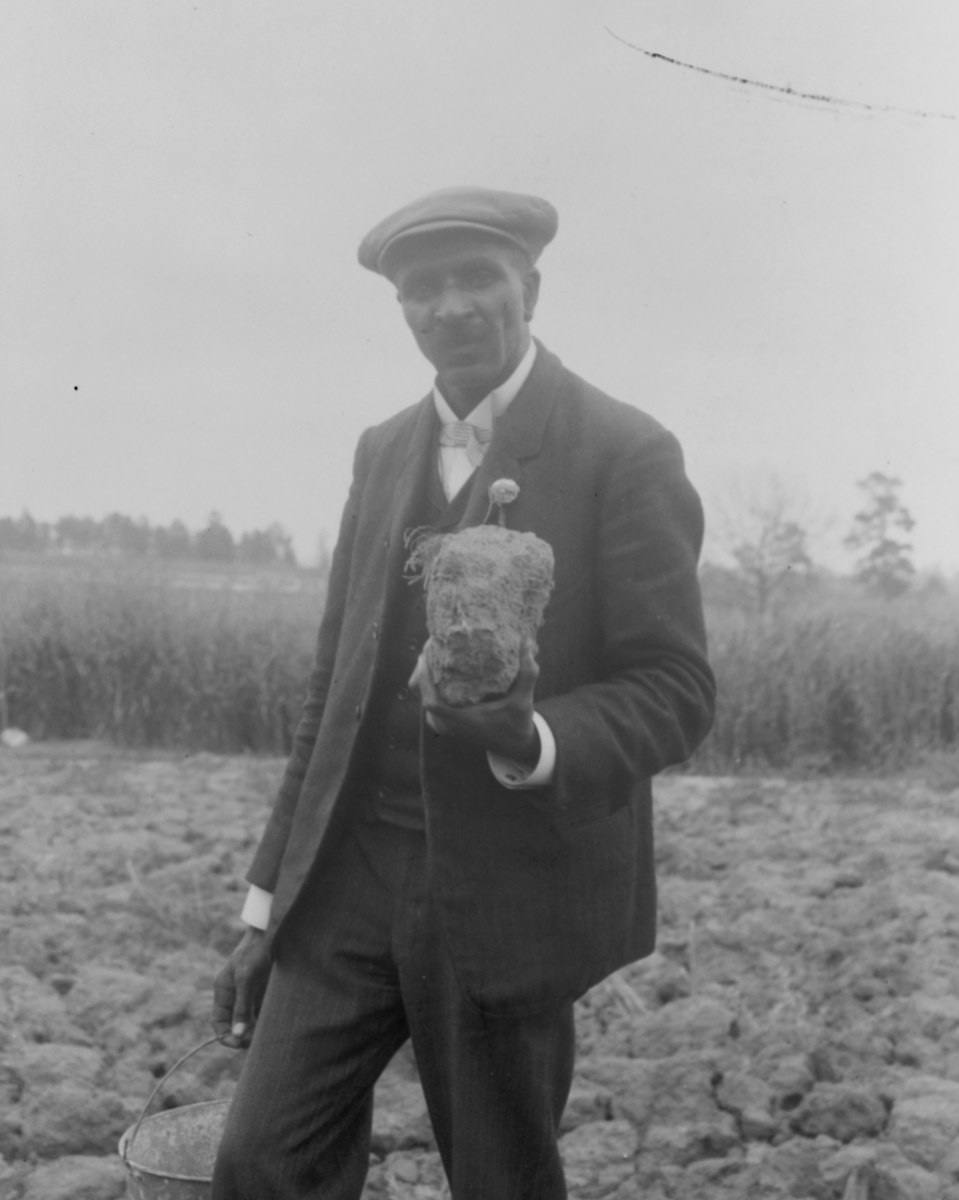
Frances Benjamin Johnston, 1906, Library of Congress Prints and Photographs Division (LC-J694-520) · Library of Congress, Prints and Photographs Division, LCCN 95507555 (LC-J694-520; cph.3c14302; Booker T. Washington Collection): 'George Washington Carver, full-length portrait, standing in field, probably at Tuskegee, holding piece of soil', photograph by Frances Benjamin Johnston (1864-1952), 1906. The image is the Library's own scan as mirrored on Wikimedia Commons (3282 x 4096 pixels, 839,321 bytes, SHA-1 33ff2bd0d46beca115967024d243377facca83d8, checked against the Library's 821 x 1024 pixel download at cdn.loc.gov: mean grey-level difference about 2 of 255, the same photograph); the Commons record carries the Library's rights line 'No known restrictions on publication' and the Library credit. It is the unrestored Library scan, not a third-party restoration. Saved as a crop of the figure's upper body (about 1999 x 2499 pixels of the original) downscaled once to 959 x 1200 (never upscaled). · Public Domain (published 1906; photographer died 1952; Library of Congress: no known restrictions on publication)
agronomist · 20th Century
George Washington Carver
1864–1943
Known For
Not yet included in personality matching — the documented evidence doesn't yet cover enough of the personality model. Everything else on this page is fully available.
Trait Constellation
Key Achievements
In 1896 George Washington Carver went to Tuskegee Institute in Alabama to head its new school of agriculture and experiment station, and for the rest of his career he worked on helping poor Southern farmers escape cotton-depleted soil. The American Chemical Society reports that by rotating cotton land with soil-enriching legumes such as cowpeas and beans he raised yields without commercial fertilizer, taking a half-acre sweet potato plot from 40 to 266 bushels in a few years. He taught at Tuskegee for 47 years.
Carver took the knowledge to the farmers. The American Chemical Society says the Jessup wagon, a travelling school that opened on 24 May 1906 with funding from the banker Morris K. Jesup (also spelled Jessup) and the Slater Fund, was designed by Carver, though he never drove it, and was soon made part of the U.S. Department of Agriculture's outreach. As director of the experiment station he also wrote bulletins for tenant farmers, teachers and housewives, 44 of them between 1898 and 1943 by the ACS's count, and the National Agricultural Library describes them as plain instructions for the 'poor tenant farmer with a one-horse equipment'.
To give farmers a market for the crops that rebuilt their soil, Carver developed uses for peanuts, sweet potatoes and native clay, more than 300 from the peanut alone by the American Chemical Society's count. His 1921 testimony before a House committee on a peanut tariff made him the public 'Peanut Man'. Historians caution that the popular image overstates him: Biography.com notes that he did not invent peanut butter, and the Encyclopedia of Alabama says much of his fame was based on myth though his real contributions were significant.
Moments That Reveal Them
In 1921 Carver appeared before the House Ways and Means Committee as an expert witness for the peanut industry. The American Chemical Society says he began badly, shabbily dressed and fumbling with his samples, but as he displayed and described product after product his time was repeatedly extended, and the committee gave him a standing ovation. Biography.com adds that the members had at first doubted him because he was Black.
This is consistent with persuading a sceptical audience through concrete demonstration rather than polished delivery. Persuasiveness
At Tuskegee Carver repeatedly pressed for room to do research on his own terms. The American Chemical Society says he insisted on a laboratory for his exclusive use and relief from teaching, often refused Booker T. Washington's suggestions (which Washington called 'a polite way of giving orders'), and was given two dormitory rooms, one for his plant specimens; Washington would not let him stop teaching altogether, and his successor Robert Moton later relieved him of all teaching except summer school.
This is consistent with a strong need to control the conditions of his own work, at some cost to his relations with the school's leadership. Need for Autonomy
Turning Points
In April 1896, with a master's degree from Iowa State, Carver chose Booker T. Washington's offer of a new agricultural school at Tuskegee over an Alcorn faculty post and a place on the Iowa State faculty. The American Chemical Society quotes his acceptance letter: it had always been the one great ideal of his life, he wrote, to be of the greatest good to the greatest number of 'my people', and the Encyclopedia of Alabama says he arrived intending to stay only a few years before a doctorate; he stayed until his death in 1943.
This is consistent with choosing a post for the people it could serve over more prestigious or secure alternatives. Impact Motivation
Similar People
People whose overall profiles resemble theirs.


Malala Yousafzai

Jane Goodall

Elizabeth Cady Stanton

Nelson Mandela

Confucius
Opposite Profile
Not a rival — a different profile shape worth a look.
Wolfgang Amadeus Mozart
Sources
- George Washington Carver (Q296898) -- verified live via the Wikidata API (2026-10-22): English label 'George Washington Carver', description 'African American botanist and inventor (1864-1943)', born 1864 (year only), died 1943-01-05, citizenship United States, Korean label present. Orientation only; not used as support for any row.
- American Chemical Society, National Historic Chemical Landmarks, 'George Washington Carver: Chemist, Teacher, Symbol' (landmark designated 27 January 2005 at Tuskegee University; web version of the 2007 commemorative booklet) -- read in full: his early life and training (Simpson College, Iowa State, master's degree 1896 under the mycologist L. H. Pammel); Booker T. Washington's 1896 call to Tuskegee; the friction over his salary, his two dormitory rooms, his wish for a laboratory of his own and relief from teaching and committee work, and his running feud with a subordinate; the 10-acre experiment station, where legume rotation took a half-acre sweet potato plot from 40 to 266 bushels without commercial fertilizer; the products from sweet potatoes and peanuts (more than 300 from the peanut); the 1906 Jessup wagon; the 44 bulletins of 1898-1943 written, edited and typed by Carver in a one-man, underfunded station; the 1921 House Ways and Means testimony; the 1930s peanut-oil massage claims ('a bit of the charlatan', yet he never took payment); his role as teacher and mentor; and the closing verdict that he was a scientist 'not one who always used the most rigorous methods' whom many groups adopted as a symbol. Balanced institutional account that names both achievements and weaknesses. CANONICAL SIGNIFICANCE SOURCE (his primary historical contribution: agricultural research, soil-restoring rotation and extension teaching for poor Southern farmers, and crop-product development).
- Encyclopedia of Alabama, 'George Washington Carver' (encyclopediaofalabama.org) -- read in full: recruited in 1896 to head Tuskegee's new school of agriculture and experiment station, arriving in October 1896 meaning to stay a few years; early friction over salary and his demand for a room to paint; an experiment station funded far below the nearby all-white Auburn station; research aimed at the 'man fartherest down' with low-cost substitutes needing no commercial fertilizer, and sweet potatoes, cowpeas and peanuts as soil-replenishing, protein-giving alternatives to cotton; 'cookstove chemistry'; two-day conferences at fairs and short courses fitted to sharecroppers' time and literacy; the Movable School run for decades by his former student Thomas Monroe Campbell; the 1921 peanut tariff testimony that made him the 'Peanut Man'; the struggling Carver Products Company of the 1920s; and the verdict that 'Much of his fame was based upon myth, but his real contributions were significant.' Independent state reference work, admiring of the work and openly critical of the myth; it does not use the term crop rotation.
- National Park Service, George Washington Carver National Monument, 'George Washington Carver' article (nps.gov/articles/gwcarver.htm) -- read in full: born into slavery in Missouri; education at Simpson College and Iowa State (Bachelor of Agriculture 1894, Master of Agriculture 1896); Booker T. Washington's 1896 invitation to head Tuskegee's Agriculture Department, where Carver taught for 47 years; his stated aim 'to be the greatest good to the greatest number of my people'; research on alternatives to cotton, more than 100 uses for the sweet potato and more than 300 for the peanut; and the movable school named for its backer Morris K. Jesup. Official park-service biography, admiring and brief; it does not mention patents, bulletins or myths.
- Biography.com, 'George Washington Carver: Beyond Peanuts' -- read in full: he did not invent peanut butter; the 1921 House Ways and Means testimony after the United Peanut Association of America asked him to speak, after which the 'Peanut Man' association stuck; the 1930s peanut-oil massage treatment of polio patients with 'no scientific evidence it helped'; the 1916 bulletin on growing and preparing peanuts; his refusal to keep a fixed list of his products; the correspondence with John Harvey Kellogg (1919-26) and the friendship with Henry Ford; weeds and wild plants promoted as food, with a former student's 1948 complaint that the dishes tasted terrible; and that he filed only three patents ('it would take so much time I would get nothing else done'). Popular-press profile that corrects the peanut-butter myth; it does not discuss rotation, teaching or the Jesup wagon.
- National Inventors Hall of Fame, inductee profile 'George Washington Carver' (invent.org) -- read in full: two U.S. patents listed (Nos. 1,522,176 and 1,541,478, the page does not say what they cover); 325 uses credited for the peanut and flour, vinegar, ink, dyes and paints from the sweet potato; soil studies at Tuskegee; teaching farmers to rotate cotton with legumes and sweet potatoes; the 1921 testimony; the ranking of peanuts among leading U.S. crops by 1940; his life savings left to a research institute at Tuskegee; and the 2005 ACS landmark. A promotional hall-of-fame profile whose claims are not independently sourced; the page and Biography.com disagree on the number of patents (two against three), so no patent count is used here.
- USDA National Agricultural Library, 'George Washington Carver's Tuskegee Institute Experiment Station Bulletins' (exhibit by Emily Marsh) -- read in full: 38 Carver bulletins of 1898-1942 held by the library, in six topic groups (crop development, farm management, homemaking, livestock, rural schools, soil productivity); bulletins written for the 'poor tenant farmer with a one-horse equipment', rural schoolteachers and housewives; Carver as author of all but four of about 25 station bulletins in the 15 years after 1905 (citing Hersey 2006); plain, list-based instruction mixed with moralising; the 1898 'Feeding Acorns' opening that promises work 'of direct benefit to every farmer'; sweet potato yields, soil bulletins building on Liebig, cotton breeding, alfalfa on sandy soil, 1918 and 1922 sweet potato product bulletins and 1942 wartime wild-greens guidance; and the exhibit's own caveats that some claims are unsubstantiated and the information dated. Library exhibit read for the content of the bulletins themselves, descriptive rather than evaluative.
- Tuskegee University Archives, digital repository record 'Jesup Agricultural Wagon' (archive.tuskegee.edu) -- read in full: Carver's hand-drawn illustration of the wagon (circa 1906), described as his means of conducting extension work in rural Alabama, named for the northern banker Morris Jesup who funded it, the first vehicle of Tuskegee's Movable School and, in the archive's words, the model for the U.S. Department of Agriculture's extension service. A short institutional archive description; the claim about the USDA model is the archive's own and is not repeated here as fact, the ACS booklet saying only that the wagon was made part of the Department's outreach.
- University of Georgia Press, publisher's description of Mark D. Hersey, 'My Work Is That of Conservation: An Environmental Biography of George Washington Carver' (2011) -- read in full with the quoted reviewer: the scholarly biography argues that Carver, widely and reductively remembered as the scientist who found many uses for the peanut, developed his most important agricultural and environmental thinking at Tuskegee among the depleted soils, poverty and institutional racism of Alabama's Black Belt, and that Progressive Era agronomy was 'greener' than commonly assumed. Publisher's blurb for an independent historian's monograph (the book itself was not opened); used only for the independent historian's framing of how his legacy has been narrowed.
- Library of Congress Prints and Photographs Division, 'George Washington Carver, full-length portrait, standing in field, probably at Tuskegee, holding piece of soil' (photograph by Frances Benjamin Johnston, 1906; LCCN 95507555, reproduction number LC-J694-520, digital id cph.3c14302, Booker T. Washington Collection), as reproduced on its Wikimedia Commons file page -- checked for the portrait's rights only; the Library's own web page returned HTTP 403 (bot challenge) to every fetch, so the record was read through Commons, which reproduces the Library's rights line 'No known restrictions on publication'. Not used for any scoring.