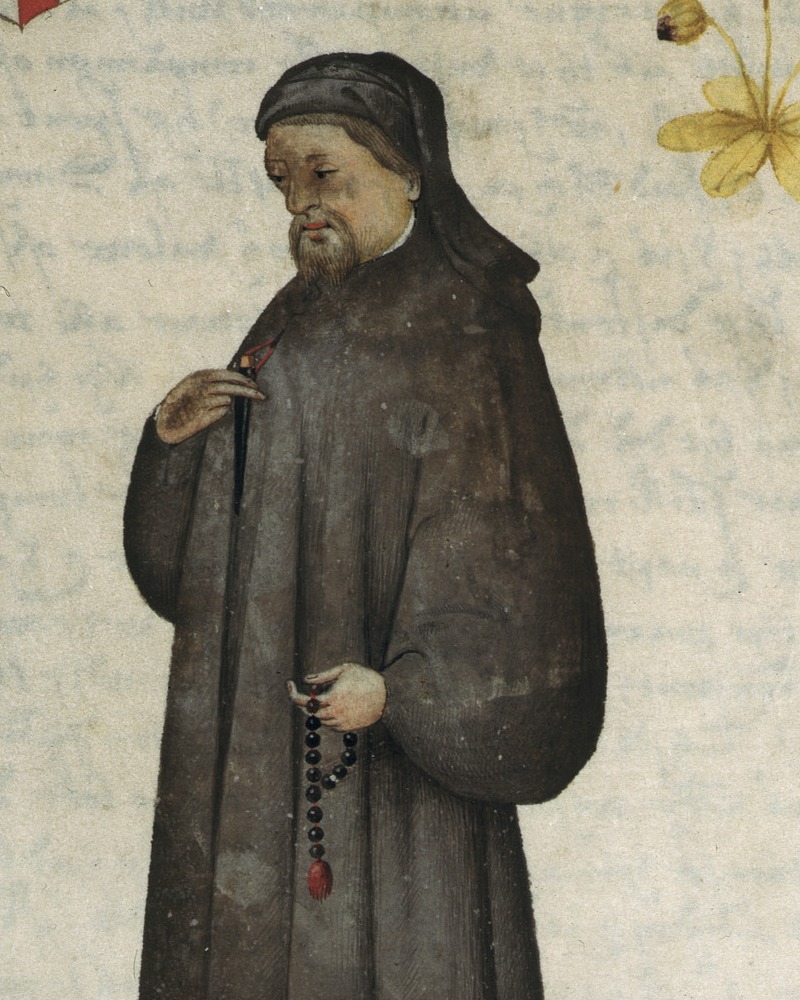

Unknown English artist, 16th century. 'Portrait and Life of Chaucer', Add. MS 5141, f.1, British Library (cropped) · Sixteenth-century portrait of Chaucer by an unknown English artist, folio 1 of the manuscript 'Portrait and Life of Chaucer', British Library, Add. MS 5141 (BL image ID 021444). The British Library's caption names the sitter. It is a later image made about a century and a half after Chaucer died, not a likeness from life. The file is a crop of the folio from head to waist, taken at original resolution from a 1277 x 1994 pixel copy of the library's digital image, with no scaling or upscaling. · Public domain (artwork by an unknown sixteenth-century artist; British Library Flickr release with no known copyright restrictions)
poet · Medieval
Geoffrey Chaucer
1343–1400
Known For
Not yet included in personality matching — the documented evidence doesn't yet cover enough of the personality model. Everything else on this page is fully available.
Trait Constellation
Key Achievements
English poet, regarded as the outstanding English poet before Shakespeare, whose unfinished frame story The Canterbury Tales, told by pilgrims from across the middle ranks of society, ranks according to Britannica as one of the greatest poetic works in the English language.
He wrote in the English vernacular while court poetry was still written in Anglo-Norman or Latin, and made poems such as The Book of the Duchess, The Parliament of Birds and Troilus and Criseyde by combining French and Italian models, including Dante, Boccaccio and Petrarch, with his own forms.
His decasyllabic couplet later evolved into the heroic couplet and he is credited with pioneering regular iambic pentameter in English; some sixty or more fifteenth-century manuscripts of the Canterbury Tales (counting fragments) survive, Caxton printed it in 1478, and his tomb in Westminster Abbey became the start of Poets' Corner.
Moments That Reveal Them
On missions to Italy in 1372 and 1378 he came to know the works of Dante, Boccaccio and Petrarch; Troilus and Criseyde afterwards retold the story from Boccaccio's Il Filostrato with a particularly Italian turn in its treatment of love.
This is consistent with a poet who took in new literary models whenever he encountered them and worked them into his own writing. Curiosity
In the Canterbury Tales, where the tellers range from the Knight to the Pardoner and the Summoner, each tale is used to answer the previous teller, some tales are interrupted by the pilgrims, and others are left unfinished.
This is consistent with a writer who kept testing new narrative arrangements within a familiar frame. Experimentation
Turning Points
About 1386 and after, when his customs post ended and he moved to Kent, he began the General Prologue of the Canterbury Tales, which the Academy of American Poets marks as the start of his artistic maturity and on which he worked, most likely, until his death in 1400.
This is consistent with a poet who gave his main creative effort to one large work in the last period of his life. Persistence
Similar People
People whose overall profiles resemble theirs.

Catherine the Great

Leonardo da Vinci

Gertrude Bell

Benjamin Franklin

Pablo Picasso
Opposite Profile
Not a rival — a different profile shape worth a look.
Mary Wollstonecraft
Sources
- Geoffrey Chaucer (Q5683), verified live via the Wikidata API (2026-11-02): label 'Geoffrey Chaucer', description '14th century English poet and author (1343-1400)', Korean label 제프리 초서, birth 1343 (year precision) and death 25 October 1400. Orientation only; not used as support for any row.
- Encyclopaedia Britannica, 'Geoffrey Chaucer', opening and early-life sections read (the fetched copy ends mid-article at The Book of the Duchess). CANONICAL SIGNIFICANCE SOURCE: the outstanding English poet before William Shakespeare, whose masterpiece The Canterbury Tales 'ranks as one of the greatest poetic works in the English language'; he also contributed to the management of public affairs as courtier, diplomat and civil servant under three kings, but it is his avocation, poetry, for which he is remembered; his works are characterised by variety of subject, genre, tone and style; he became competent in French, Latin and Italian and his writings show close familiarity with many important books; The Book of the Duchess (c.1369-70) shows 'originality in combining dream-vision with elegy', tactful use of a first-person narrator who 'both is and is not the poet himself', and skill in presenting natural conversation within Middle English verse. Encyclopedia; admiring, retrospective.
- Poetry Foundation, 'Geoffrey Chaucer' biography, read in full: wrote in the English vernacular when Latin and French dominated; his early poems rest on a French base, and trips to Genoa, Florence and Lombardy (1372-73, 1378) developed an interest in Italian that shaped Troilus and Criseyde (from Boccaccio's Il Filostrato); The Parliament of Birds assigns a distinctive voice to each class of bird and 'presages The Canterbury Tales'; the Tales use the frame-tale technique of the Decameron but with tale-tellers from the middle classes who answer ('quite') the previous teller, with tales interrupted or left unfinished; the author notes that he created innocent, bookish self-portraits in the early dream poems unlike 'the canny businessman and social climber he actually was'; the Tales left unfinished, perhaps because the task was too large (about 24 of a planned 120 tales; the Foundation says he was 'not one quarter through his original plan'); the 'Retraction' disclaims his impious works. Poetry organisation biography (literary-critical); its political-career passages are not used.
- Academy of American Poets (poets.org), 'About Geoffrey Chaucer', read in full: joined the invasion of France in 1359, was captured and ransomed in 1360; travelled on missions to Italy in 1372 and 1378 where he 'discovered the works of Dante, Giovanni Boccaccio and Petrarch', each of which 'greatly influenced' him; early work shaped by French love poetry, transitional Italian-influenced works include Anelida and Arcite, the Parliament of Fowls and Troilus and Criseyde; the General Prologue of the Canterbury Tales marks his maturity, on which he worked most likely until his death in 1400; 'considered a cultural touchstone' and now the 'Father of English literature'; wrote in the English vernacular while court poetry was written in Anglo-Norman or Latin; the decasyllabic couplet of the Tales later evolved into the heroic couplet and he is credited with pioneering the regular use of iambic pentameter; buried in Westminster Abbey, whose Poets' Corner tradition began with Spenser's burial nearby in 1599. Poetry organisation biography; retrospective praise.
- World History Encyclopedia, 'Geoffrey Chaucer' (Joshua J. Mark), read: poet best known for The Canterbury Tales; none of his pieces was published in his lifetime but hand-copied by scribes, and he did not make a living from his writing; he translated the Romance of the Rose (c.1368-72) and Boethius' Consolation of Philosophy (1380s); credited with establishing Middle English as a respectable literary medium and with introducing the rime royal stanza; quoting Larry Benson, 'Chaucer was most prolific as a writer when he was apparently most busy with other affairs'; he completed ten stories of the Legend of Good Women and left it unfinished, and wrote 24 tales of the planned 120; the French poet Eustache Deschamps wrote him a ballad of tribute c.1385; the Canterbury Tales are 'invaluable' as a snapshot of medieval life. Popular reference; some claims (such as the invention of St Valentine's Day) are speculation and are not used.
- Encyclopaedia Britannica, eleventh edition (1911), 'Chaucer, Geoffrey', as reproduced on Luminarium (luminarium.org/medlit/chaucerbio.htm), read for the documentary record and reception: household accounts of Elizabeth, countess of Ulster, for 1357 and Edward III's contribution to his ransom in 1360 (documentary entries), his 1386 deposition in the Scrope-Grosvenor case, the royal grants and the 1399 lease at Westminster, burial in Westminster Abbey, the description of the Hoccleve portrait made by his disciple; on reception, that successive copyists reduced his text to a state in which lines could be scanned only by accident, so that 'for fully three centuries his reputation was sustained solely by his narrative power', that over sixty fifteenth-century manuscripts of the Canterbury Tales survive, and that Caxton printed his minor poems and the Canterbury Tales (1478); it also argues his service to the English language is that he proved English 'was sufficient' for poetry, noting Gower had used the best English of his day too. Older scholarly reference reading the archival records; the independent, partly critical voice. Its biographical political details are not used.
- Chaucer, 'Chaucers Wordes unto Adam, His Owne Scriveyn' (seven-line poem), Chaucer's Works edited by Walter W. Skeat, Volume I, Wikisource, read: Chaucer rebukes his copyist Adam, saying that if he has to copy Boece or Troilus again he should suffer the scall, that he must 'so ofte a daye' correct and 'rubbe and scrape' the work because of the scribe's 'negligence and rape' (haste), and asks him to 'wryte trewe'. Chaucer's own words, so self-report; used only for what he describes himself doing, never as sole support for a row.