
Confucius
87% Profile Match
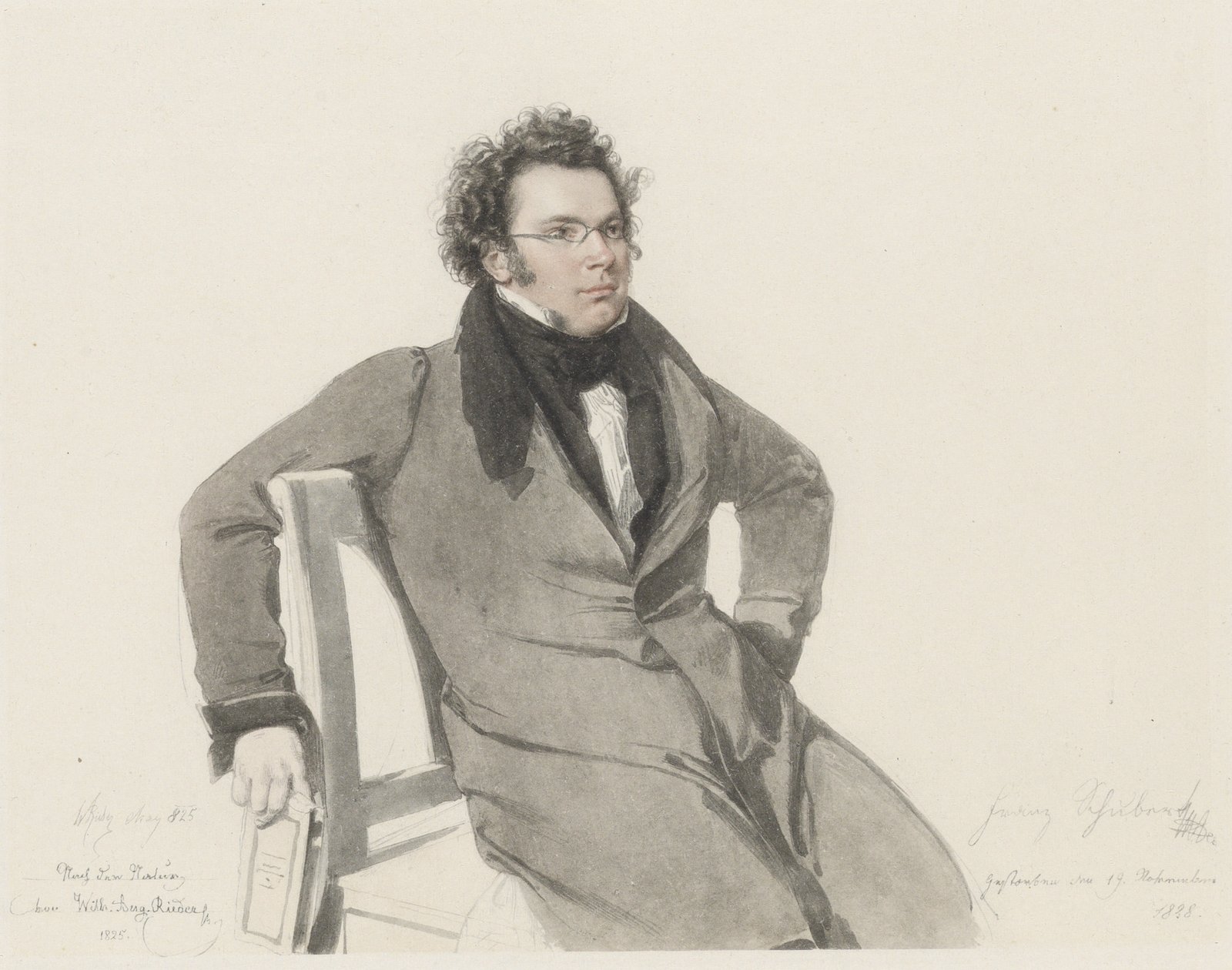
Wien Museum Online Sammlung (inv. 103817), collotype by Max Jaffe, published by Karl Konig, after Wilhelm August Rieder's 1825 watercolour portrait of Schubert made from life; the Wien Museum page states the image may be reused under CC0 and asks that the author, photographer and Wien Museum be named as source · Wien Museum Online Sammlung, inventory 103817: 'Franz Schubert (1797-1828), Komponist (Reproduktion eines Aquarells von Wilhelm August Rieder von 1825)', collotype (Lichtdruck) c. 1870-1900, published by Karl Konig, Vienna, printed by Max Jaffe, after Wilhelm August Rieder (1796-1880) · CC0 1.0 (Wien Museum object page); the underlying watercolour (1825) and the print (c. 1870-1900) are in the public domain
composer · 19th Century
1797–1828
Not yet included in personality matching — the documented evidence doesn't yet cover enough of the personality model. Everything else on this page is fully available.
At seventeen Schubert wrote the song 'Gretchen am Spinnrade' (October 1814) and, in the winter of 1815, the ballad 'Erlkönig' to Goethe's poems. Grove counts 137 songs from 1815 alone. In 1821 the Erlkönig was engraved and published as his first printed song after Vienna's two leading publishers, Diabelli and Haslinger, had declined it, and the cost was met by subscribers from the Sonnleithner circle; the singer Johann Michael Vogl performed it publicly in Vienna on 7 March 1821.
In 1823 he set twenty poems from Wilhelm Müller's 'Die schöne Müllerin' as a song cycle, published in 1824 as his Opus 25, and in February 1827 began the twenty-four songs of Müller's 'Winterreise', whose first twelve are dated that month and whose second part he completed later in 1827. Haslinger published the first part in January 1828. Grove reports that Franz Lachner took half a dozen of the Winterreise songs to a publisher at Schubert's request and came back with six gulden.
Schubert began a symphony in B minor on 30 October 1822 and completed two movements, the work known as the 'Unfinished'; the manuscript stayed in Graz with Anselm Hüttenbrenner until Johann Herbeck conducted it in Vienna in 1865 and it was published in 1867. In March 1828 he began his last symphony, in C major, a 218-page autograph; the parts were copied and some rehearsals held by the Vienna Gesellschaft der Musikfreunde, but it was withdrawn as too long and difficult, and neither symphony was performed in his lifetime (Grove).
His chamber music includes the Octet for clarinet, horn, bassoon and strings (February to March 1824, written for Count Troyer, an amateur clarinettist), the String Quartet in D minor (first played on 29 January 1826), two piano trios (October and November 1827) and the String Quintet in C of 1828, which Grove called not only Schubert's finest chamber work but one of the finest of its kind. On 26 March 1828 he gave the only public concert devoted wholly to his own music; the Musikverein hall was crowded and, according to Grove, it brought him about 800 gulden.
According to his friend Josef von Spaun, one afternoon at the end of 1815 Spaun found Schubert in his room at his father's house in a state of excitement over Goethe's 'Erlkönig'. Schubert had read the poem twice, and Spaun found him writing the song down; the accompaniment was filled in quickly and in the evening he sang it at the Convict, the former choir school, where the audience made faces at the harmonies at 'Mein Vater, jetzt fasst er mich an' until their harmony teacher Ruzicka explained them. Kreissle and Grove both retell the account from Spaun; it does not come from a second witness.
Composing a finished song within one afternoon is consistent with fast execution; it is the best-known story of its kind and rests on one friend's account. Execution Speed
In 1823 Schubert began the three-act opera Fierrabras on 25 May, had the first act fully scored by 31 May and finished all three acts, about a thousand pages, by 1 October. Early in 1824 he learned that the Court Opera had dismissed it; the libretto by Josef Kupelwieser was blamed. In a letter to Kupelwieser's brother, the painter Leopold, in March 1824, he wrote that he had thus composed two operas to no purpose, and in the same letter that his octet and quartets were meant to prepare the way for a grand symphony. The opera was not staged in his lifetime.
Turning from rejected operas straight to chamber works he described as steps toward a symphony is consistent with persistence; the same pattern of choosing weak libretti is also noted by Grove. Persistence
In April 1816 Schubert, then an assistant teacher at his father's school, applied for a newly created music post at Laibach with testimonials from Salieri and the school superintendent Spendou; the post went to Jacob Schaufl on Salieri's recommendation. In the autumn of 1816 Franz von Schober, a student who admired his songs, took him into his lodgings, and Schubert left his father's school. Grove adds that he soon gave up the few lessons he tried. Years later he refused the court organist post and applied unsuccessfully for the court vice-Kapellmeister post in 1826.
Leaving salaried teaching for an uncertain life among friends, and later refusing a court organist post that Josef Hüttenbrenner said he declined to keep his liberty, is consistent with a strong need for autonomy, at the cost of a secure income. Need for Autonomy
People whose overall profiles resemble theirs.

Not a rival — a different profile shape worth a look.
