Sigmund Freud
93% Profile Match
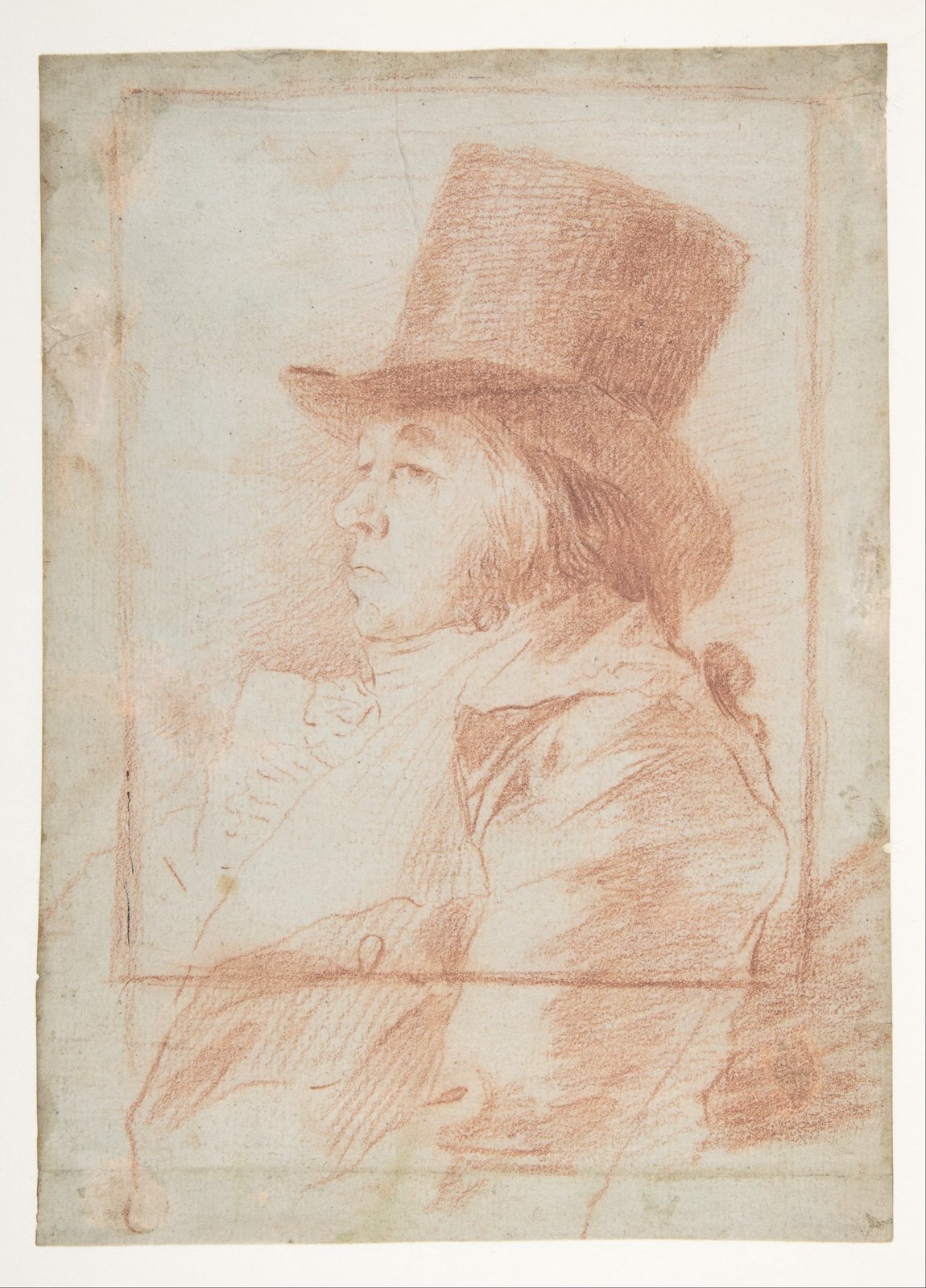
Francisco de Goya y Lucientes, self-portrait drawing in red chalk, ca. 1797-98; The Metropolitan Museum of Art, New York, Bequest of Walter C. Baker, 1971 (1972.118.295); Open Access · The Metropolitan Museum of Art, Drawings and Prints, accession 1972.118.295 (Bequest of Walter C. Baker, 1971), Open Access record (Met collection API objectID 334315): 'Self-Portrait; wearing a top hat facing left within a drawn frame (recto); two studies of his face (verso)', red chalk on laid paper, ca. 1797-98; image DP800146 downsized from 2592x3605 to 1150x1600 · CC0 1.0 / Public Domain Dedication (The Met Open Access; Met API isPublicDomain: true, empty rightsAndReproduction field; Goya died 1828)
painter · Early Modern
1746–1828
Not yet included in personality matching — the documented evidence doesn't yet cover enough of the personality model. Everything else on this page is fully available.
Goya became painter to the king in 1786, court painter by royal order of 25 April 1789, and first court painter on 31 October 1799 at 50,000 reales a year. His portrait of Charles IV and his family, painted in 1799-1800 and now in the Prado, shows the painter himself standing behind the canvas.
Goya's Los Caprichos is a series of 80 etchings with aquatint that mock vices, superstition and social habits of his day. Early sets were sold from January 1799; on 9 October 1803 he handed the 80 copper plates and 240 printed sets to the Royal Chalcography (Real Calcografia), and the Crown granted his son a pension of 12,000 reales.
Goya painted the Second of May 1808 and the Third of May 1808 as life-size companion canvases, showing the street fighting in the Puerta del Sol and the executions at the Principe Pio hill. From 1810 he also etched The Disasters of War, over 80 plates on the French invasion; he printed only a few proofs, and the series was first published in 1863 by the Academy of San Fernando.
Goya etched the 33 plates of La Tauromaquia, issuing a limited number of impressions in 1815, and in 1825 at Bordeaux drew the four large Bulls of Bordeaux lithographs, printed by Gaulon in about 300 copies. He also painted the walls of his country house outside Madrid, work later transferred to the Prado.
In 1781, while painting the Pilar frescoes in Zaragoza, Goya answered the building board's wish to have his sketches checked by his brother-in-law Francisco Bayeu with a written memorial. He objected to being made Bayeu's 'mere executor and mercenary dependent' and said criticism should follow 'the authorised rules of art'. According to Francisco Zapater, after the Carthusian prior Felix Salcedo wrote to him, he agreed on 6 April to make new sketches in accord with Bayeu.
Refusing in writing to work as another painter's dependent, while later accepting a compromise, is consistent with a strong need for autonomy that stayed within a working relationship. Need for Autonomy
On 30 May 1824 Ferdinand VII granted the 78-year-old Goya six months' leave to take the waters at Plombieres. He travelled alone to Bordeaux without speaking French and, after three days with the poet Leandro Fernandez de Moratin, went on to Paris. Moratin wrote on 27 June that Goya was 'very anxious to see the world'; Lafond says he never reached Plombieres and used the stay to study French painting.
Setting out alone for Paris at that age to look at contemporary French painting is consistent with strong curiosity; the sources record the trip but not his own comments on what he saw. Curiosity
Goya's 1824 leave was extended in January 1825, and on 17 June 1826 Ferdinand VII granted him retirement on his full salary of 50,000 reales and leave to return to France. He settled in Bordeaux, where he took up lithography and ivory miniatures, and he died there on 16 April 1828.
Moving to Bordeaux and starting two new media there in his late seventies is consistent with experimentation continuing late in his career. Experimentation
People whose overall profiles resemble theirs.

Not a rival — a different profile shape worth a look.