Ernest Shackleton
75% Profile Match
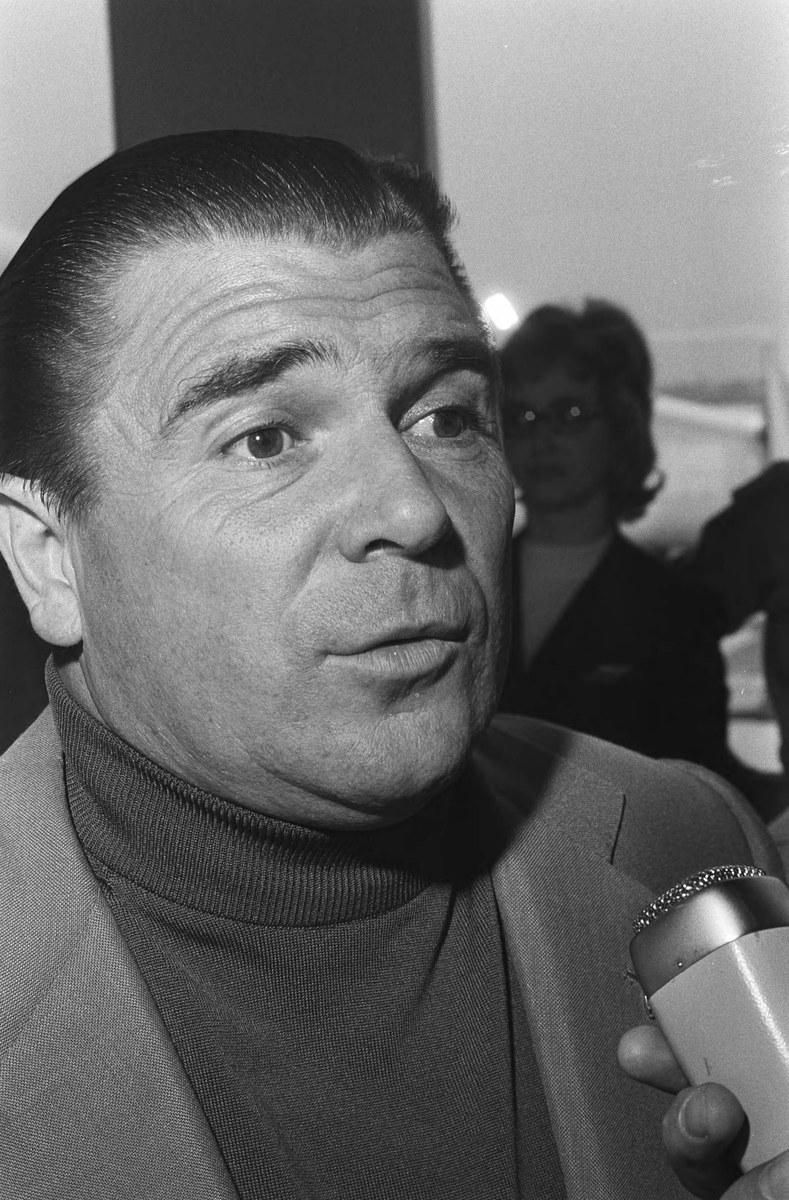
Photo: Anefo (unknown photographer), 4 May 1971, Nationaal Archief, CC0, resized from the original · Black-and-white press photograph of Ferenc Puskas on his arrival at Amsterdam-Schiphol airport as coach of the Greek club Panathinaikos, 4 May 1971, by an unknown photographer for Anefo; Nationaal Archief (Dutch National Archives), Fotocollectie Anefo, file number 924-5181, series 'Aankomst van Ferenc Puskas, trainer van de Griekse voetbalclub' (permanent link hdl.handle.net/10648/abbde3be-d0b4-102d-bcf8-003048976d84). Rights review: the live archive record (opened 2026-11-05) gives the photographer as 'Fotograaf Onbekend / Anefo', the date 1971-05-04, the person keyword 'Puskas, Ferenc', the organisation 'Panathinaikos' and the rights holder as 'Nationaal Archief, CC0'; the archive's own original file is a normal portrait frame (not a failed shot) with the same 2399 x 3650 pixel dimensions as the Commons copy, and the Commons file page also states CC0. The sitter is identified by the archive title and person keyword; the frame carries no lettering. Original 2399 x 3650 pixels, downscaled to 789 x 1200 (no cropping, never upscaled). · CC0 1.0 (public domain dedication by the Nationaal Archief)
athlete · 20th Century
1927–2006
Not yet included in personality matching — the documented evidence doesn't yet cover enough of the personality model. Everything else on this page is fully available.
Hungarian forward and captain of the 1950s 'Golden Team': 83 goals in 84 internationals (counts differ slightly between sources), Olympic football champion in 1952, scorer of two in the 6-3 win at Wembley in 1953, and a World Cup finalist in 1954, named the tournament's best player.
After a two-year ban he joined Real Madrid at 31 and, alongside Alfredo Di Stefano, won three European Cups (1959, 1960, 1966) and five league titles; he scored four of Real's goals in the 7-3 European Cup final win over Eintracht Frankfurt in 1960.
After playing he coached clubs and national sides in many countries; his biggest success was leading Panathinaikos to the 1971 European Cup final (lost 2-0 to Ajax) and two Greek league titles, and FIFA later named its annual best-goal award after him.
In the last game of his first season at Real Madrid, with Di Stefano and himself level as the league's top scorers, he rounded the goalkeeper and, according to one football-history feature, passed across the open goal for Di Stefano to score instead of scoring himself.
This is consistent with a striker who accepted a partner's star billing and put the team's combination ahead of his own tally. Collaboration
Arriving at Real Madrid at 31 and out of condition, to a public that thought him too old and overweight, he is reported to have hung plastic rings in his garden and spent hours practising shooting the ball through them.
This is consistent with a player who answered doubts about his fitness with deliberate, repeated practice of his craft. Mastery Orientation
Having served a two-year ban, he signed for Real Madrid in 1958 at 31 and rebuilt his career in Spain as the second striker beside Di Stefano, later playing for Spain and, after retiring, coaching abroad.
This is consistent with someone who adjusted to a new country, club and role when his earlier career was interrupted. Adaptability
People whose overall profiles resemble theirs.