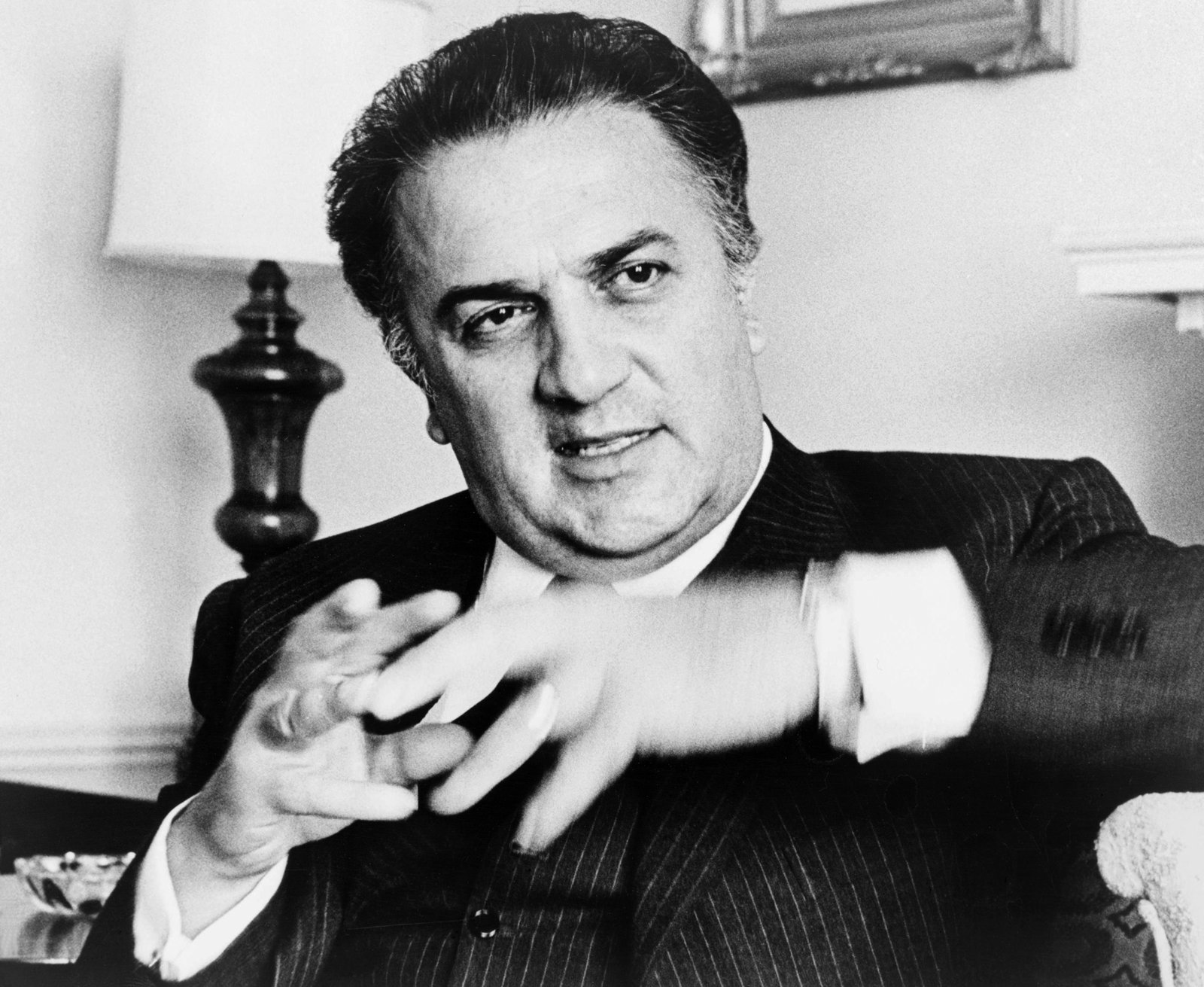
Walter Albertin, New York World-Telegram and Sun staff photographer, 1965; Library of Congress, Prints and Photographs Division, New York World-Telegram and Sun Newspaper Photograph Collection · Wikimedia Commons, from the Library of Congress New York World-Telegram and Sun Collection (resized derivative of the original photograph) · No known copyright restrictions (Library of Congress staff-photographer collection; reproduction rights transferred to the Library of Congress by Instrument of Gift)
Trait Constellation
Key Achievements
Fellini won the Academy Award for Best Foreign Language Film for La strada (1954), in which his wife Giulietta Masina plays the waif Gelsomina opposite Anthony Quinn's travelling strongman, and again for Le notti di Cabiria (1957), with Masina as an optimistic Roman prostitute. Shanahan notes that critics on the political Left attacked both films for leaving the neorealist social brief behind.
La dolce vita (1960) follows a Roman gossip reporter, played by Marcello Mastroianni, through the city's nightlife of celebrity and scandal, and gave English the word 'paparazzi' through the photographer character Paparazzo. Dixon calls it an immediate commercial and critical sensation despite condemnation by the Catholic Church, and Bosley Crowther's 1961 New York Times review judged that Fellini had come closest of recent filmmakers to a comprehensive picture of frantic modern civilisation.
In 8 1/2 (1963) Mastroianni plays a film director who cannot remember the film he is supposed to be making, and dream, memory and fantasy mix with the working day of a production. The film won the Oscars for Best Foreign Language Film and for Best Costume Design in black and white, and Dixon notes it is regularly cited among the greatest films in international critics' polls.
Amarcord (1973), set in a fascist-era Rimini assembled from remembered and invented stories, won him his fourth Best Foreign Language Film Oscar, at the 1975 ceremony. Fellini said of it that he had invented the whole tale, and Jackson notes that its sea and ocean liner were deliberately built to look artificial.
Moments That Reveal Them
Frustrated by the pressures of shooting on the real Via Veneto for La dolce vita, Fellini had designer Piero Gherardi rebuild the street at Cinecittà. Thirty years later he wrote that, passing the Café de Paris, he could not stop himself thinking the authentic Via Veneto was the one in Studio 5, adding that the studio street's dimensions seemed to him more accurate, or certainly more attractive. For Intervista (1987) he again used a scale model of the studio so as to re-route its avenues and recolour its roofs.
Preferring a built street to the real one, and a model of the studio to an aerial shot, is consistent with aesthetic sensitivity; the quotations are Fellini's own later recollections, relayed by a magazine writer. Aesthetic Sensitivity
When the first producer of La dolce vita, Dino De Laurentiis, wanted Paul Newman in the lead, Dixon reports that Fellini refused to give up Marcello Mastroianni, and after strenuous negotiations De Laurentiis dropped out. Fellini was then involved with three producers at once before settling on Angelo Rizzoli and Giuseppe Amato's company, and signed the contract on 28 October 1958.
Holding to his own casting choice at the price of losing his first producer is consistent with a need for control over the film's key decisions; Dixon's account of the other producers' positions is brief. Need for Autonomy
Turning Points
Fellini began preparing 8 1/2 in 1961-62 with a spa setting and a leading cast but, he told his friend Angelo Solmi, without knowing the plot, and he said he was fifty times on the point of telling the producer he could not go on. The change that unlocked the film, Dixon writes, was making the hero a film director like himself, a burnt-out man who must begin a film he cannot remember. The result won two Academy Awards.
Proceeding with sets and casting while the story was still open, and then turning the problem itself into the film's subject, is consistent with a high tolerance for ambiguity; the account depends on Fellini's own later description as relayed by Solmi. Ambiguity Tolerance
Similar People
People whose overall profiles resemble theirs.


Sequoyah

Yayoi Kusama
Fela Kuti

Wolfgang Amadeus Mozart

Pablo Picasso
Sources
- Federico Fellini (Q7371) -- verified live via wbgetentities (2026-10-10): en label 'Federico Fellini', description 'Italian filmmaker (1920-1993)', born 20 Jan 1920, died 31 Oct 1993, citizenship Italy, instance of human, ko label '페데리코 펠리니'. Orientation only; not used as support for any row.
- Wheeler Winston Dixon (film historian), 'La Dolce Vita', Senses of Cinema, CTEQ Annotations on Film, issue 54 (April 2010) -- INDEPENDENT scholarly essay (non-self) on Fellini's early career and the making of La dolce vita: the apprenticeship with Rossellini, the first two films' failures, the dispute with the first producer over casting Mastroianni, the dropped Luise Rainer role, the reconstruction of the Via Veneto at Cinecittà and the cutting of the film. Read in full.
- Wheeler Winston Dixon, 'A Fantastic, Enchanted Ballet: Federico Fellini's 8 1/2 (1963)', Senses of Cinema, CTEQ Annotations on Film, issue 82 (January 2017) -- INDEPENDENT scholarly essay (non-self) on the genesis of 8 1/2, relying on Angelo Solmi's 1967 book and Fellini's own quoted remarks: preparation without a settled plot, the change of the protagonist into a film director, the casting and the improvised ending. Read in full.
- Antonia Shanahan, 'Fellini, Federico', Senses of Cinema Great Directors, issue 21 (July 2002) -- INDEPENDENT critical survey (non-self) of the whole career, drawing on Peter Bondanella's readings: Fellini's formation as a caricaturist and magazine writer without film-school training, the ten years of scriptwriting and set apprenticeship with Rossellini and others, his chosen influences, the break with the neorealist 'social' brief after Paisa, the criticism from the political Left, and the turn to dream and memory. Read in full except the later bibliography.
- Roberto Chiesi (Cineteca di Bologna), film note on 'Fellini: A Director's Notebook' (1969), Il Cinema Ritrovato festival catalogue, 2019 edition -- INSTITUTIONAL film-archive note (non-self) recording that in 1966 Fellini withdrew from his planned film Il viaggio di G. Mastorna although sets were built and contracts signed, and that the 1969 television film he then made began on the abandoned set and included a Nights of Cabiria sequence cut at the producer's request. Read in full.
- Fondazione Cinema per Roma, 'Fellini Oniricon - The Book of My Dreams' (exhibition announcement, 17 November 2008) -- INSTITUTIONAL press text for the 2009 Academy of Motion Picture Arts and Sciences exhibition curated by Tullio Kezich and Vittorio Boarini; used only for the physical description and dating of the dream diary (two ledgers, drawings and notes dated 1960-1982 with scattered pages to 1990, begun on the advice of the Jungian analyst Ernst Bernhard). PROMOTIONAL in tone; not used for claims about influence. Read in full.
- Gideon Bachmann, 'Federico Fellini: The Cinema Seen as a Woman... An Interview on the Day City of Women Premiered in Rome', Film Quarterly vol. 34 no. 2 (Winter 1980-81), pp. 2-9, JSTOR scan on the Internet Archive -- SELF source: Fellini's own account of how he works and what he refuses (control until the final mix, film-making as a crew 'tribe', refusal to make a political platform of his films). Self-presentation by a famously unreliable self-narrator, so used only as one voice beside non-self sources and never alone for a row. Read in full.
- 'Inside Federico Fellini's dream factory in Rome', Apollo Magazine (art-history journalism) -- NON-SELF magazine feature on Cinecitta and Fellini that quotes his later recollections of building the Via Veneto in Studio 5 for La dolce vita and the scale model of the studio for Intervista (1987). Read in full; the quotations are Fellini's own, the framing is the writer's.
- Zach Zimmermann, 'Film as History: Fellini's La Dolce Vita as a Historical Artifact', Elements (Boston College undergraduate journal) -- student scholarly article on the reception of La dolce vita in Italy and the United States, quoting Bosley Crowther's 1961 New York Times reviews (admiring) and Time magazine's 1961 notice (hostile) and noting the later academic fall in Fellini's reputation. Read in full for the reception section; the formal analysis was skimmed.
- Roger Ebert, 'La Dolce Vita', Great Movies, Chicago Sun-Times (5 January 1997), read via the Internet Archive's 2023 capture of the Roger Ebert site -- CRITIC's retrospective (non-self) that places the film at the dividing point between the neorealism of the earlier films and the carnival visuals of the later ones and credits Nino Rota's score. Read in full.
- Bruce Jackson, 'Fellini's Memory: Amarcord', Senses of Cinema, feature article, issue 104 (January 2023) -- scholarly film essay (non-self) on how Amarcord was built from remembered and invented stories and from deliberately artificial studio sets (the cardboard liner Rex), quoting Fellini's remark that he invented the whole tale. Read in full for method and set design; the scene-by-scene analysis was skimmed.
- Benjamin Halligan (critic), review of Sam Rohdie's 'Fellini Lexicon' (BFI, 2002), 'The Felliniesque Besieged', Senses of Cinema issue 24 (January 2003) -- CRITICAL, interpretive review (non-self) that describes Fellini as repeatedly rewriting his own themes and reports Pauline Kael's later judgment that Casanova made 'an epic of his own alienation'. Used only as a sceptical counter-perspective on the scale of his originality; read in full.
- Jacob Agius, 'I Remember: Amarcord (Federico Fellini, 1973)', Senses of Cinema, CTEQ Annotations on Film, issue 104 (February 2023) -- short scholarly essay (non-self) on the film's collaboration with screenwriter Tonino Guerra, Fellini's remark that he invented the whole tale, and the film's Best International Feature Film Oscar at the 1975 ceremony. Read in full.
- Federico Fellini, English Wikipedia (raw wikitext read 2026-10-10) -- ORIENTATION ONLY for names, dates and the list of awards and collaborators; its claims that rest on Tullio Kezich's 'Fellini: His Life and Work' (2006), Bondanella and Alpert could not be checked against the books and are not used as support for any scored row.