Ada Lovelace
90% Profile Match
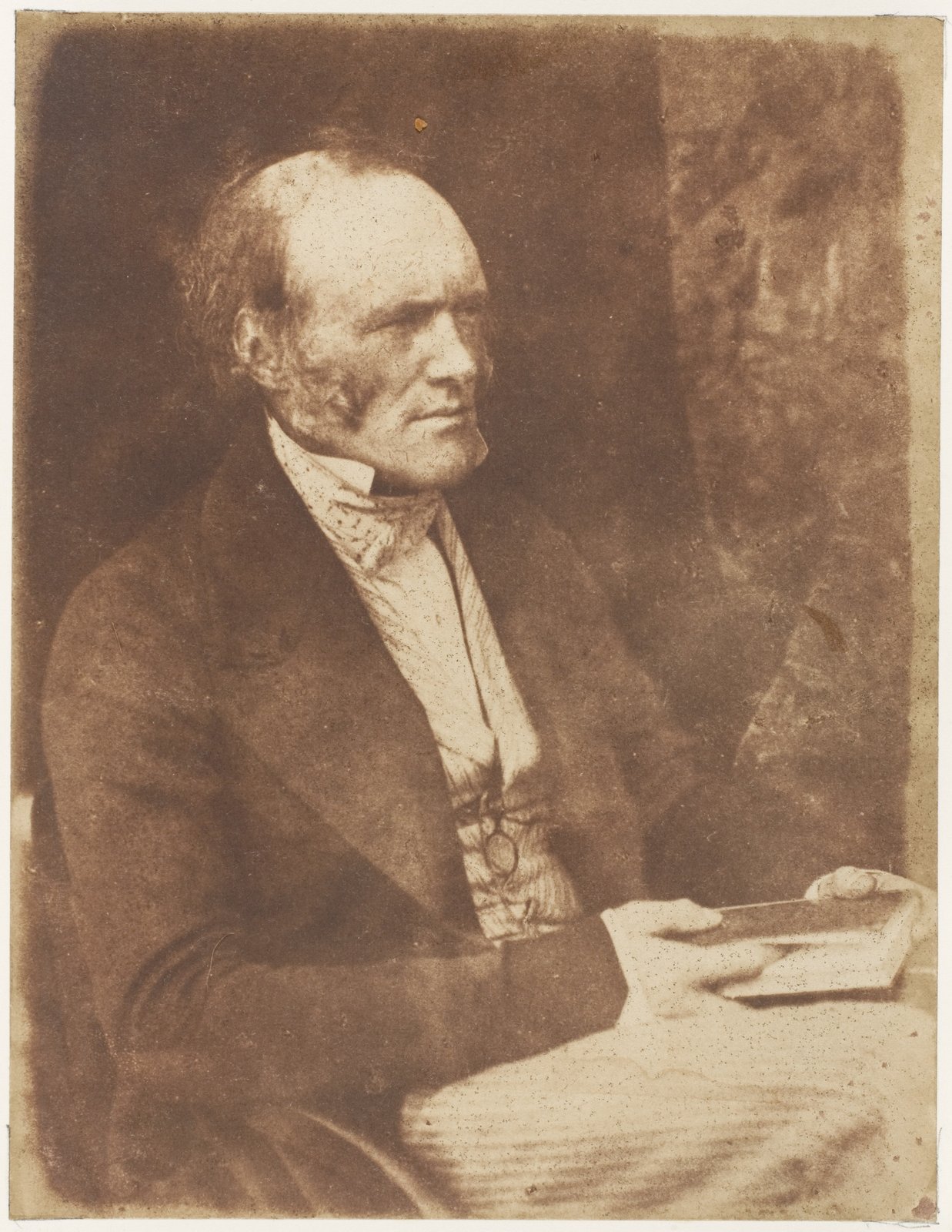
David Octavius Hill and Robert Adamson (Hill and Adamson), 'Sir Charles Lyell - Geologist', 1843-47, salted paper print from paper negative, The Metropolitan Museum of Art, Harris Brisbane Dick Fund, 1937 (37.98.2.109) · Metropolitan Museum of Art, New York, accession 37.98.2.109, 'Sir Charles Lyell - Geologist', salted paper print from paper negative, Hill and Adamson, 1843-47 (Harris Brisbane Dick Fund, 1937), Open Access · Public domain (Metropolitan Museum Open Access, CC0); photograph by Hill and Adamson, 1843-47 (Adamson d. 1848, Hill d. 1870)
scientist · 19th Century
1797–1875
Not yet included in personality matching — the documented evidence doesn't yet cover enough of the personality model. Everything else on this page is fully available.
Lyell's Principles of Geology (three volumes, 1830-33) argued that the past changes of the earth's surface should be explained by causes still in operation, drew on his own fieldwork on Etna and elsewhere, and called for geology to be separated from cosmogony. Darwin took the first volume on the Beagle voyage and wrote that Lyell's views were far superior to those of any other work he knew. The book went through eleven editions between 1830 and 1872.
In volume 3 of the Principles (1833) Lyell divided the Tertiary into stages according to the proportion of living species among their fossil shells, naming them Eocene, Miocene and the Older and Newer Pliocene. The fossil-shell tables came from the Paris conchologist Gerard Paul Deshayes, and Lyell credited William Whewell with help in devising the names.
Elements of Geology (1838) set out the science as a manual. Part I sorted rocks by character into aqueous, volcanic, plutonic and metamorphic classes, and Part II arranged them by age, from Recent and Tertiary onward, with 294 figures, many of them fossils. Lyell kept revising it, including a sixth edition in 1865.
The Geological Evidences of the Antiquity of Man (1863) gathered the evidence that humans had lived alongside extinct mammals: flint implements in the Somme gravels at Abbeville and Amiens, where Lyell collected specimens himself, and cave deposits such as Brixham in Devon, together with a long account of glacial deposits and a discussion of the views of Lamarck, Darwin and Wallace on the origin of species. Three editions appeared in 1863 and a fourth in 1873.
On 14 June 1830, about ten days before the Principles appeared, Lyell wrote to Poulett Scrope, who was to review it in the Quarterly Review. He hoped Scrope could get into the review 'what will free the science from Moses', but advised him not to 'triumph over' opponents, and said that full half of his own history and comments had been cut because stating it openly would anticipate 'twenty or thirty years of the march of honest feeling'.
Choosing what to say, what to cut and how his reviewer should pitch it, with the stated aim of carrying readers along rather than irritating them, is consistent with deliberate, strategic persuasion. Persuasiveness
Lyell had urged Darwin in 1856 to write out his species theory, and on 1 July 1858 he and Joseph Hooker introduced the joint reading of Darwin's and Wallace's papers at the Linnean Society. But when Antiquity of Man appeared in 1863 Darwin was disappointed that Lyell had not spoken out more. Lyell told Hooker he had 'spoken out to the full extent of my present convictions', and told Darwin that after arguing a whole chapter for man's descent from animals he found himself 'relapsing to my old views' on re-reading a few pages of the Principles.
Moving from arguing against transmutation to presenting the case for it, while openly admitting that his feelings lagged behind his reasoning, is consistent with belief updating that was real but slow, which is why Darwin found it frustrating. Belief Updating
Lyell was elected to the new chair of geology at King's College London in 1831 and lectured in 1832 and 1833. On 24 December 1831 he told his family of his 'decided wish to get free of the professorial chair'. After the 1833 course he resigned; the family account says the duties would interfere with his travelling and original research, and Bailey adds that attendance had fallen after women were excluded from the lectures. His next long journeys were to Sweden in 1834 and North America in 1841-42.
Giving up a London chair for freedom to travel and write is consistent with a strong need to control his own working life; because Bailey also notes falling attendance, the decision cannot be read as purely a matter of principle. Need for Autonomy
People whose overall profiles resemble theirs.



Not a rival — a different profile shape worth a look.