Ada Lovelace
94% Profile Match
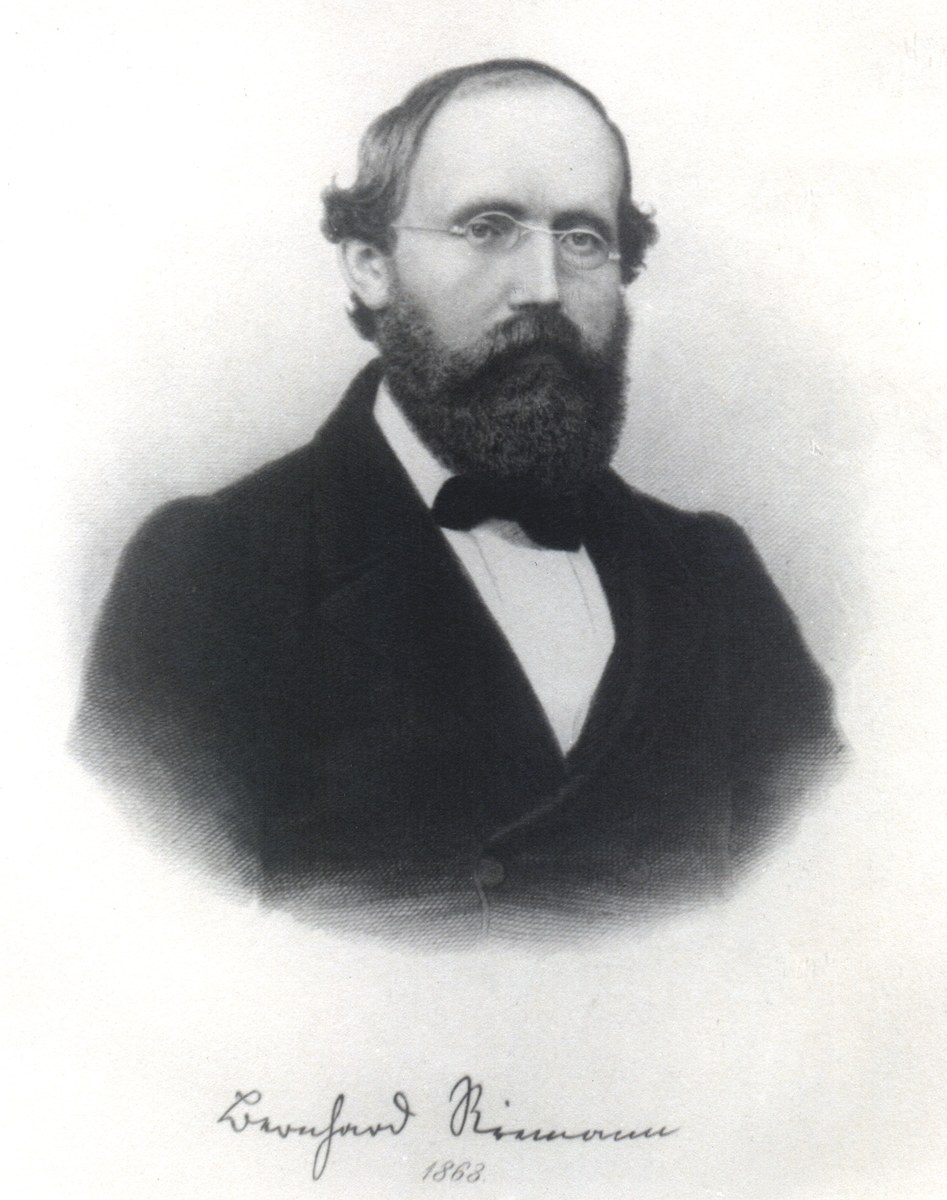
Portrait of Bernhard Riemann, 1863, creator unidentified; Smithsonian Institution Libraries, Dibner Library of the History of Science and Technology · Smithsonian Institution Libraries, Dibner Library 'Scientific Identity' collection (accession SIL14-R003-02), via Flickr Commons photo 2551069295 and Wikimedia Commons file 'Portrait of Bernhard Riemann (1826-1866), Mathematician (2551069295).jpg'. The item is a printed portrait with a facsimile signature and the date 1863 (an engraving or print after the 1863 portrait photograph), creator unidentified, medium unknown, 15.5 x 14 cm. Original file 2574 x 3262; downscaled only (never upscaled) to 947 x 1200. · Public domain (published 1863; Smithsonian Institution: no known copyright restrictions)
mathematician · 19th Century
1826–1866
Not yet included in personality matching — the documented evidence doesn't yet cover enough of the personality model. Everything else on this page is fully available.
His 1854 habilitation lecture defined n-dimensional curved spaces with an intrinsic metric, the basis of Riemannian geometry that Einstein later used for general relativity.
His 1859 paper on the number of primes treated the zeta function as a complex function, established its functional equation and stated the Riemann hypothesis, which remains unsolved.
He introduced Riemann surfaces and topological methods into complex analysis (1851 thesis, 1857 abelian functions) and defined the Riemann integral.
For his 1854 habilitation lecture Riemann prepared three topics; Gauss chose the geometry one, and according to MacTutor only Gauss in the audience appreciated its depth.
This is consistent with an originality that ran ahead of the field's ability to follow it. Creative Originality
In the 1859 paper he wrote that it was very probable all the zeta zeros are real, but that he had put aside a stricter proof after some fleeting futile attempts.
This is consistent with a mind that advanced on intuition and openly left the rigorous proof for others. Intuitive Synthesis
In 1859 Dirichlet died and Riemann succeeded him to the Göttingen chair; days later he was elected to the Berlin Academy on a nomination calling him a mature and independent investigator, and his prime-number paper followed.
This is consistent with a move from near-unknown young investigator to the centre of German mathematics. Creative Originality
People whose overall profiles resemble theirs.




Not a rival — a different profile shape worth a look.