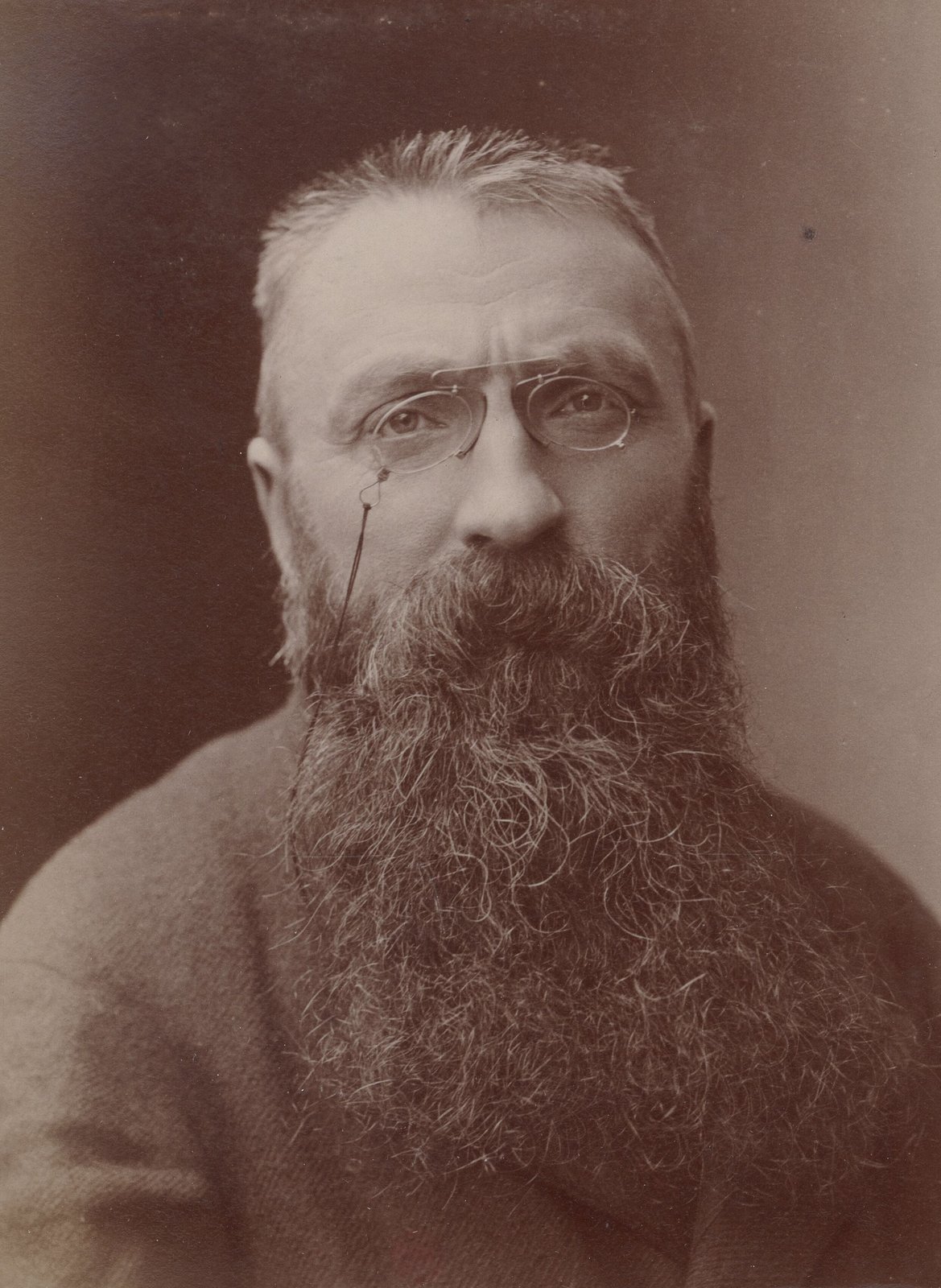

Atelier Nadar, portrait of Auguste Rodin (c. 1891; BnF dates the print 1875-1895), Bibliotheque nationale de France / Gallica; public domain; cropped to the photograph and downscaled · Atelier Nadar, 'M. Rodin', studio demonstration print no. 9115 B, albumen print, Bibliotheque nationale de France, departement Estampes et photographie, FT 4-NA-238 (25) (Gallica ark:/12148/btv1b531708194), via Wikimedia Commons · Public domain
Trait Constellation
Key Achievements
Asked by the town of Calais in 1885 for a statue of one burgher, Rodin proposed all six hostages of 1347 as a single group for the same fee. The full-size plasters were shown in Paris in 1889, and the bronze monument was unveiled in Calais on 3 June 1895.
In 1880 the French State commissioned from Rodin a bronze door, The Gates of Hell, for a planned museum of decorative arts. He worked on it for years; the Musée Rodin counts more than 200 figures and groups made for it, many of which he later developed into independent works.
In 1916 Rodin donated his works, collections and reproduction rights to the French State to found a museum in the Hôtel Biron in Paris. The Musée Rodin opened to the public there in 1919, two years after his death.
Moments That Reveal Them
Commissioned in 1891 to make a statue of Balzac within eighteen months, Rodin visited Touraine, studied portraits and descriptions of the novelist, and made series of nude and draped studies. In 1894 he accepted a new agreement without a deadline, writing that his only concern was to make the figure as perfect as possible; the plaster was exhibited in 1898, when the commissioning society refused it.
The years of studies and the deadline he gave up are consistent with this profile's high perfectionism score, which is marked as cutting both ways: the same documents record a strained relationship with his patrons. Perfectionism
His secretary Anthony Ludovici, writing from notes made in 1906, recalls that after seeing the Cambodian royal dancers perform in Paris that July, Rodin described their movements in detail. When the troupe left for Marseilles he followed them and spent several days there drawing the king and the dancers.
Travelling at sixty-five to draw an unfamiliar dance tradition offers one example of the curiosity scored in this profile, alongside his use of antiquities from his own collection in new works. Curiosity
Turning Points
When The Age of Bronze was shown at the 1877 Paris Salon, critics alleged that it had been cast from a living model. Rodin petitioned the fine-arts administration and supplied casts and photographs of his model for comparison; he was cleared only in 1880, after a group of established sculptors wrote on his behalf, and that year the State bought the work.
Pressing a three-year case while continuing to model new figures in a small shed sits alongside the persistence scored in this profile; the Musée Rodin also notes that the dispute drew attention to him, and the Gates of Hell commission followed in 1880. Persistence
Similar People
People whose overall profiles resemble theirs.

Frida Kahlo

Leonardo da Vinci

James Joyce
Coco Chanel

Martha Graham
Opposite Profile
Not a rival — a different profile shape worth a look.
Alexander Hamilton
Sources
- Auguste Rodin (English Wikipedia) -- orientation only; not used as support for any scored row. Korean Wikipedia title '오귀스트 로댕' confirmed via the Wikidata sitelink.
- Auguste Rodin (Q30755) -- verified live via wbgetentities (2026-09-26): en label 'Auguste Rodin', description 'French sculptor (1840–1917)', ko label '오귀스트 로댕', born 1840-11-12, died 1917-11-17, citizenship Q142 (France), P18 'Auguste Rodin fotografato da Nadar nel 1891.jpg', kowiki '오귀스트 로댕'. Orientation only.
- Frederick Lawton, The Life and Work of Auguste Rodin (London: T. Fisher Unwin, 1906), archive.org OCR full text (lifeworkofaugust00lawtiala) -- AUTHORIZED-BIOGRAPHER perspective: the preface states that Lawton's information came mainly from Rodin's own conversations and from letters and documents Rodin lent him, so narrative claims are partly self-derived and admiring; weight is placed on the DOCUMENTS he transcribes and on his own firsthand observation. Read: Author's Preface; ch. II pp. 26-27 (the Man with the Broken Nose refused by the Salon); ch. IV pp. 44-51 (Age of Bronze 1875-80: the letter to L'Etoile belge of Jan. 1877, the petitions to Under-Secretary Turquet, the inconclusive inquiry, the casts and photographs of the model, the letter signed by Carrier-Belleuse, Dubois, Falguiere and others, the working shed in the rue des Fourneaux); ch. V pp. 72-74 (Edmond de Goncourt's diary entries of 1886-88, quoted); ch. VI pp. 92-93 (Falguiere bust, 1899 Salon); ch. X pp. 145-154 (Burghers of Calais 1884-95: the offer of six figures for the fee of one, the Calais committee documents, Lawton's own 1904 study of the plasters at Meudon, Rodin's wish for a high pillar or ground-level siting); ch. XII pp. 174-189 (Balzac 1891-98: the 3 July 1891 application letter, Zola's letter of 14 Aug. 1891 recording a 12-8 vote, the secretary's letters of 6 Dec. 1892 and 15 June 1893, the Nov. 1894 agreement removing the time clause and Rodin's letter placing the 10,000 franc advance on deposit, the Aug. 1896 and 1898 press statements, the May 1898 Societe resolution, the Pellerin offer and Rodin's letter to his supporters keeping sole possession); p. 171.
- Judith Cladel, Rodin: The Man and His Art, with Leaves from His Note-book, trans. S. K. Star (New York: Century, 1917), Project Gutenberg #43327 via archive.org -- FRIEND/INSIDER perspective (a close friend and later his biographer; strongly eulogistic; many youth details are evidently Rodin's own reminiscences as retold by her). Read: 'The Career of Rodin'; 'Childhood. Youth. First Studies' (the Petite Ecole routine, the Louvre/Bibliotheque/Gobelins schedule, the youthful notebook she examined herself); opening of 'Rodin and the Beaux-Arts'; 'Plaster Casts' (Belgium 1871-76, the Age of Bronze and its eighteen months of modelling, the accusation and the Boucher/Dubois letter, and HER OWN FIRSTHAND account of Rodin refusing to include the Age of Bronze in the 1899 Brussels exhibition she was supervising and later reversing his judgment in front of the Luxembourg bronze); 'Flemish Painting -- Journeys in Italy and France' (the 1875 Italian journey); the Hotel Biron passage of 'An Artist's Day'. The Note-book leaves themselves (Rodin's own text) are SELF and not used for any row. James Huneker's introduction read but not relied on.
- Rodin's OWN recorded conversations in Auguste Rodin, Art, 'Conversations with Paul Gsell', trans. Romilly Fedden (Boston: Small, Maynard, 1912), archive.org OCR (artbyaugusterodi00rodi) -- SELF, one perspective, never sole support for a row. Read: ch. I 'Realism in Art' (his account of working from freely moving models, 'I am not at their orders, but at those of Nature'); ch. VIII (his remarks on the Laurens bust, the Burghers fee -- six figures in bronze 'for the price they offered me for one' -- and on Falguiere after the Balzac refusal).
- Paul Gsell's own narrative observations in the same book (1911 French; 1912 English), ch. I -- JOURNALIST WITNESS perspective, admiring: Gsell reports that he repeatedly watched Rodin at work at the Depot des Marbres towards evening, paying several nude models to walk about the studio and quickly modelling small clay figures whenever a movement pleased him, and contrasts this with colleagues who posed models on a stand. Kept separate from Rodin's own words (src_rodin_self_gsell).
- Rainer Maria Rilke, Auguste Rodin, Erster Teil (1903), read in German in the Insel-Verlag edition (Leipzig, 1920), archive.org OCR (augusterodin00rilk) -- POET/ADMIRER perspective, lyrical and interpretive, written after his 1902 visits and before he served as Rodin's secretary (1905-06). Read: the Brussels years (commissions executed conscientiously while his own work was done in the evenings; reading Dante and Baudelaire; repeated visits to cathedrals; 'Man muss sich nicht eilen'), the busts passage (working from memory after sittings), and the Balzac passage (visits to Touraine, reading letters and works, studying daguerreotypes and Lamartine's description, seven fully worked nude studies, then draped versions). Used only for concrete reported actions, never for its characterisations.
- Anthony M. Ludovici, Personal Reminiscences of Auguste Rodin (London: John Murray, 1926), archive.org OCR (in.ernet.dli.2015.167503) -- NON-SELF FIRSTHAND perspective of his private secretary for most of 1906, written from notes made at the time; candid and not uniformly admiring (describes Rodin's temper and their parting). Read: Preface; ch. I pp. 40-41 (studio organisation, technical personnel, assistants carving the marbles); pp. 58-60; pp. 100-104; pp. 122-124; pp. 130-133 (the Cambodian dancers, July 1906: Rodin's reaction after the 10 July performance and his journey to Marseilles to draw them).
- Musee Rodin, Paris (the national museum holding Rodin's bequest), English web pages read in full 2026-09-26 -- MUSEUM/SCHOLARLY perspective, independent of the period biographies: collection entries for The Age of Bronze, Monument to Balzac, Monument to the Burghers of Calais and The Gates of Hell; the chronology 'Rodin's life 1840-2015'; the technique pages on modelling and marble carving; and the essay 'Multiples, fragments, assemblages' (casting and re-use of figures, partial figures, marcottage, enlargements by Henri Lebosse from 1894, the 1889 Monet-Rodin exhibition, the Walking Man, the antiquities collection at Meudon). Note: the Burghers page gives 1894/1895 for the Calais approach and commission, evidently a slip for 1884/1885 (it gives completion of the final version in 1889 and the unveiling on 3 June 1895).