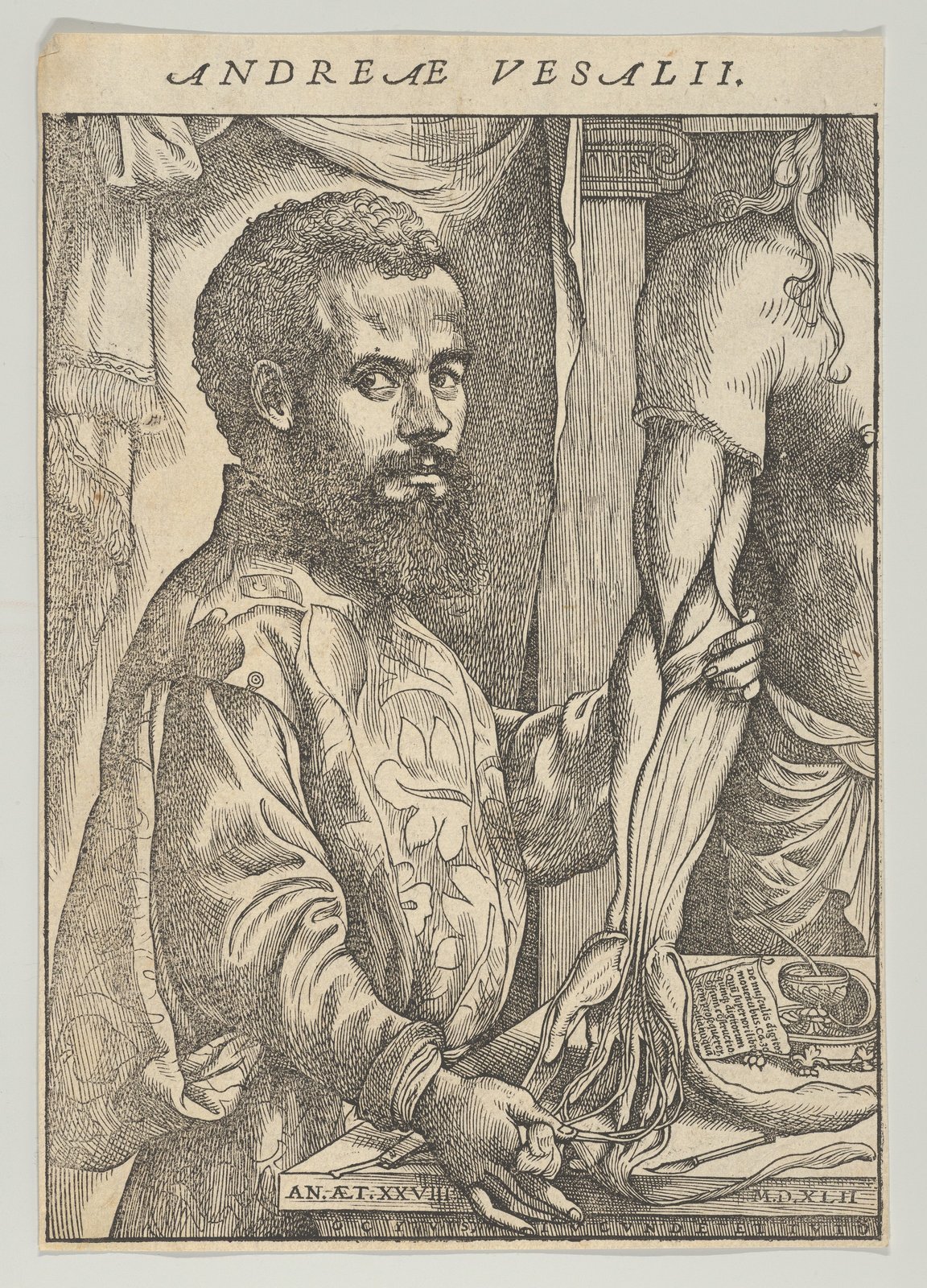
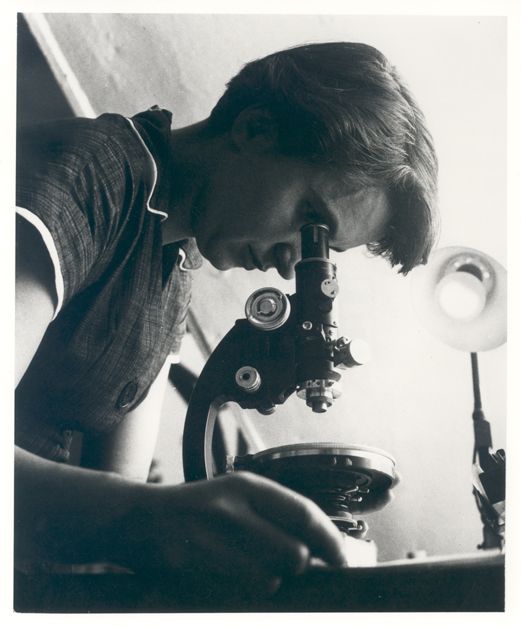
Portrait of Andreas Vesalius, woodcut dated 1542 (inscribed 'AN. AET. XXVIII', age 28), attributed to John (Jan Stephan) of Calcar; Metropolitan Museum of Art, Gift of Richard Day, 1980 (1980.1001) · The Metropolitan Museum of Art, New York, Drawings and Prints, accession 1980.1001 (Gift of Richard Day, 1980), impression of the portrait leaf of De humani corporis fabrica (Basel, 1543), Open Access image DP853465, downsized from 2658 x 3693 px Classified as a historical depiction: a woodcut by an unknown cutter after Calcar, and no source states it was drawn from life. · Public domain / Met Open Access (CC0); sixteenth-century woodcut, Met Open Access API reports isPublicDomain true and no rightsAndReproduction notice
anatomist · Early Modern
Andreas Vesalius
1514–1564
Known For
Not yet included in personality matching — the documented evidence doesn't yet cover enough of the personality model. Everything else on this page is fully available.
Trait Constellation
Key Achievements
In 1543 Vesalius published De humani corporis fabrica in Basel, printed by Johannes Oporinus and dedicated to Charles V. Its seven books treat bones and cartilages, ligaments and muscles, veins and arteries, nerves, the organs of nutrition and generation, the heart and lungs, and the brain and sense organs, with large woodcuts that sit beside the text. A shorter Epitome for students appeared the same year. The illustrations are traditionally attributed to Jan Stephan van Calcar of Titian's circle.
Vesalius argued from dissection that Galen had described the body of an ape, not of a man. In the Fabrica he showed, among other corrections, that the sternum has three parts rather than seven, that the lower jaw is a single bone, that humans have no rete mirabile and that nerves are not hollow. His 1543 text still spoke of blood passing through invisible pores in the heart's septum; in the 1555 second edition he wrote that, as far as the senses can tell, none passes through it.
Vesalius was appointed to teach surgery and anatomy at Padua in December 1537. Where anatomy was usually taught by a professor reading from a text while a barber cut, he dissected and lectured himself. In 1538 he issued six large printed sheets, the Tabulae anatomicae sex, for his students, with drawings credited to Calcar, and in 1540 he gave dissection demonstrations at Bologna that the student Baldasar Heseler recorded in his notes.
Moments That Reveal Them
In Paris in the 1530s, anatomy was taught by professors who lectured from Galen while barbers cut the bodies. In an account Vesalius gave himself, which the biographer James Ball retells, he took the knife in his own hands and carried out a systematic dissection of the abdominal organs and the arm muscles. The Paris professor Joannes Guinterius wrote in 1539 of Vesalius as a young man of 'singular zeal' for anatomy, with whom he had examined the muscles, veins, arteries and nerves.
Taking over a task the teachers were not performing, rather than waiting for the chance to do it, is consistent with proactive agency. The main account comes from Vesalius himself through an older biographer; Guinterius's 1539 remark is the one independent confirmation. Proactive Agency
In 1561 Gabriele Falloppio published Observationes anatomicae, which praised Vesalius while correcting him. From Madrid Vesalius answered in a reply that was published in Venice in 1564. According to Vivian Nutton, the tone was cordial: Vesalius accepted Falloppio's criticism of his belief in venous fibres that controlled the flow of blood, was pleased by his account of teeth, and acknowledged that others had found the eyelid-raising muscle and the third ear ossicle, adding that he had confirmed the ossicle by dissection.
Accepting a younger anatomist's correction and crediting others' discoveries is consistent with belief updating. Nutton sets this against his quieter handling of priority in the 1555 annotations, so it was not a general rule of his conduct. Belief Updating
Turning Points
When he left Italy for the imperial court, Vesalius burned his notes on Galen, the copy of Galen he had used for teaching, a fuller paraphrase of Rhazes's Almansor and material on drug formulas, after court physicians had judged his books harshly. In a 1546 letter he wrote that he did it 'with the intention of restraining myself somewhat in writing', that he had often regretted it, and that friends had advised against it. Nutton records his reply to Falloppio as his only publication after 1555.
Burning the notes after hostile judgments is consistent with a limit on how long he stayed in open dispute, although the same letter defends his work against Sylvius. The account is his own, written two to three years after the event. Conflict Tolerance
Similar People
People whose overall profiles resemble theirs.

Gertrude Bell

Leonardo da Vinci

Rosalind Franklin

Ada Lovelace

Benjamin Banneker
Opposite Profile
Not a rival — a different profile shape worth a look.

Susan B. Anthony
Sources
- Andreas Vesalius (Q170267) -- verified live via wbgetentities (2026-10-08): en label 'Andreas Vesalius', description 'Flemish anatomist, physician and author (1514-1564)', died 16 Oct 1564, instance of human, ko label '안드레아스 베살리우스', P18 'Vesalius Fabrica portrait.jpg'. Orientation only; not used as support for any row.
- Vivian Nutton (historian of medicine, UCL), 'Vesalius Revised. His Annotations to the 1555 Fabrica', Medical History 56(4), 2012, open-access full text on PubMed Central -- INDEPENDENT scholarly study of Vesalius's own heavily annotated copy of the 1555 edition, prepared for a never-published third edition; admiring of his precision but openly critical of how he handled credit to contemporaries and of the 'brash young man in a hurry' of 1543. Read in full (text, footnotes not read).
- A. H. Compier (Leiden), 'Rhazes in the Renaissance of Andreas Vesalius', Medical History 56(1), 2012, open-access full text on PubMed Central -- INDEPENDENT scholarly article that reads Vesalius's early Paraphrasis of Rhazes (1537), his 1539 bloodletting letter, the Fabrica preface and his 1546 letter on the China root (long passages translated, including his own account of burning his notes). Read the introduction, the sections on the 1537 Paraphrasis, the 1538-1546 development and the discussion of the 1546 letter; the closing speculation about Rhazes's possible influence on his criticism of Galen was skimmed only.
- F. Zampieri, M. ElMaghawry, A. Zanatta and G. Thiene (University of Padua), 'Andreas Vesalius: Celebrating 500 years of dissecting nature', Global Cardiology Science and Practice 2015, open-access full text on PubMed Central -- ADMIRING Padua-based review for the 500th anniversary, quoting the Fabrica preface and the 1543 and 1555 passages on the heart septum; relies on O'Malley (1964) and Cushing (1962). Read in full (figure captions skimmed).
- James Moores Ball, 'Andreas Vesalius, the Reformer of Anatomy' (St. Louis, 1910), Internet Archive scan -- OLD POPULAR biography by an American physician, admiring and partly romantic (it repeats the pilgrimage legend and some embellished anecdotes, which are not used here); useful for the structure of the Padua courses, the contents of the Fabrica book by book, the Tabulae of 1538, and the quarrels with Sylvius and Colombo. Read chapters 4-15 (early life to death); the opening chapters on ancient and medieval anatomy were skimmed.
- Moritz Roth, 'Andreas Vesalius Bruxellensis' (Berlin, 1892), Internet Archive scan (German, poor OCR) -- standard archival biography of the 19th century. Read only the passages on Vesalius's departure from Italy and the burning of his notes (pp. 189-191, with the Latin of his 1546 letter in the footnote) and on Jacobus Sylvius's attacks on Vesalius (pp. 227-230); the remaining ~500 pages were not read.
- Gabriele Falloppio (Italian anatomist and Vesalius's junior contemporary, who taught at Pisa and Padua), 'Observationes anatomicae' (Venice, 1561/1562), digitised Wellcome copy at the Internet Archive (Latin) -- CONTEMPORARY respectful critic of Vesalius; read the author's preface and opening pages (his statement of how he came to side with Vesalius and where he thought Vesalius went wrong) and located the many later passages that name Vesalius; the anatomical body of the book was not read.
- M. H. Spielmann, 'The Iconography of Andreas Vesalius' (London: Wellcome Historical Medical Museum, 1925), Internet Archive scan -- scholarly iconography with forewords by Arthur Keith and others; read the foreword and the chapter on the Fabrica woodcut portrait (authorship by Calcar's drawing, Vesalius's reuse of the block in several works); the catalogue of painted portraits was skimmed.
- P. Krishnan and S. Nag, 'Historical Vignette: Andreas Vesalius and Head Injuries in Royalty', Asian Journal of Neurosurgery 2021, open-access full text on PubMed Central -- short secondary vignette of Vesalius's involvement in the 1559 Henri II and 1562 Don Carlos head-injury cases; rests on Norwich, Kean and others. Read in full.
- J. Xiang and S. Venkatesan (Imperial College London), 'The role of Vesalius and his contemporaries in the transfiguration of human anatomical science', Journal of Anatomy 2023, open-access full text on PubMed Central -- student-level secondary review; some details are loose (e.g. the places where Falloppio held his posts) and are not relied on. Used only for its quotations of the 1540 Bologna student notes of Baldasar Heseler and of Sylvius's 1551 pamphlet. Read in full.
- The Metropolitan Museum of Art, object 1980.1001 (Gift of Richard Day, 1980): woodcut 'Portrait of Andreas Vesalius, half-length ... frontispiece to De humani corporis fabrica libri septem', John of Calcar, dated 1542, Open Access (public domain flag true in the Met Open Access API, no rights notice) -- institutional record of the portrait leaf; used only for the portrait chain, not for any row.