Ibn Khaldun
94% Profile Match
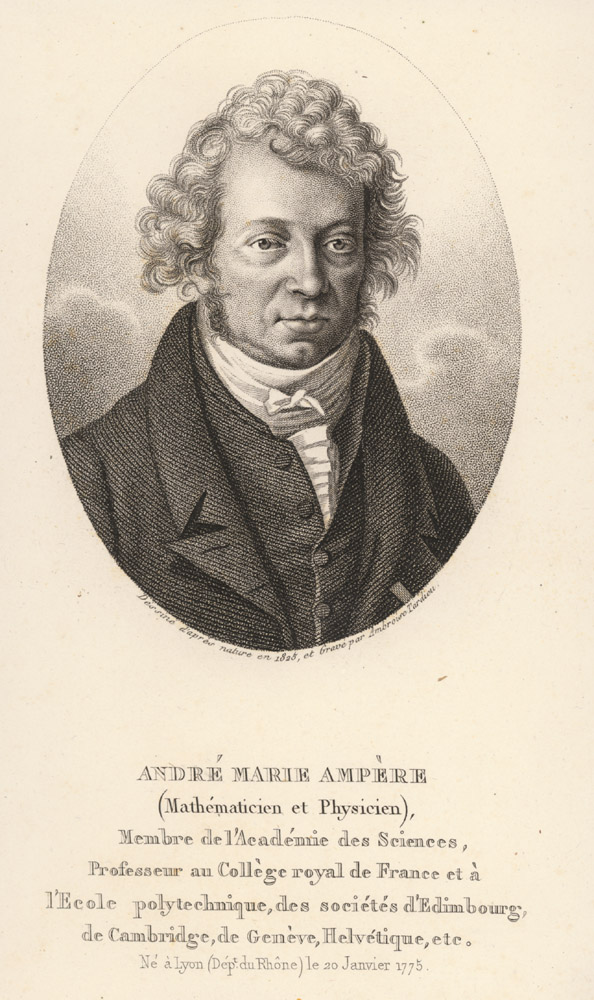
Ambroise Tardieu (engraver, after a drawing from life of 1825); image from the Smithsonian Libraries and Archives Dibner Library collection, via the Scientific Identity portrait gallery · Stipple engraving of André-Marie Ampère by Ambroise Tardieu, printed with the legend 'drawn from life in 1825 and engraved by Ambroise Tardieu'; Smithsonian Libraries and Archives, Dibner Library portrait collection (Scientific Identity), item SIL14-A4-05 · Public domain (engraving published in France in or about 1825; engraver Ambroise Tardieu died in 1841)
physicist · 19th Century
1775–1836
Not yet included in personality matching — the documented evidence doesn't yet cover enough of the personality model. Everything else on this page is fully available.
In September 1820, a week after news of Oersted's discovery reached the Académie des sciences in Paris, Ampère showed that two parallel wires carrying electric current attract each other when the currents run the same way and repel when they run in opposite ways. He went on to derive a mathematical law for the force between current elements, which he set out in his 1826 memoir on the mathematical theory of electrodynamic phenomena, and he named the new science electrodynamics. Maxwell called the investigation 'one of the most brilliant achievements in science', and NIST notes that until 2019 the ampere was defined by a general version of an experiment Ampère conducted in the 1820s.
Ampère proposed that magnetism is itself electrical: a magnet owes its properties to small closed electric currents circulating in its molecules, and the Earth's magnetism can be treated as a system of currents running east to west around the globe. He coiled wire into a helix he called a solenoid, which behaves like a bar magnet when a current passes through it, and Whittaker records that he showed a circuit to be equivalent in its magnetic effects to a magnetic shell.
Before electrodynamics Ampère was known as a mathematician. His 1802 treatise on the mathematics of games of chance, which showed that the odds run against the habitual gambler, led to posts at Lyon and then Paris, and he was professor of mathematics at the École polytechnique from 1809 to 1828. His 1814 classification of partial differential equations preceded his election to the Institut that November. Late in life he wrote the Essai sur la philosophie des sciences, an attempt at a natural classification of all human knowledge.
In letters of December 1820 and February 1821 Ampère told friends that for three months he had had only one idea, the action of currents and magnets on each other, that he was sitting up late into the night with two courses to teach, and that he had put aside even metaphysics, until then his favourite subject. In the second letter he also admitted that his memoir had been written with extreme haste, in detached pieces, and was not clear enough.
Setting aside other interests and working through the night on one question is consistent with deep focus; his own admission that the haste left the memoir unclear shows the cost, and the account rests on his letters as retold by an admiring biographer. Deep Focus
Until 1816 Ampère had been a zealous supporter of the emission theory of light. Valson reports that when Fresnel's work was described in the Annales de chimie et de physique, Ampère admitted that he gave up, not without pain, a theory he had loved; by 1816 he was an advocate of the wave theory, siding with Fresnel against Biot and Laplace, and Fresnel lodged in his house from 1822 until his death in 1827.
Giving up a theory he cared for once the evidence for the rival account was set before him is consistent with belief updating. Belief Updating
Oersted's experiment on the action of a current on a magnetic needle was repeated before the Académie des sciences on 11 September 1820. Seven days later, on 18 September, Ampère presented a more general result with apparatus already built, and over the following weeks visitors came to his study to see a platinum wire orient itself under the Earth's action. Valson notes that for the following years his metaphysical studies were set aside, and in 1826 he began teaching electrodynamics at the Collège de France in a course of his own design.
Turning within days from his other work to a newly reported experiment is consistent with opportunity sensing; that he foresaw an entire field in advance is stated only by admirers and is not claimed here. Opportunity Sensing
People whose overall profiles resemble theirs.



Not a rival — a different profile shape worth a look.