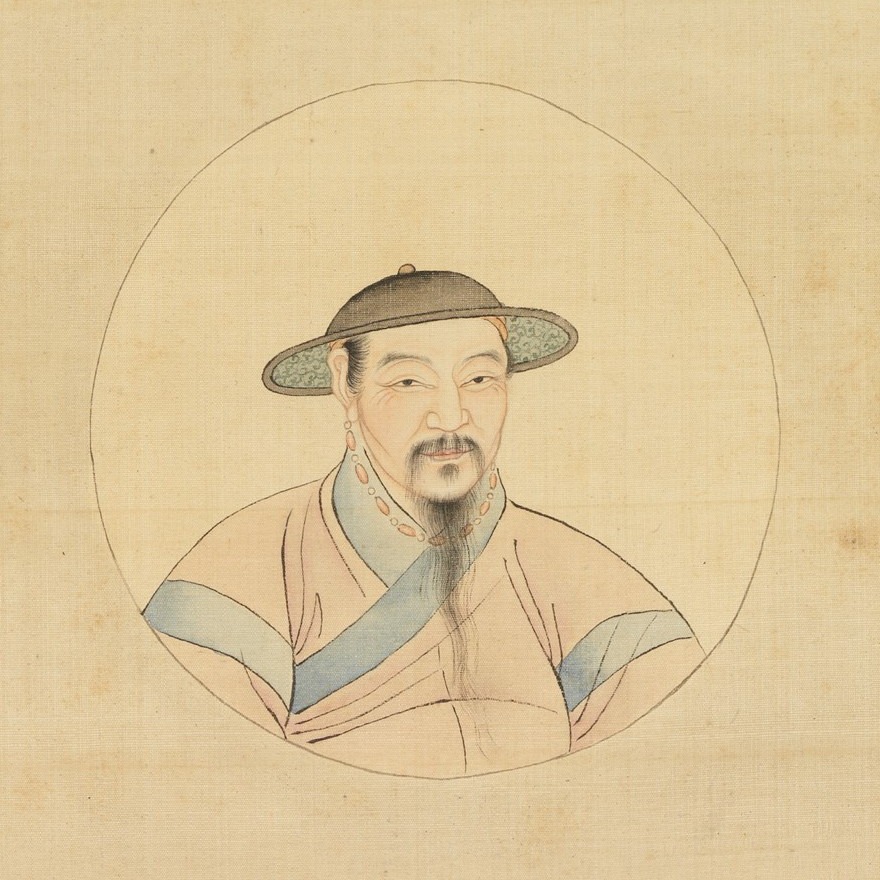
Unidentified artist, 19th century. Copy of a Portrait of Zhao Mengfu, 1986.267.3. The Metropolitan Museum of Art, Gift of Robert Hatfield Ellsworth, in memory of La Ferne Hatfield Ellsworth, 1986 (Open Access, cropped) · Roundel portrait from the hanging scroll 'Copy of a Portrait of Zhao Mengfu', ink and colour on silk, 63.8 x 30.8 cm, unidentified artist, 19th century, The Metropolitan Museum of Art, New York (accession 1986.267.3; Gift of Robert Hatfield Ellsworth, in memory of La Ferne Hatfield Ellsworth, 1986). The museum's title names the sitter. It is a later copy of an earlier portrait, made more than five centuries after Zhao Mengfu's death, not a likeness from life. The file is a crop of the portrait roundel from the museum's Open Access image (2111 x 4000 pixels), taken at original resolution with no scaling or upscaling; the inscription and seals are cropped away. · Public domain (Metropolitan Museum Open Access, CC0; nineteenth-century painting by an unknown artist)
화가 · 중세
조맹부
1254–1322
주요 업적 분야
아직 성격 매칭에 포함되지 않았습니다 — 기록된 근거가 성격 모델 전체를 다루기에는 충분하지 않습니다. 이 페이지의 다른 모든 내용은 자유롭게 확인하실 수 있습니다.
핵심 특성
주요 업적
자연의 재현보다 개인적 표현을 추구한 문인화(文人畫) 전통의 초기 대가로 존경받는 중국의 화가이자 서예가로, 당대 최고의 서예가로 평가받았다.
그는 회화를 '고의(古意)', 곧 옛 대가들의 정신으로 되돌렸다. 브리태니커는 그의 그림이 송 화원 이후 옛 대가들에게서 관심을 끌어낸 최초의 작품들에 속한다고 하며, 친구 주밀을 위해 1295년에 그린 두루마리 〈작화추색도〉는 동원 풍의 모티프를 새롭게 재해석한다.
전서·예서·행서·초서를 아우른 그의 서예는 왕희지의 서풍을 되살렸고, 《원사》는 인도의 한 승려가 수만 리를 와서 그의 글씨를 구해 갔다고 전하며, 다음 세대인 원말 사대가(四大家)가 그의 문인화 혁신을 완성했다.
삶의 장면들
그는 북중국 여행길에서 남쪽에는 거의 알려지지 않았던 10~11세기 대가 이성·동원·범관의 산수화를 보고 수집했으며, 회화에서 가장 중요한 것은 '고의(古意)'라고 썼다.
이는 당시의 지배적 화풍을 따르기보다 옛 대가들에게서 직접 배워 새로운 접근의 토대로 삼은 화가의 모습과 부합한다. 창의적 독창성
《원사》는 그의 《상서》 주석, 거문고와 음악의 기원에 관한 저술, 시문, 모든 서체의 글씨, 산수·화훼·대나무·인물·말 그림을 열거하고, 서화에 가려 그의 재능의 한 면을 아는 이는 다른 면을 알지 못했다는 사학자 양재의 말을 전한다.
이는 서로 함께 알려지는 일이 드물었던 여러 예술 분야를 넘나든 학자 겸 예술가의 모습과 부합한다. 분야 횡단성
전환점
1279년 송이 멸망한 뒤 그는 집에 머물렀고 《원사》는 그가 학문에 더욱 힘썼다고 전하며, 이후 북쪽을 여행하며 옛 대가들의 그림을 보고 모았고, 1295년에는 《세계 인명 백과》가 그의 가장 유명한 현존 두루마리라고 부르는 〈작화추색도〉를 그렸다.
이는 학문을 더욱 깊이 한 시기가 이후 수년에 걸쳐 그의 특징적인 원숙한 회화로 이어진 모습과 부합한다. 숙련 지향
비슷한 인물
전체적인 프로필이 이 사람과 닮은 사람들이에요.


에이다 러브레이스

라빈드라나트 타고르

볼프강 아마데우스 모차르트

프란츠 카프카

앨런 튜링
출처
- Zhao Mengfu (Q197461), verified live via the Wikidata API (2026-11-02): no English label (the entity is labelled in Chinese and Korean, Korean label 조맹부), English description 'Chinese painter (1254-1322)', birth 1254 and death 1322 (year precision), occupations including painter. Orientation only; not used as support for any row.
- Encyclopaedia Britannica, 'Zhao Mengfu', read in full (short entry). CANONICAL SIGNIFICANCE SOURCE: Chinese painter and calligrapher who, 'though occasionally condemned for having served in the foreign Mongol court', has been honoured as an early master within the tradition of the literati painters (wenrenhua), who sought personal expression rather than the representation of nature; his paintings were among the first after the collapse of the Song dynasty and its painting academy to take an interest from the subjects and styles of ancient masters; he is popularly remembered as a horse painter in the manner of Han Gan but also painted other animals, landscapes and bamboo, generally avoiding superficial beauty through deliberately simplified colour and composition and a schematic, even childlike rendering of forms; his wife Guan Daosheng and son Zhao Yong were painters of note. Encyclopedia; short; the political-service passages are not used.
- Encyclopedia of World Biography (Gale), 'Chao Meng-fu' (as hosted on Encyclopedia.com), read in full: helped establish the tradition of amateur scholarly painting (wen-jen-hua); considered the leading calligrapher of his time, noted for small formal and running script, in which he revived the fluid, harmonious style of Wang Xizhi; as a youth he studied under Ao Shan and was influenced by Qian Xuan; on journeys in North China after 1286 he saw and collected paintings by Li Cheng, Dong Yuan and Fan Kuan, which inspired him to break from the conventions into which landscape painting had hardened at the end of the Southern Song, writing 'the most important thing in painting is the spirit of antiquity (ku-i)' and meaning not copying but reviving the spirit of the old masters; Autumn Colors on the Qiao and Hua Mountains (1295) 'interprets archaic conventions in a revolutionary way' and the later Water Village handscroll (seven years later) is more relaxed and spontaneous; his own comment that his paintings 'may seem simply and carelessly done, but true connoisseurs will realize that they are very close to the old models'; most surviving horse paintings bearing his name are forgeries; the next generation of Yuan scholar painters, the Four Masters, carried the revolution to fruition. Gale reference work; admiring, retrospective; its remarks about his official posts and his regrets about taking office are not used.
- National Palace Museum, Taipei, exhibition page 'Autumn Colors on the Qiao and Hua Mountains' (National Treasures for Fun), read: the handscroll (ink and colour on paper, 28.4 x 90.2 cm) was painted in 1295 after he headed back south, for his friend Zhou Mi (1232-1298), and depicts the scenery of Zhou's ancestral land; the composition is succinct, and the sloping banks and trees are very similar to the motifs in Dong Yuan's landscapes, made 'even more animated' by Zhao's brush, ink and colouring. Museum catalogue text; short and admiring; its passage on his official service is not used.
- History of Yuan (Yuan shi), chapter 172, biography of Zhao Mengfu (Chinese Wikisource, original Chinese read), compiled in 1370 under the Ming: as a child he memorised what he read and wrote quickly; after the fall of the Song, living at home, he 'applied himself still more to study' (宋亡,家居,益自力於學); his writings include a commentary on the Book of Documents and the Qinyuan and Yueyuan on the origins of the zither and of music; seal, clerical and every other script, he 'surpassed all ancients and moderns' and was famous across the land for his writing, an Indian monk travelling tens of thousands of li to obtain his calligraphy, which his country treasured; he painted landscapes, trees and rocks, flowers and bamboo, people and horses with special finish; the emperor Renzong compared his writing to Li Bai and Su Shi and praised his learning and mastery of calligraphy and painting; the historian Yang Zai said his talent was 'largely masked by calligraphy and painting', so those who knew his painting did not know his prose, and those who knew his prose did not know his statecraft. Official dynastic history, written about 50 years after his death; heavily laudatory; the long passages on his court and administrative career are NOT used.
- Siku quanshu zongmu tiyao (Imperial Catalogue of the Four Treasuries, Qing, 1780s), chapter 166, entry for Zhao Mengfu's collected writings 'Songxue zhai ji' (Chinese Wikisource, original Chinese read): a critical Qing editorial verdict that as a descendant of the Song imperial house who 'changed his allegiance to serve the Yuan' he was 'out of harmony with public opinion' and in old age could not avoid regret, citing a poem line, yet 'in talent and art' his 'elegance and literary grace surpassed his time'; his calligraphy was 'the first of the Yuan dynasty' and his prose could stand beside the leading Yuan writers; the entry also notes that the Ming-era edition was incomplete and that the surviving ten-chapter collection includes the Qinyuan and Yueyuan. Used as the counter-voice (the critical judgment of his choices) and for the Qing verdict on his artistic standing; the allegiance question itself is NOT scored.