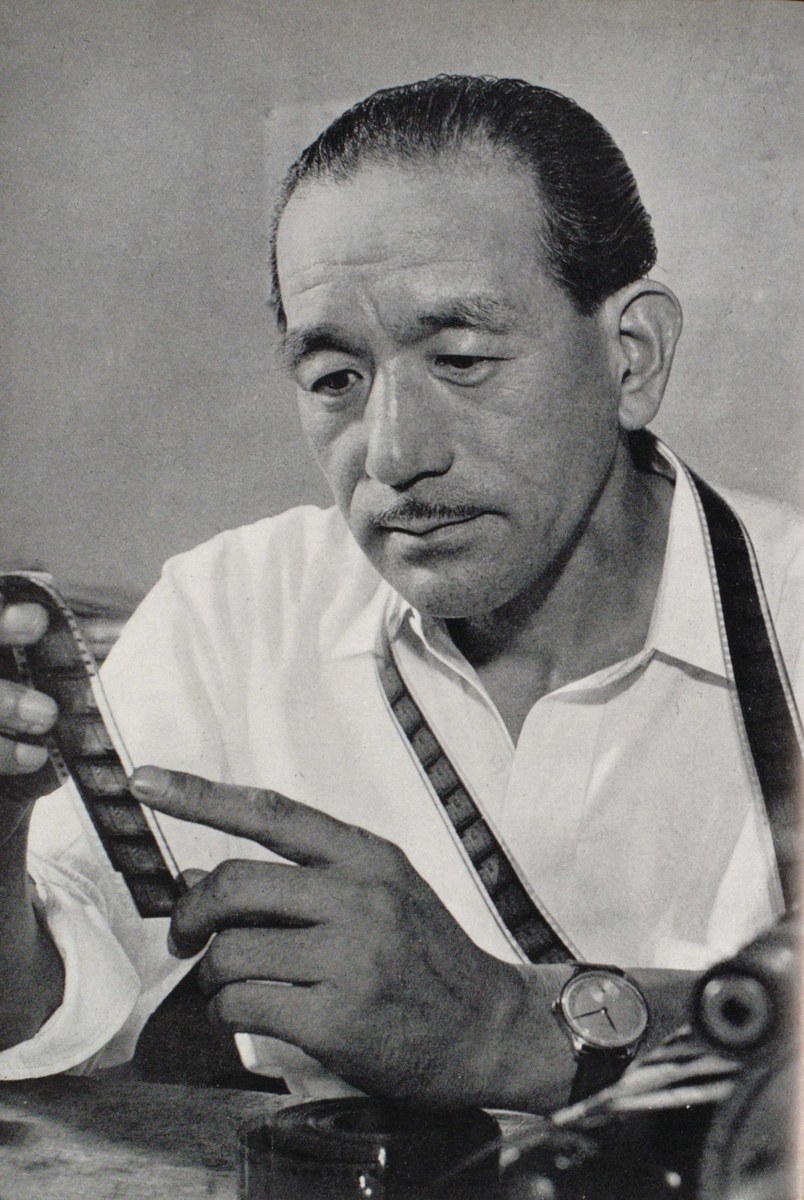

Shigeru Tamura, 1953; National Diet Library, Japan, Portraits of Modern Japanese Historical Figures · Portrait photograph of Yasujiro Ozu by Shigeru Tamura (1909-1987), taken from the photographic book 'Gendai Nihon no hyakunin' (Bungei Shunju Shinsha, 1953) and shown on the National Diet Library's digital exhibition 'Portraits of Modern Japanese Historical Figures' (the fourth photograph on Ozu's page). The Library's site statement says all images in that exhibition are in the public domain and may be reused, including commercially, with the source cited. The same photograph is on Wikimedia Commons with the Japanese old-photograph public-domain tag and a Library source link. Original 2423 x 3615 pixels, downscaled to 804 x 1200 with no cropping and no upscaling. · Public domain (National Diet Library, Japan, exhibition statement)
영화감독 · 20세기
오즈 야스지로
1903–1963
주요 업적 분야
아직 성격 매칭에 포함되지 않았습니다 — 기록된 근거가 성격 모델 전체를 다루기에는 충분하지 않습니다. 이 페이지의 다른 모든 내용은 자유롭게 확인하실 수 있습니다.
핵심 특성
주요 업적
전쟁 뒤 『만춘』(1949)부터 『동경 이야기』(1953), 『꽁치의 맛』(1962)까지 일본의 가족을 다룬 영화를 만들었고, 일본 국립국회도서관은 이 작품들을 슬프면서도 유머가 있다고 설명한다.
그는 거의 움직이지 않는 카메라, 페이드와 디졸브 대신 단순한 컷, 장면 사이에 끼워 넣은 빈 방과 풍경 쇼트로 이루어진 극도로 절제된 영화 언어를 만들어 냈다.
그의 『동경 이야기』는 BFI 사이트 앤드 사운드 감독 투표에서 역대 최고의 영화로 선정되었다.
삶의 장면들
배우 류 치슈에 따르면 그는 노다 고고와 약 넉 달에 걸쳐 시나리오를 썼고, 끝날 무렵에는 모든 쇼트의 모든 이미지를 정해 두어 촬영 현장에서 시나리오를 바꾸지 않았다.
이는 고도로 계획적인 작업 방식과 부합한다. 계획 지향
시네마스코프가 유행할 때 그는 그것과 상관하고 싶지 않다고 말했고, 대신 클로즈업과 더 짧은 쇼트를 더 많이 사용했다.
이는 유행이 아니라 자신의 판단으로 방식을 정하는 태도와 부합한다. 독립적 사고
전환점
『만춘』(1949)으로 그는 전후 가족 이야기 연작을 시작했고, 이후 이 이야기를 변주하며 여러 번 다시 다루었으며 절제된 스타일을 유지했다.
이는 경력 후반에 독자적인 스타일이 굳어진 것과 부합한다. 창의적 독창성
비슷한 인물
전체적인 프로필이 이 사람과 닮은 사람들이에요.
출처
- Yasujiro Ozu (Q55402), verified live via the Wikidata API (2026-10-28): label 'Yasujirō Ozu', description 'Japanese film director, screenwriter (1903-1963)', born 1903-12-12, died 1963-12-12, citizenship Japan, Korean label present, P18 image 'Yasujiro Ozu by Shigeru Tanura.jpg'. Orientation only; not used as support for any row.
- National Diet Library, Japan, 'OZU Yasujiro', Portraits of Modern Japanese Historical Figures (English page), read in full. CANONICAL SIGNIFICANCE SOURCE: library-staff biographical note describing him as a film director who joined Shochiku in 1923, directed his first film in 1927, moved from short comic films to realistic portrayals of everyday life, and after the war made films centred on the Japanese family (Late Spring, Early Summer, Tokyo Story, An Autumn Afternoon), noting his lower camera position for every shot as internationally recognised. Short institutional note; no behavioural detail.
- Nick Wrigley, 'Ozu, Yasujiro', Senses of Cinema Great Directors, issue 26 (May 2003), read in full (about 30,000 characters): his background and entry to Shochiku, his own statements about formulating his style without a teacher, Audie Bock on the gap between his life and films, the film-by-film survey, actor Chishu Ryu on his scripting with Kogo Noda, his refusal of CinemaScope, and his reception by the Japanese New Wave. Film-journal career overview; admiring in tone, with the author's personal favourites noted.
- Donald Richie, 'Yasujiro Ozu: The Syntax of His Films', Film Quarterly vol. 17 no. 2 (Winter 1963-64), read in full (JSTOR copy via the Internet Archive): his restricted grammar of the cut, middle shot and low position, structure of return, placement of the cut after the emotional point, accuracy of geography and time. Written in Ozu's lifetime by a Western critic who knew Japanese cinema first-hand; analytical and admiring.
- Donald Richie, 'The Later Films of Yasujiro Ozu', Film Quarterly (JSTOR copy via the Internet Archive), read for the opening sections (about 20,000 characters): Ozu as regarded in Japan as 'the most Japanese' director, his restraint, his avoidance of dissolves and fades with his own quoted remarks, his single recurring subject of the family, and the young Japanese critics who called him old-fashioned. Contemporary critic's essay; includes Ozu's own remarks as reported by Richie.
- Thom Andersen, 'Ozu Yasujiro: the master of time', BFI Sight and Sound (Directors' Poll, updated 2019), read in full (about 15,000 characters): his system as both conservative and radical, crossing the axis in every cut, shots of empty spaces, his dramaturgy that avoids a single character's viewpoint, assistant Masahiro Shinoda's remark on the low camera, and a reading of his films as depicting economic change. Film-maker/critic essay for the Sight and Sound polls; strongly admiring and openly interpretive, including a Marxist reading Ozu never stated.
- Chris Berry, review of David Bordwell's 'Ozu and the Poetics of Cinema' (BFI, 1988) in 'Our Problem Cinema: The Challenge of Japanese Cinema', Continuum vol. 4 no. 1 (1990), read in full (about 22,000 characters): Bordwell's findings on Ozu's systematic style, his correction that the camera is level rather than tatami-low and proportional to the subject, his evidence of Ozu's interest in the West against 'traditional Japan' readings, and the reviewer's critique of Bordwell's polemic and of the claim that Ozu's practices were progressive or original. Academic review; Bordwell's book itself was not opened, so his findings reach this profile through the review.