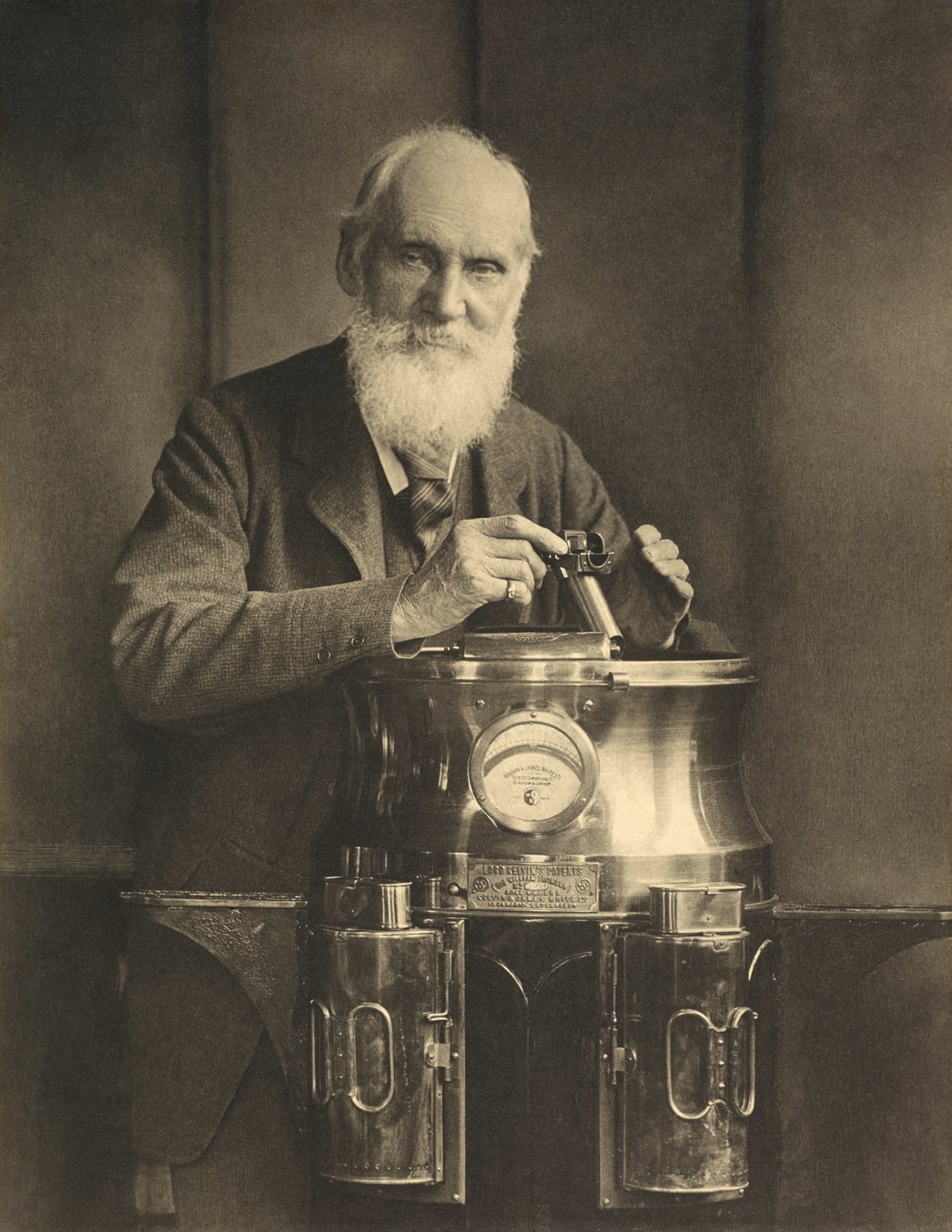

T. & R. Annan & Sons (Glasgow), carbon print of Lord Kelvin with his compass and azimuth mirror, c. 1900; National Galleries of Scotland PGP 230.1; restored scan by Adam Cuerden on Wikimedia Commons · National Galleries of Scotland, accession PGP 230.1 ('Sir William Thomson, Baron Kelvin, 1824 - 1907. Scientist, resting on a binnacle and holding a marine azimuth mirror', carbon print, 19.00 x 14.70 cm), via the Wikimedia Commons file 'Sir William Thomson, Baron Kelvin by T. & R. Annan & Sons.jpg' (restoration by Adam Cuerden of the scan; the unrestored scan is 'Sir William Thomson, Baron Kelvin by T. & R. Annan & Sons - Original.jpg') · Public domain
물리학자 · 19세기
켈빈 남작 윌리엄 톰슨
1824–1907
주요 업적 분야
아직 성격 매칭에 포함되지 않았습니다 — 기록된 근거가 성격 모델 전체를 다루기에는 충분하지 않습니다. 이 페이지의 다른 모든 내용은 자유롭게 확인하실 수 있습니다.
핵심 특성
주요 업적
톰슨은 1848년 카르노의 열기관 이론에 바탕을 둔 절대 온도 눈금을 제안했다. 이 눈금에서는 온도의 한 눈금이 온도계에 쓰는 물질에 좌우되지 않았고, 그는 르뇨(Regnault)의 측정값으로 그 값을 표로 계산했다. 1851년 논문 「열의 동역학 이론에 관하여」는 카르노의 이론을 열과 일의 등가에 관한 줄(Joule)의 결과와 조화시켰고, 1852년에는 역학적 에너지가 흩어지는 보편적 경향의 원리를 발표했다. 그는 변환의 법칙은 클라우지우스(Clausius)의 공로로 돌리면서, 자신은 다른 공리에서 출발한 증명을 제시했다. 켈빈 눈금과 국제단위계(SI)의 온도 단위 켈빈은 그의 이름을 딴 것이다.
톰슨은 긴 해저 케이블을 통한 신호 전송의 수학을 정립해, 신호 지연이 케이블 길이의 제곱에 비례해 커진다는 점을 보이고 더 굵은 구리 도체를 쓸 것을 주장했다. 그는 1857년과 1858년의 대서양 케이블 항해에 참여했고, 1858년의 케이블이 몇 주 만에 불통이 된 뒤에는 1865년과 1866년의 항해에도 참여했다. 1858년에는 희미한 신호를 읽을 수 있게 한 거울 검류계의 특허를 얻었고, 나중에는 사이펀 기록기를 고안했다. 1866년에는 케이블 사업에서의 역할로 기사 작위를 받았다.
톰슨은 1870년대부터 철선(鐵船)에 맞게 나침반을 새로 설계했다. 아주 가벼운 나침반 카드에 가는 바늘 여덟 개를 명주실로 매달았고 조정 가능한 보정 자석을 갖췄으며, 달리는 배에서 깊은 바다의 수심을 재는 측심기도 개발했다. 독일과 러시아 해군이 영국 해군보다 먼저 이를 주문했고, 영국 해군은 1889년 11월에야 그의 나침반을 표준으로 삼았다. 이 장비는 글래스고의 계기 제작업체 제임스 화이트(James White), 훗날의 켈빈 앤드 제임스 화이트(Kelvin and James White Ltd.)에서 만들었다.
톰슨은 1846년부터 1899년 퇴임할 때까지 글래스고 대학의 자연철학 석좌를 맡았다. 1850년경에는 쓰지 않던 포도주 저장고를 실험실로 삼아 학생들이 측정 작업을 하게 했는데, 전기 작가 톰프슨(Thompson)은 이를 어느 대학에서든 학생에게 개방된 최초의 물리학 실험실이라고 부른다. 그는 P. G. 테이트(Tait)와 함께 『자연철학 논고』를 썼으며, 에너지의 관점에서 쓴 이 교재의 1권은 1867년에 나왔다.
삶의 장면들
1858년 8월, 케이블이 놓인 뒤 회사의 전기 기사 화이트하우스(Whitehouse)는 자신의 중계기로는 뉴펀들랜드에서 오는 신호를 또렷이 받지 못했다. 이사들의 편지를 인용한 톰프슨의 서술에 따르면, 이사회는 8월 17일 케이블 관리를 화이트하우스에게서 거두고 톰슨에게 발렌시아(Valentia)의 지휘를 맡겼다. 톰슨은 자신의 거울 검류계가 이미 설치되어 있는 것을 발견하고 뉴펀들랜드 운용자들이 그것으로 바꾸게 해 통신을 되살렸다. 그는 이어 이사회에 화이트하우스의 해임을 다시 검토해 달라고 청했으나, 이사회는 매섭게 거절했다. 화이트하우스는 나중에 낸 소책자에서 자신의 장치뿐 아니라 톰슨의 검류계로도 신호를 받았다고 적었다.
주 장치가 실패하자 자신이 만든 작동하는 기구를 투입한 일은 임기응변의 능력과 부합한다. 사건의 순서는 이사들의 문서에 대한 톰프슨의 서술에 의존하며, 화이트하우스 쪽 입장은 1858년의 소책자로만 확인된다. 자원 활용 성향
1869년 2월 19일 런던 지질학회 회장 T. H. 헉슬리는 지구의 열과 태양의 한정된 연료로 볼 때 약 1억 년밖에 허용되지 않는다는 톰슨의 주장에 답하면서, 수학을 넣은 만큼만 내놓는 방앗간에 비유했다. 톰슨은 1869년 4월 5일 글래스고에서 「지질학적 동역학에 관하여」로 응답하며, 많은 지질학자가 물리학의 원리를 자기 일과 무관한 것으로 취급한다고 비판했다. 1871년 다윈은 월리스(Wallace)에게 보낸 편지에서 선(先)실루리아기를 생각하면 톰슨이 '불길한 유령처럼' 나타난다고 썼다. 톰프슨은 훗날 방사성 발열이 발견되어 온도 기울기에 바탕한 논증이 약해졌다고 적는다.
스스로 영국 지질학자의 '아마도 다수'라고 부른 상대에 맞서 입장을 지키고 선두 논객에게 직접 답한 일은 독립적 사고와 부합한다. 다만 그 입장은 나중에 불완전한 물리학에 바탕한 것으로 드러났으므로, 같은 태도에는 대가도 따랐다. 독립적 사고
전환점
1847년 톰슨은 옥스퍼드의 영국 과학진흥협회 모임에서 제임스 줄의 논문 발표를 들었고, 훗날 본인의 설명에 따르면 그것이 틀렸다고 느꼈으나 기다렸다가 줄에게 따로 이야기했다. 그는 약 3년 동안 카르노의 이론을 붙들면서도 다른 사람들에게 줄의 연구가 중요하다고 말했다. 1850년 그는 줄에게 증기에 관한 한 결론이 알려진 사실과 조화되려면 줄의 발견이 있어야 한다고 썼고, 1851년의 논문은 두 이론 위에 이론을 다시 세웠다.
의심에서 수용까지 약 3년이 걸렸고 그동안에도 증거가 중요하다고 공개적으로 말한 일은, 느리지만 결국 받아들이는 방식의 믿음 갱신과 부합한다. 이 서술은 주로 그를 높이 평가하는 전기 작가와 본인의 회고에 의존한다. 입장 수정 성향
비슷한 인물
전체적인 프로필이 이 사람과 닮은 사람들이에요.
출처
- William Thomson, 1st Baron Kelvin (Q122701) -- verified live via wbgetentities (2026-10-07): en label 'William Thomson, 1st Baron Kelvin', description 'British physicist and engineer (1824-1907)', ko label '켈빈 남작 1세 윌리엄 톰슨', P569 given as 26 June 1825 (the biographies give 26 June 1824), P570 17 Dec 1907, P18 'Sir William Thomson, Baron Kelvin by T. & R. Annan & Sons.jpg'. Orientation only; not used as support for any row.
- Silvanus P. Thompson, The Life of William Thomson, Baron Kelvin of Largs, 2 vols (London: Macmillan, 1910), Internet Archive full text (lifeofwillthom01thomrich, lifeofwillthom02thomrich) -- AUTHORISED, ADMIRING biography by a physicist and friend who worked from Kelvin's papers and family and colleagues' reminiscences; much of it reproduces letters and lectures in Kelvin's own words and includes verbatim minutes and letters of the Atlantic Telegraph Company directors. Read locally: vol. I Ch. VI (thermodynamics: the Oxford 1847 meeting with Joule, the years of suspended judgment, the absolute scale and 1851 paper, in part), Ch. VII (the laboratory, in part), Ch. VIII (Atlantic telegraph 1856-58: law of squares dispute, 1857-58 expeditions, the Whitehouse affair, in part), Ch. X (the Treatise, opening pages) and Ch. XIII (the geological controversy, in full); vol. II Ch. XV (the 1871 Lalla Rookh cruise with Helmholtz), Ch. XVI (Helmholtz's 1876 opinion), Ch. XVII (the compass and the Admiralty, in part), Ch. XIX (the Faure accumulator episode), Ch. XXII (the 1894-95 Perry correspondence), Ch. XXIII (the age of the earth, last pronouncement) and Ch. XXIV (the vortex-atom and ether passages, the 1896 Jubilee statement). Its praise is not used as evidence; the verbatim documents and dated actions are.
- Andrew Gray, Lord Kelvin: An Account of His Scientific Life and Work (London: J. M. Dent, 1908), Internet Archive full text (lordkelvinaccoun00grayrich) -- INSIDER scientific biography by Kelvin's former assistant and successor in the Glasgow chair, written within a year of his death; deliberately concerned with the science, with candid passages on the geological dispute. Read locally: the passages on the dynamical theory of heat (1851) and Clausius, the age-of-the-earth passages including the Perry challenge and Huxley's 1869 address, and the passages on the mirror galvanometer and siphon recorder.
- Henry M. Field, The Story of the Atlantic Telegraph (New York: Scribner, 1892), Internet Archive full text (storyofatlantict00fieluoft) -- narrative history by the brother of the cable promoter Cyrus W. Field, an admiring partisan of the promoter and not of Kelvin; independent of Kelvin's Glasgow circle. Read locally: the passages on the 1857-58 expeditions, the 1865 contract arrangements that kept the company electricians from interfering, the 1866 expedition, the knighthood notice of 1866 and the chapters on the instruments.
- E. O. Wildman Whitehouse, The Atlantic Telegraph: The Rise, Progress, and Development of Its Electrical Department (London: Bradbury & Evans, 1858), Internet Archive full text (cihm_47982) -- ADVERSARIAL PRIMARY pamphlet by the company's own electrician, Kelvin's opponent in the 1855-58 dispute over cable design; written in autumn 1858, after the cable had failed and after his dismissal, about his own instruments, with only a few cool references to Thomson. Read in full (57,000 characters).
- Edward Brailsford Bright and Charles Bright, The Life Story of the Late Sir Charles Tilston Bright, Civil Engineer, with which is incorporated the story of the Atlantic cable (London: Constable, 1899), Internet Archive full text (cihm_48206) -- biography of the cable's engineer-in-chief by his brother and son; a partisan of Bright, who was Kelvin's colleague and sometime rival in the cable enterprise, hence independent of Kelvin's circle. Read locally: the passages on the 1855-58 cable design and Thomson's theory, the 1857-58 expeditions with Thomson aboard the Agamemnon, and his unpaid service.
- Francis Darwin (ed.), The Life and Letters of Charles Darwin, vol. II (London: John Murray; New York: Appleton, 1887), Internet Archive full text (lifelettersofch02darw) -- published letters of Darwin, the other party in the 1860s-70s dispute over the age of the earth; read only for Darwin's 12 July 1871 letter to A. R. Wallace mentioning 'Sir W. Thomson like an odious spectre' and the editor's footnote on Huxley's 1869 address to the Geological Society. An independent but one-sentence view; it is not used for any positive trait.
- Agnes Gardner King, Kelvin the Man: A Biographical Sketch by His Niece (London: Hodder and Stoughton, 1925), Internet Archive full text (kelvin-the-man) -- FAMILY memoir by Kelvin's niece, affectionate and anecdotal, with an introduction by the Glasgow University principal; it repeats the Admiralty compass delay from the family letters. Read in part (the professorship, work and compass pages); used only to corroborate the compass and his habit of carrying a notebook, never as a sole source for a row.
- National Institute of Standards and Technology (NIST), 'Kelvin: Introduction' (SI redefinition pages) -- national-metrology-institute overview, read in full: the kelvin is the SI unit of temperature and the Kelvin scale is named for Lord Kelvin (1824-1907) and starts at absolute zero. Used only for the naming of the scale and unit.