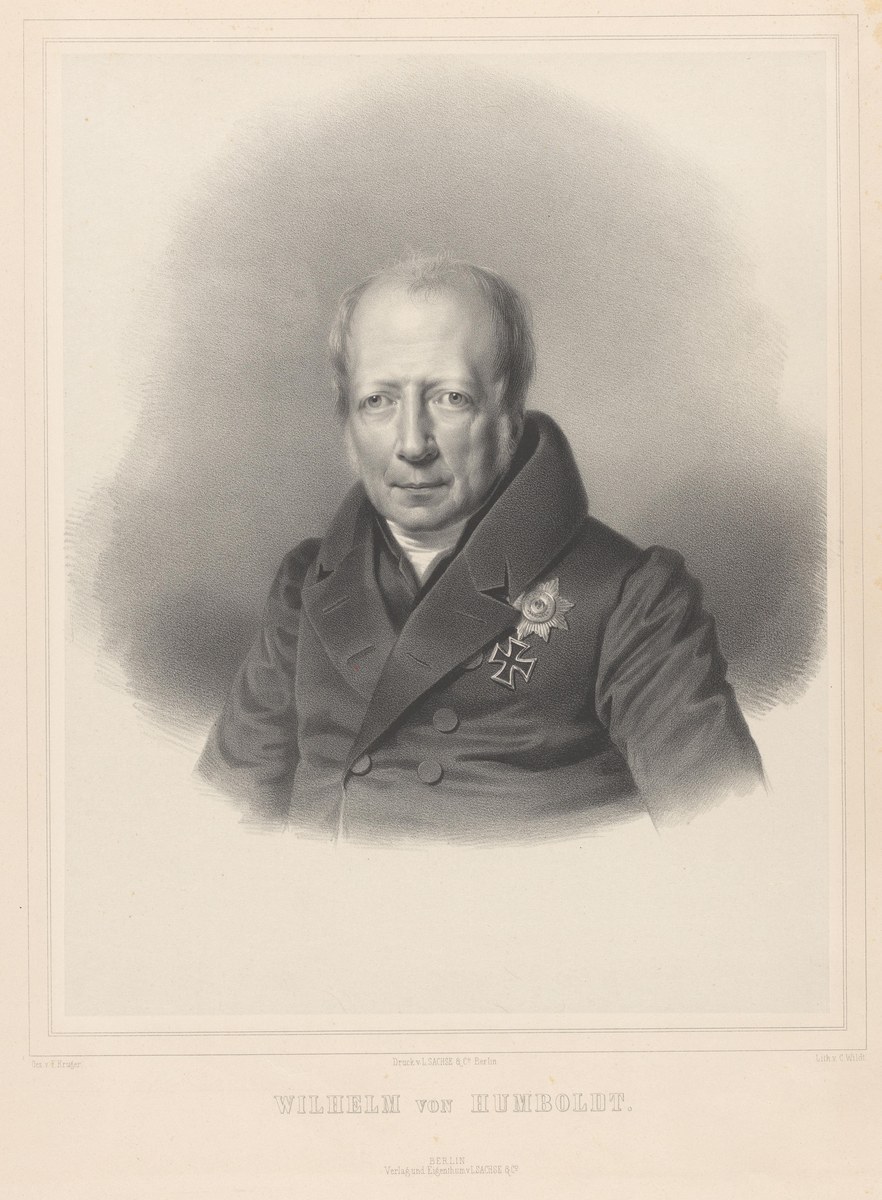
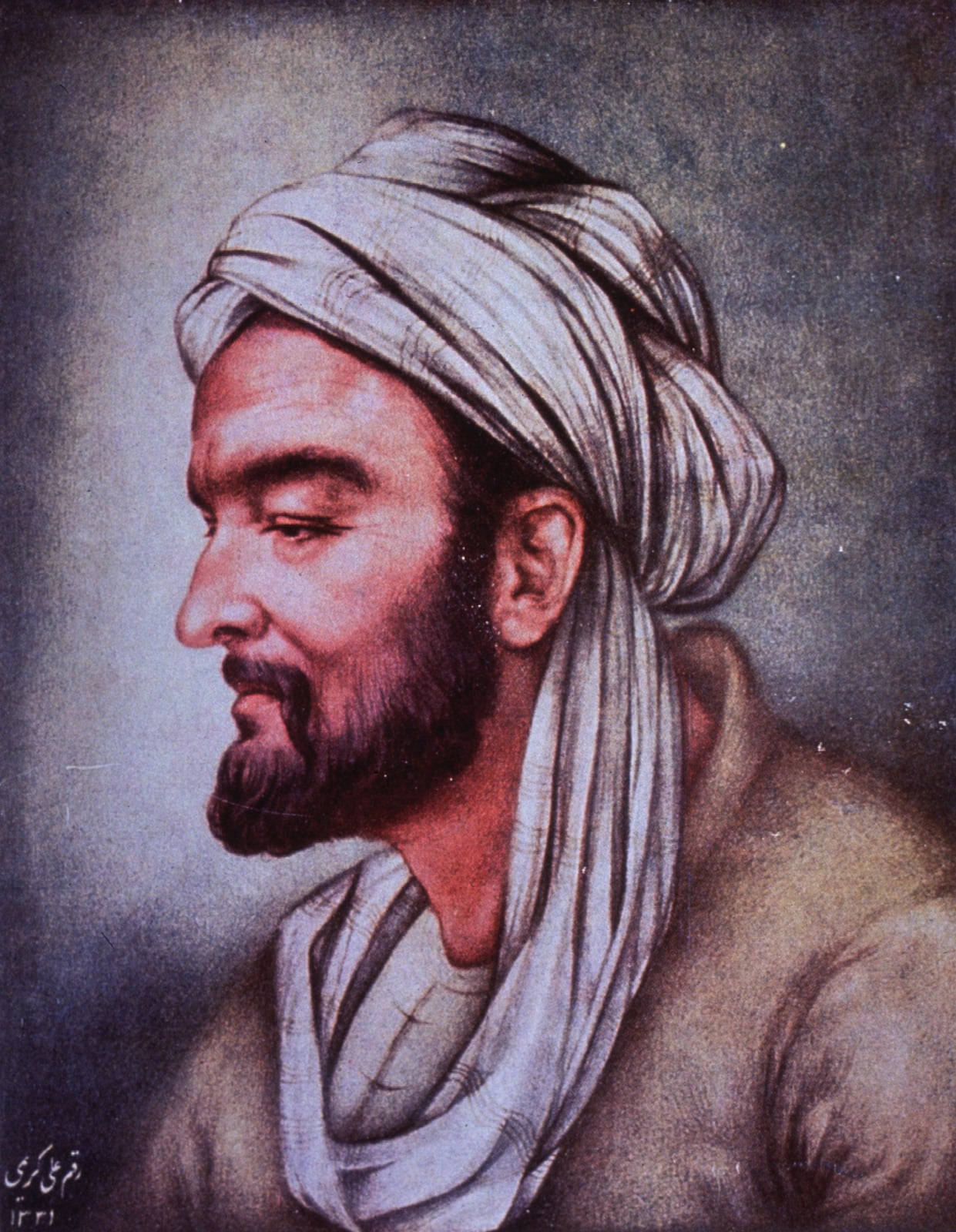
Carl Wildt after Franz Krueger, 'Portret van Wilhelm von Humboldt', lithograph, 1830-1860, Rijksmuseum, Amsterdam (RP-P-1903-A-23176), public domain · Lithographic portrait lettered 'WILHELM von HUMBOLDT.' by Carl Wildt after a drawing by Franz Krueger, printed by L. Sachse and Co., Berlin, made between 1830 and 1860; held by the Rijksmuseum, Amsterdam (RP-P-1903-A-23176). The museum scan (5,174 x 6,643 pixels) was cropped to the printed plate and lettering and downscaled once to 882 x 1,200 pixels; nothing was upscaled. Shown as a later print depiction, not as a documented sitting. · Public domain (Rijksmuseum Public Domain Mark; nineteenth-century lithograph)
철학자 · 19세기
빌헬름 폰 훔볼트
1767–1835
주요 업적 분야
아직 성격 매칭에 포함되지 않았습니다 — 기록된 근거가 성격 모델 전체를 다루기에는 충분하지 않습니다. 이 페이지의 다른 모든 내용은 자유롭게 확인하실 수 있습니다.
핵심 특성
주요 업적
언어철학자였던 그는 언어가 이미 있는 생각을 전달하는 수단이 아니라 사고를 형성하는 기관이라고 주장했고, 1820년에는 새로운 학문인 비교언어학의 구상을 제출했으며, 브리태니커는 언어에 대한 그의 학문적 기여가 20세기에 높이 평가받게 되었다고 전한다.
1809~10년 프로이센 내무부의 교육 담당 부서장으로서 그는 학교 제도를 개혁하고 교육과 연구를 결합한다는 구상 위에 베를린 대학(현 훔볼트 대학)을 세우는 데 중심적 역할을 했다. 대학은 그를 공동 창립자로 소개하며, 역사학자들은 이른바 '훔볼트 모델'이 훗날 그 혼자의 업적 이상으로 부풀려졌다고 지적한다.
여섯 대륙의 선교사, 외교관, 학자들로 이루어진 서신 교환망을 이용해 그는 여러 언어의 문법서와 어휘 목록을 모았고, 카위어 연구에서 남태평양 언어들이 오늘날 오스트로네시아어족이라 불리는 하나의 어족을 이룬다는 점을 보였다.
삶의 장면들
1820년 6월 그는 베를린 학술원에 새로운 학문인 비교언어학의 구상을 제출해 그 철학과 방법론, 그리고 연구 계획의 청사진을 제시했다.
이는 자료를 모으는 데 그치지 않고 한 분야의 일반적 틀을 세우려는 태도와 일치한다. 시스템적 사고
1794년부터 예나에 자리 잡은 그는 괴테와 실러의 철학적 조언자이자 비판적 협력자로 활동했으며, 스탠퍼드 철학 백과에 따르면 그의 비평은 실러의 『인간의 미적 교육에 관한 편지』와 괴테의 『헤르만과 도로테아』에 기여했다.
이는 다른 창작자들과 긴밀히 작업하며 비평으로 그들의 작업을 다듬는 모습과 일치한다. 협업 성향
전환점
1790년 프로이센 관직에 들어선 그는 그 자리가 의욕을 주지 못한다고 여겨 1791년 휴직하고, 이후 몇 해를 예나 부근에서 학문과 철학 연구에 쏟았다.
이는 이른 관직 경력보다 학문적 독립을 택하는 성향과 일치한다. 자율성 욕구
비슷한 인물
전체적인 프로필이 이 사람과 닮은 사람들이에요.
출처
- Wilhelm von Humboldt (Q77888), verified live via the Wikidata API (2026-11-06): label 'Wilhelm von Humboldt', description 'Prussian philosopher, government official, diplomat, and educator (1767-1835)', born 22 June 1767, died 8 April 1835, Korean label 빌헬름 폰 훔볼트. Orientation only; not used as support for any row.
- Stanford Encyclopedia of Philosophy, 'Wilhelm von Humboldt' (introduction and the life sections from education and early writings to the later linguistic writings read in full, about 5,500 words). CANONICAL SIGNIFICANCE SOURCE: gives his work across philosophy, literature, linguistics, anthropology and education; his role with Goethe and Schiller at Jena; his Basque and American-language studies; the 1809-10 reform of the Prussian education system and the founding of the University of Berlin on the principle of combining teaching and research; his Kawi work and the demonstration of the Austronesian family against Bopp; the 1820 plan for comparative linguistics and the idea of language as the 'formative organ of thought'. Admiring in tone (written by a Humboldt specialist) and notes that his linguistics was long ignored or partially appropriated.
- Encyclopaedia Britannica, 'Wilhelm von Humboldt' (public-web portion read in full, about 800 words). General-encyclopedia account: language scholar, philosopher and educational reformer whose contribution to the scientific study of language became highly valued in the twentieth century; chiefly instrumental in founding the Friedrich Wilhelm University at Berlin; his Basque studies and the unfinished Kawi work with its introduction on the diversity of language structure. Diplomatic and treaty service in the entry was read but is not scored.
- Humboldt-Universitat zu Berlin, University Library collections portal, 'Biografie, Wilhelm von Humboldt' (record read in full, about 400 words, in German). The university's own account: one of the co-founders (Mitbegruender) of the Berlin university, reform of Prussian education with Nicolovius and Suvern including the concept of the Berlin university and the new humanist Gymnasium, and the insight that language is a dynamic phenomenon (energeia). Holder record for the portrait search; its rights page requires contacting the library for digital copies, so none of its images is used.
- Ian F. McNeely, 'Wilhelm von Humboldt and the World of Languages', Ritsumeikan University journal, vol. 23 no. 2, pp. 129-148 (a historian's lecture article; the opening sections and the sections on Sanskrit, Indo-European and the Austronesian family were read, about 3,500 words of roughly 8,000; the remainder was not read). Independent historian's account: Humboldt as tireless empirical researcher who built a correspondence network of missionaries, merchants, diplomats and scholars on six continents and collected word lists and grammars; his work on Sanskrit, Basque and the Austronesian family; helped recruit Bopp and A. W. Schlegel to professorships. COUNTER-VOICE: notes that he regarded Indo-European languages as superior because of inflection, rejected the idea of Sanskrit as a divine or racial marker, and that his comprehensive ambition left his work misunderstood by the professional disciplines he helped to create.
- Oleg Morozov, 'Wilhelm von Humboldt and Berlin University: A New Look at the Origin of the Humboldt Myth', National Research University Higher School of Economics working paper WP BRP 134/HUM/2016 (first section and framing read, about 2,500 words of a 16-page paper). COUNTER-VOICE: summarises historians (Ash, Paletschek, Langewiesche, Tenorth and others) who find the 'Humboldt model' of the university contained little new and was never fully implemented, that Berlin was not Humboldt's brainchild alone (Fichte and Schleiermacher were involved) and that he headed the education section for about sixteen months from early 1809.
- Rijksmuseum, Amsterdam, print 'Portret van Wilhelm von Humboldt' (RP-P-1903-A-23176), lithograph by Carl Wildt after a drawing by Franz Krueger, printed by L. Sachse and Co., Berlin, 1830-1860; linked-art collection record read (Public Domain Mark on the image, CC0 on the data; title on object 'Wilhelm von Humboldt'). Holder record for the portrait.