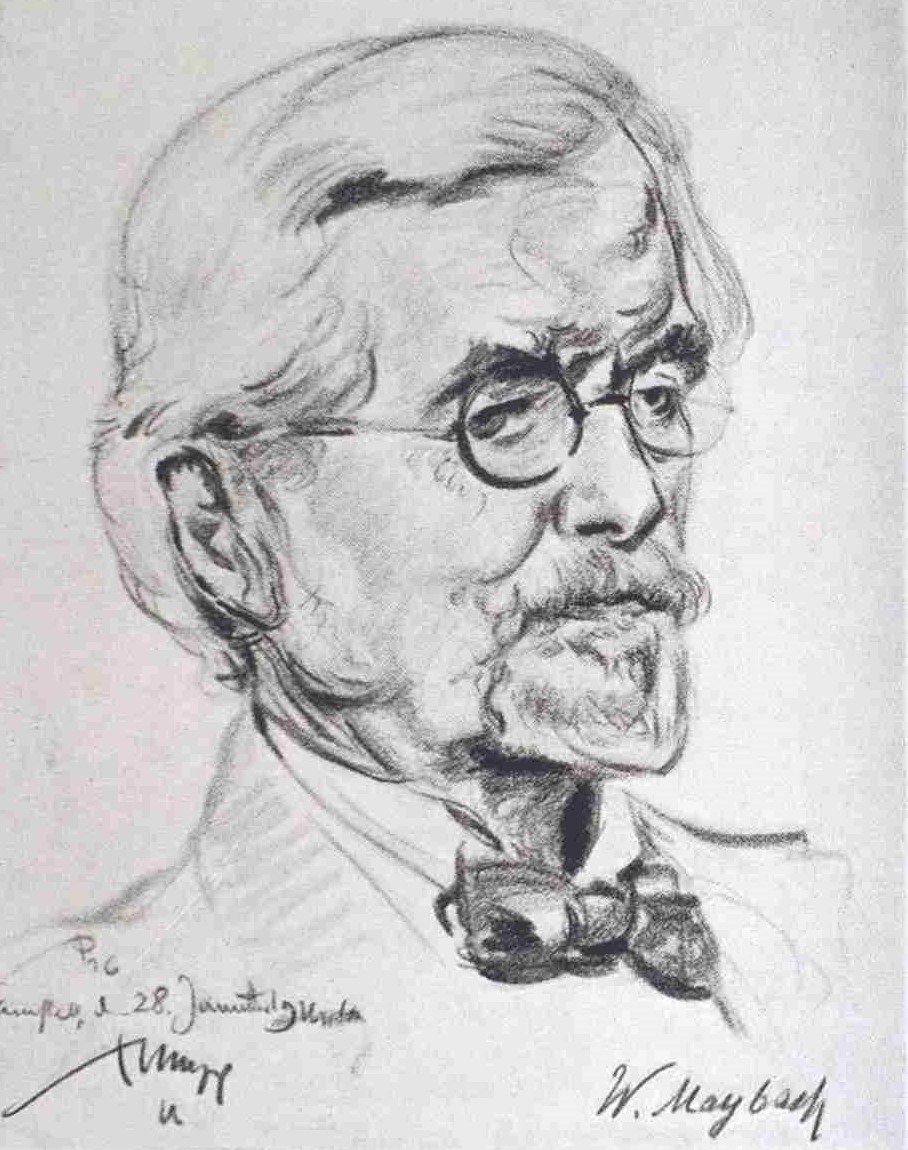

Emil Stumpp (1886-1941), 'Wilhelm Maybach', published in Koepfe in Schwaben, Stuttgarter Neues Tagblatt, 1926; Wikimedia Commons, Public domain · Emil Stumpp, 'Wilhelm Maybach', charcoal/crayon portrait drawing signed by the artist and by the sitter, published in 'Koepfe in Schwaben: Portraetskizzen von Emil Stumpp', Stuttgarter Neues Tagblatt, 1926 (Wikimedia Commons 'Emil Stumpp Wilhelm Maybach.jpg') · Public domain
공학자 · 19세기
빌헬름 마이바흐
1846–1929
주요 업적 분야
아직 성격 매칭에 포함되지 않았습니다 — 기록된 근거가 성격 모델 전체를 다루기에는 충분하지 않습니다. 이 페이지의 다른 모든 내용은 자유롭게 확인하실 수 있습니다.
핵심 특성
주요 업적
마이바흐는 1882년부터 칸슈타트의 다임러 작업장에서 가볍고 고속으로 도는 가솔린 엔진을 개발했다. 독일 특허청(DPMA)은 1884년의 수직 '벽시계(Standuhr)' 엔진이 작고 가벼우면서도 차량을 움직일 만큼 빠르게 돌았다고 설명하고, 독일인명사전(NDB)은 그가 커넥팅 로드, 크랭크축, 베어링, 밸브 기구를 새로 설계해 회전수를 분당 약 110회에서 900회로 끌어올렸다고 기록한다. 이 엔진은 1885년 '라이트바겐(Reitwagen)'이라 불리는 목제 이륜차를 움직였고, 속도는 시속 약 12km였다. 특허를 낸 사람은 다임러였기에, 두 사람의 공로를 어떻게 나눌지는 자료마다 견해가 다르다.
마이바흐는 1891~95년 자택과, 칸슈타트의 옛 호텔 헤르만의 연회장을 빌린 작업장에서 벨트 구동 장치, 2기통 피닉스(Phoenix) 엔진, 그리고 1893년의 분사 노즐식 기화기를 개발했다. NDB는 이 기화기가 널리 보급되었다고 하고, DPMA는 수십 년 동안 자동차 산업에서 쓰였다고 한다. 1904년의 윅스(Weeks)의 참고서도 이미 다임러 공장에 대한 그의 '유능한 도움'과 기화기를 언급했다.
1900년 마이바흐의 설계실(에른스트 뫼베스, 오이겐 링크, 알베르트 헤스 등)은 오스트리아 사업가 에밀 옐리네크의 주문으로 4기통 35마력 엔진과 기화기 2개를 갖춘 경주용 자동차를 만들었다. 옐리네크는 36대를 주문했고 딸의 이름을 따 '메르세데스'라고 불렀다. NDB는 벌집형 냉각기, 경합금 사용, 기어식 변속기를 꼽고, DPMA는 이 차가 현대 자동차의 기본 형태를 정했다고 평가한다. 이 차는 1901년 3월 니스 레이스 주간에서 선보였다.
1907년 DMG를 떠난 마이바흐는 1908년 체펠린 백작에게 아들 카를의 설계를 바탕으로 한 비행선 엔진을 제안하는 편지를 썼고, 1909년 3월 23일 비싱엔에 항공기 엔진 회사(Luftfahrzeug-Motorenbau)가 설립되었다. 첫 엔진은 카를이 직접 설계했으며(NDB), 1911년 체펠린 LZ 10 '슈바벤'호가 이 회사 엔진 3기를 달고 날았다. 이 회사는 훗날 마이바흐 모터렌바우가 되어 1921년 첫 자동차를 선보였다.
삶의 장면들
마이바흐는 다임러를 위해 자료를 조사하던 중, 왓슨이라는 영국인이 낸 특허에서 조절하지 않는 열관(hot-tube) 점화 방식을 발견했다. 메르세데스-벤츠 기록보관소는 이것이 더 높은 회전수를 얻는 데 중요한 조건이었다고 설명한다. 1883년 수평형 시험 엔진이 만들어졌고, 이어 수직형 '벽시계' 엔진이 나왔다.
기존 특허를 찾아 보고 시험 엔진으로 직접 검증한 일은 실험 정신과 부합한다. 다만 이 서술은 후속 회사의 기록보관소에서 나왔고, 왓슨 특허 자체는 확인하지 못했다. 실험 성향
마이바흐는 1889년 파리 만국박람회를 위해 자전거 제작 방식을 본뜬 차체, 통고무 타이어, 기어식 변속기, V형 2기통 엔진을 갖춘 사륜 '스틸 휠 카'를 만들었다. NDB에 따르면 그와 프랑스 라이선스 업체의 에밀 르바소르가 파리 거리에서 직접 몰았고, DPMA는 마차에 엔진을 얹는 대신 엔진을 중심으로 차량을 설계했다고 설명한다.
마차를 개조하는 대신 변속기, 차체, 타이어, 엔진을 하나의 차량으로 설계한 일은 시스템적 사고와 부합한다. 두 서술 모두 마이바흐에게 호의적이며, 다른 자료는 다임러의 지휘 몫도 함께 언급한다. 시스템적 사고
전환점
1903년 이후 DMG에서 입지가 약해지고 감독이사회 일부가 그의 퇴진을 원하자, 마이바흐는 1907년 4월 회사를 떠났다. NDB에 따르면 옐리네크의 지원도 소용이 없었다. 1908년 8월 체펠린 LZ 4호가 에히터딩겐에서 파괴된 뒤 그는 체펠린 백작에게 아들 카를의 엔진 설계를 제안했고, 이는 1909년 엔진 회사 설립으로 이어졌다. 이 회사는 마이바흐라는 이름을 비행선, 철도, 자동차 엔진으로 이어 갔다.
강제 퇴진을 1년 남짓 만에 새 고객에 대한 제안으로 바꾼 일은 기회 포착과 부합한다. 다만 엔진 설계 자체는 아들의 몫이었고, 1907년 퇴진에 대한 서술은 주로 NDB와 DPMA에 의존한다. 기회 감지
비슷한 인물
전체적인 프로필이 이 사람과 닮은 사람들이에요.
출처
- Wilhelm Maybach (Q77125) -- verified live through the Wikidata API (wbgetentities, 2026-10-08): en label 'Wilhelm Maybach', description 'German engine designer and industrialist (1846-1929)', born 1846-02-09 (Heilbronn), died 1929-12-29, citizenship Germany, ko label '빌헬름 마이바흐', P18 'Wilhelm-maybach-1900.jpg'. Orientation only.
- Hans Christoph Graf von Seherr-Thoss, 'Maybach, Wilhelm', Neue Deutsche Biographie 16 (1990), pp. 523-525, deutsche-biographie.de -- read in full: Bruderhaus training from 1861, Karlsruhe 1869, Deutz 1872-82 (surface carburettor, tube ignition, Otto engine to series production), Cannstatt 1883-88 (engine speed raised from 110 to 900 rpm, Veloziped 1885, boat 1886, the 1889 steel-wheel car), the Hotel Hermann workshop 1892-95, the 1895 return as technical director, the 1900 35 hp car built with a named team, the conflicts that led to his 1907 departure, and the 1908-09 offer to Count Zeppelin. INDEPENDENT SCHOLARLY biographical dictionary entry (non-self; credits Maybach with most of the design work, so it leans toward his side of the Daimler priority question).
- Karl Maybach, 'Maybach, Karl', Neue Deutsche Biographie 16 (1990), p. 525, deutsche-biographie.de -- read for the 1908 Echterdingen episode and the founding of Luftfahrzeug-Motorenbau (the father offered Count Zeppelin an airship engine developed from his son's new design; the son designed the first airship engine himself). INDEPENDENT SCHOLARLY entry (non-self); important as a limit: it attributes the Zeppelin engine design to Karl, not Wilhelm.
- Deutsches Patent- und Markenamt (DPMA), 'Wilhelm Maybach - The father of the modern automobile', Milestones/Automobiles: The beginnings, text by Jan Bjorn Potthast (last updated 10 December 2025) -- read in full, with the patent numbers it cites. GOVERNMENT PATENT-OFFICE perspective (non-self; independent of the Mercedes-Benz successor company; celebratory in tone and states its own 'father of the modern automobile' framing, which is not used as evidence).
- Mercedes-Benz Classic public archive (M@RS), 'Wilhelm Maybach' biography (Mercedes-Benz Group) -- read in full: the most detailed dated chronology (Bruderhaus, the April 1882 contract and the promised 30,000-Mark share, the Watson patent found during research, the 1889 steel-wheel car, the February 1891 departure, the Hotel Hermann ballroom funded by Daimler, the November 1895 return, the 1900-01 first Mercedes, the post-1903 loss of position, April 1907 departure, 1909 Zeppelin engine company). CORPORATE successor-company perspective (not independent).
- Susanne Eckelmann, 'Wilhelm Maybach 1846-1929', LeMO Lebendiges Museum Online, Deutsches Historisches Museum (2014) -- read in full as a dated chronology (training, Deutz, Cannstatt, the 1889 Paris steel-wheel car, the 1890-95 separation from the DMG, the 1900 car for Jellinek, the 1907 departure, honours). INSTITUTIONAL museum perspective (non-self; summary level; its note on a son's illness is not used).
- European Route of Industrial Heritage (ERIH), 'Wilhelm Maybach (1846-1929)' biography page -- read in full: short overview. INSTITUTIONAL heritage-network perspective (non-self; summary; it says Maybach designed the Phoenix engine 'with Daimler and his son Paul', which differs from the other sources and is not used).
- 'The Late Dr. W. Maybach', Engineering, 10 January 1930, as transcribed on Grace's Guide (Wilhelm Maybach page) -- read in full: contemporary trade-press obituary written days after his death. PERIOD PRESS perspective (non-self; short and partly inaccurate: it places the Maybach works at Ludwigshafen and dates events loosely, so only its broad pattern -- Deutz, tube ignition claimed for him, jet carburettor, Mercedes, 1907 retirement, Zeppelin link -- is used, never a date).
- Lyman Horace Weeks, Automobile Biographies (New York: The Monograph Press, 1904), the Daimler chapter's passage on Maybach, Internet Archive full text (automobilebiogra00weekrich) -- read: contemporary American reference book that mentions 'the able assistance of William Maybach' and the aspirating carburettor. CONTEMPORARY foreign perspective (non-self; one short passage only).
- MTU Friedrichshafen press release, 'Chronicle of a Century of Engines' (10 March 2009) -- read: the 1908 letter from Wilhelm Maybach to Count Zeppelin about an engine design by his son Karl, the founding of Luftfahrzeug-Motorenbau on 23 March 1909, the Type AZ engine and the LZ 10 Schwaben (1911). CORPORATE successor-company perspective (not independent).