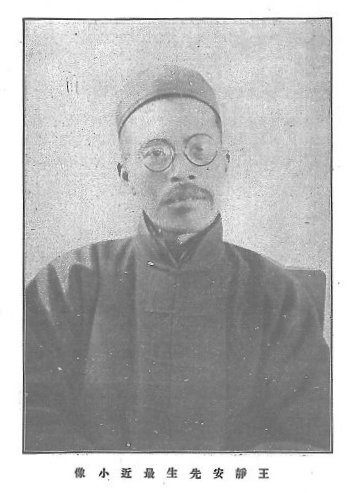
Photographer unknown, Wang Guowei, photograph reproduced in the Wang Jing'an memorial number, Tsinghua School Research Institute, 1927-28, public domain · Photographic portrait of Wang Guowei reproduced as a plate captioned 'Wang Jing'an xiansheng zuijin xiaoxiang' (Mr Wang Jing'an, recent small portrait; Jing'an is his courtesy name) in the Wang Jing'an memorial number published by the Tsinghua School Research Institute; Wikimedia Commons attributes the scan to that memorial issue and dates the photograph to before June 1927, and the issue of Guoxue luncong vol. 1 no. 3 that carries Liang Qichao's preface is dated April 1928 on Chinese Wikisource. The photographer is not named. The image is used at its original 357 x 493 pixels (a plate scan; nothing was resized or upscaled). Caveats: the holder of the scan is not identified (the Commons page gives no URL or library record), the exact issue year of the plate is taken from Commons' attribution to the memorial number, and the basis is publication in China in 1927-1928, well before 1931, not a Commons tag. Shown as a published photograph of the sitter, identified by the plate caption. · Public domain (photograph published in China in 1927-1928)
학자 · 20세기
왕궈웨이
1877–1927
주요 업적 분야
아직 성격 매칭에 포함되지 않았습니다 — 기록된 근거가 성격 모델 전체를 다루기에는 충분하지 않습니다. 이 페이지의 다른 모든 내용은 자유롭게 확인하실 수 있습니다.
핵심 특성
주요 업적
갑골문과 청동기 명문을 옛 문헌과 함께 읽어 중국 고대사 연구에 새 토대를 놓았으며, 그 성과는 직접 엮은 《관당집림》에 모여 있고, 칭화대학은 그를 20세기 중국 학술에서 가장 영향력 있는 대가의 한 사람으로 꼽는다.
문학비평에서는 《홍루몽 평론》(1904)과 《인간사화》(1908)로 서양 미학을 중국 문학 연구에 적용하고 '경계설'을 제시했으며, 1913년에는 송·원 희곡의 역사를 다룬 《송원희곡사》를 완성했다.
1925년부터 1927년까지 칭화학교 연구원 국학문의 지도교수로서 고대사와 청동기 명문을 가르쳤고, 몽골 및 요·금 시기 사료의 교주 작업을 했다.
삶의 장면들
1909년에 낸 송대부터 청대까지의 희곡 목록 《곡록》은 3천 가까운 제목을 실었고, 1923년 후스는 잘못 분류되었거나 빠진 작품을 짚으며, 그 뒤 새로 나온 희곡 자료를 반영해 왕궈웨이가 개정해 주기를 바랐다.
이는 한 동시대 비평가가 보여 주듯, 꼼꼼하지만 오류가 없지는 않은 대규모 목록 작업과 부합한다. 디테일 지향
칭화 연구원의 동료였던 량치차오는 1927~28년에, 왕궈웨이가 조금이라도 확신이 서지 않는 결론은 글로 남기지 않았고 앞사람이 이미 한 말은 버렸다고 썼다.
이 호의적인 동료의 증언은 증거를 신중하게 스스로 점검하는 태도와 부합한다. 분석적 엄밀성
전환점
제자 우치창에 따르면 그는 1909년경부터 문학비평과 쇼펜하우어에 기댄 미학을 접고 고대사와 금석문 연구로 방향을 틀어 뤄전위의 갑골 자료 출간을 도왔으며, 그러면서도 1913년에 희곡사를 마무리했다.
이는 옛 작업을 마무리하면서 새로운 분야로 연구를 옮겨 가는 태도와 부합한다. 적응력
비슷한 인물
전체적인 프로필이 이 사람과 닮은 사람들이에요.


아리스토텔레스

에이다 러브레이스

라빈드라나트 타고르

이븐 할둔

이븐 시나
출처
- Wang Guowei (Q707376), verified live via the Wikidata API (2026-11-05): label 'Wang Guowei', description 'scholar, writer and poet from China (1877-1927)', born 1877, died 2 June 1927, Korean label 왕궈웨이. Orientation only; not used as support for any row.
- Tsinghua University, 'Walking into the exhibition Du shang gao lou (Alone on the high tower) and getting close to the master Wang Guowei' (Tsinghua University Art Museum, 15 March 2018; page read in full, in Chinese). CANONICAL SIGNIFICANCE SOURCE: presents him as one of the most influential masters of twentieth-century Chinese scholarship, a tutor at the Tsinghua Research Institute of Chinese Studies from 1925 to 1927, who joined Western philosophy and aesthetics with Chinese tradition and then turned to drama and ci, ancient history, paleography, archaeology, Dunhuang studies and frontier studies, with more than sixty works and the self-edited collections Jingan wenji and Guantang jilin.
- Encyclopaedia Britannica, 'Wang Guowei' (entry read in full, about 600 words). Dated career facts: failed the 1893 provincial examination, joined Luo Zhenyu's Dongwen Learning Society in 1898, chief editor of Jiaoyu shijie in 1901, self-directed reading of Western philosophy and literature after returning from Japan, Hongloumeng pinglun (1904), Renjian cihua (1908, the 'theory of realm'), Song-Yuan xiqushi (finished January 1913), tutor at Tsinghua from 1925; its assessment of his influence on Chinese historiography and literary scholarship.
- Wu Qichang, 'Wang Guowei xiansheng shengping ji qi xueshuo' (Life and teachings of Mr Wang Guowei), a lecture published in Fengtu shizhi 1(1), September 1943, as transcribed on Chinese Wikisource (about 7,500 characters read in full, in Chinese). Account by a former Tsinghua student: three phases of work (philosophy, literary criticism and drama history; ancient history and inscriptions from about 1909; Mongol, Liao-Jin history and northwest geography from the mid-1920s), his study under Luo Zhenyu's patronage, the Tsinghua teaching and the courses he gave; admiring and retrospective. The political and death passages were read but not used.
- Liang Qichao, preface to the Wang Jing'an memorial number of Guoxue luncong (vol. 1, no. 3, April 1928; written winter 1927), as transcribed on Chinese Wikisource (about 1,000 characters read in full, in Chinese). Contemporary colleague at the Tsinghua Institute describing the scope of his work (oracle-bone readings, the history of Song-Yuan drama, Shuijing zhu collation, Mongol sources), his method and his habit of not writing down what he was not sure of; admiring in tone, and the passages on his death were not used.
- Hu Shih, 'Du Wang Guowei xiansheng de Qulu' (Reading Mr Wang Guowei's Qulu), Dushu zazhi no. 7, 4 March 1923, as transcribed on Chinese Wikisource (about 1,400 characters read in full, in Chinese). COUNTER-VOICE: a contemporary scholar's review of Wang's 1909 catalogue of Song-to-Qing drama (about three thousand titles) that lists misclassified works and omissions, notes how much new drama material had appeared in the fourteen years since publication, and asks Wang to revise it.