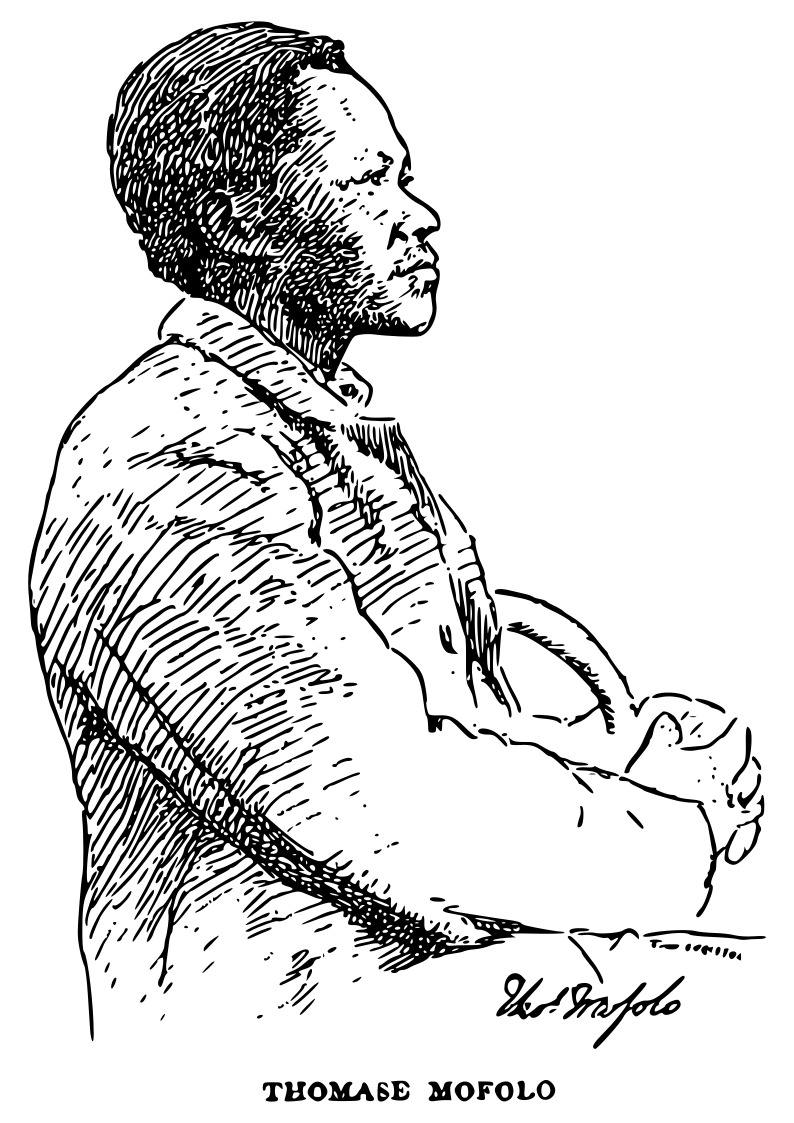

Frederic Christol (1850-1933), 1911, in L'art dans l'Afrique australe, Berger-Levrault, Paris. Scan: Smithsonian Libraries (https://doi.org/10.5479/sil.244705.39088000226712) · Line-drawn portrait sketch of Thomas Mofolo, captioned 'Thomase Mofolo' and showing his signature, by Frederic Christol, published on page 42 of L'art dans l'Afrique australe: impressions et souvenirs de mission (Berger-Levrault, Paris, 1911), as scanned by the Smithsonian Libraries (DOI 10.5479/sil.244705.39088000226712) and shared on Wikimedia Commons. The book's text names the sitter as the teacher and author of Moeti oa bochabela. The file is the scan's 794 x 1123 pixel image converted from PNG to JPEG with no resizing, cropping or upscaling. It is a contemporary drawing, not documented as made from life. · Public domain (published 1911; the Smithsonian Libraries record states CC0 1.0 and 'No Copyright - United States')
작가 · 20세기
토머스 모폴로
1876–1948
주요 업적 분야
아직 성격 매칭에 포함되지 않았습니다 — 기록된 근거가 성격 모델 전체를 다루기에는 충분하지 않습니다. 이 페이지의 다른 모든 내용은 자유롭게 확인하실 수 있습니다.
핵심 특성
주요 업적
레소토의 소토어 작가로, 『모에티 오아 보차벨라』(1907), 『피트셍』(1910), 『차카』(1925)는 브리태니커가 남부 소토어 최초의 서구식 소설로 꼽는 작품이다.
줄루 왕 샤카를 다룬 역사 소설 『차카』는 전승 기록을 꼼꼼히 연구해 쓴 작품으로 그의 명성의 토대가 되었다. 그가 일하던 선교 서점의 선교사들이 출간을 미룬 끝에 1925년에 나왔고, 1931년 영어로 번역되었다.
첫 소설의 성공은 다른 젊은 교사들이 소설 쓰기에 도전하도록 이끌어 사하라 이남 아프리카 최초 수준의 문학 운동 가운데 하나를 열었다고 평가된다.
삶의 장면들
『차카』는 그가 모리자 서점에서 일하던 시기에 쓰였으나, 이교 관습을 비판하지 않은 점을 우려한 선교사들이 수년간 출간을 미루었고 1925년에야 나왔다.
이는 선교 고용주가 기대한 도덕적 틀을 따르지 않은 작가의 면모와 일치한다. 독립적 사고
한 선교사 동료는 훗날 모폴로가 줄루 왕에 관한 전승 기록을 꼼꼼히 연구한 뒤 『차카』를 썼으며 이 작품이 단순한 연대기가 아니라고 적었다.
이는 역사 자료를 먼저 조사한 뒤 소설로 빚어낸, 기량을 중시한 작가의 면모와 일치한다. 숙련 지향
전환점
마지막 책인 『차카』 이후 그는 글쓰기를 멈추었고, 1910년부터 가르치며 목공을 배운 뒤 광산 일과 노동자 모집, 제분소(1916년경), 상점(1928) 등 사업에 나섰으나 재정 손실과 건강 악화로 끝났다.
이는 이후 직접 사업을 벌였으나 성과가 엇갈린 작가의 이력과 일치한다. 선제적 행동력
비슷한 인물
전체적인 프로필이 이 사람과 닮은 사람들이에요.


쿠사마 야요이

그레이스 호퍼

프리다 칼로

마크 트웨인

볼프강 아마데우스 모차르트
출처
- Thomas Mokopu Mofolo (Q1452076), verified live via the Wikidata API (2026-11-04): English label 'Thomas Mokopu Mofolo', description 'Lesotho novelist (1876-1948)', no Korean label, born 22 December 1876, died 8 September 1948, citizenship Lesotho. Orientation only; not used as support for any row.
- Encyclopaedia Britannica, 'Thomas Mokopu Mofolo' (encyclopaedia biography by the editors), read in full. CANONICAL SIGNIFICANCE SOURCE: first important writer from what is now Lesotho, who created the first Western-style novels in the Southern Sotho language; teacher's certificate from the Morija missionary training college in 1898; worked at the Sesuto Book Depot there for more than a decade as manuscript reader, proofreader and secretary, taught elsewhere and contributed to the mission newspaper Leselinyana; Moeti oa Bochabela (1907) is an allegory, Pitseng (1910) a Christian fable whose hero sees white people betray their religion's promise, and Chaka (1925) the classic on which his reputation rests, presenting the Zulu king Shaka as a fully realized tragic character some critics liken to Macbeth; its publication was delayed 15 years by missionaries at the depot who were disturbed by his failure to condemn pagan tribal customs; discouraged, he gave up writing and worked at business ventures, was reduced to financial straits by business losses and suffered a stroke in 1941. Neutral encyclopaedia entry.
- Encyclopedia of World Biography (Gale), 'Thomas Mofolo' (reference biography, via Encyclopedia.com), read in full: Lesothoan writer whose historical novel Chaka encouraged a vernacular literary movement in South Africa; educated in Paris Evangelical Missionary Society schools; while he worked at the Morija book depot missionaries encouraged him to write what became the first novel in Southern Sotho, Moeti oa bochabela (1907), a conversion story interwoven with traditional myths and praise poems, whose success prompted other young teachers to try fiction and so launched one of the earliest literary movements in sub-Saharan Africa; Pitseng (1910) offers perceptive descriptions of mores and a 'by no means encomiastic' appraisal of Christianity's influence on marriage customs; Chaka is called the earliest major contribution of black Africa to modern world literature, a tragedy of overweening ambition; the missionaries were reluctant to publish it for its pictures of pre-Christian life; he then became a labour agent for the Transvaal mines and Natal plantations, bought a store in Lesotho after 1927, acquired a South African farm in 1937 from which he was evicted under the Bantu Land Act, and returned to Lesotho in 1940 sick, dying in 1948. Reference biography; the praise is strong and unattributed.
- E. W. Smith, 'Thomas Mofolo', Notes and News, Africa: Journal of the International African Institute, vol. 19 no. 1 (January 1949), pp. 67-68, read in full: obituary by a missionary-scholar who first met Mofolo when teaching at Morija and calls him one of his students; gives his schooling (Masitisi mission school, Morija Bible School and Normal School, teachers' certificate 1899), work as proof-reader at the Morija Book Depot, teaching at Maseru, going in 1910 to the institution at Leloaleng to teach and learn carpentry, then mining at Johannesburg and labour recruiting (first for the Eckstein group, then freelance), a mill started at Teyateyaneng as early as 1916 and a trading store at Bokong in 1928, a farm in the Matatiele district that he found difficult to run under the Land Acts, and long ill health; says Chaka was written after careful study of the traditional accounts of the Zulu king but is no mere chronicle, that it was translated into English by F. H. Dutton and published by the International African Institute in 1931, and that Mofolo reportedly began a study of Moshoeshoe whose manuscript was lost or destroyed (Smith relays this as hearsay). Near-contemporary obituary by a colleague of the mission world; sympathetic and partly second-hand.
- 'Thomas Mofolo', page on the Pitzer College 'New African Movement' website (unsigned on the page; critical essay quoting Daniel P. Kunene), read in full: calls Mofolo a great stylist whose first novel shows poetic power; argues that his picture of African traditional societies as heathen darkness derived from his ideological alignment with Christian civilisation rather than from historical actuality, while also pointing out that he was ambivalent about modernity, quoting a passage of Pitseng that says courtship has become a plaything and that the old days were wiser about marriage; ends with Kunene's remark that on only three published books he is counted among the great writers of the world. Critical, independent voice that supplies the counter-reading of his Christian stance; it is an interpretive essay and uses the novels' text as evidence.
- Thapelo Mokoatsi, 'Thomas Mokopu Mofolo: A pioneer of Sesotho literature', The Journalist (South Africa, 17 February 2015), read in full: says Chaka remains one of the most widely read Sesotho books and has been translated into several languages; says Moeti oa bochabela, the first Sotho novel, resulted from his missionary employers' encouragement at the Sesotho Book Depot in Morija where he was manuscript reader, proofreader and secretary; says some missionaries feared the celebration of African culture in Chaka would drive Africans back to 'Satan'; quotes a 2010 paper by Bouteldja Riche praising his handling of Chaka's childhood and growth; much of the text restates encyclopaedia entries and it gives 1906 for the serialisation start where others give 1907. Popular regional press; derivative, used only for the missionary reaction and as a second voice on Chaka's reception.
- R. C. Lutz, 'Thomas Mofolo', EBSCO Research Starters (2024), read in full: reference biography with a bibliography of Kunene, Gerard, Ayivor and Swanepoel; says Mofolo served the Reverend Alfred Casalis at Morija's Bible school, press and book depot, wrote Moeti oa bochabela there (serialised in Leselinyana from 1 January 1906), serialised Pitseng from 1909 to March 1910, probably finished the manuscript of Chaka by 1909 (published 1925), later worked as a labour-recruitment agent, ran a postal route and a trading house, bought a farm in 1933 that was seized under the 1913 Native Land Act after he lost his legal appeals, and had a stroke in 1941. Several dates and the account of his later years differ from Smith and Britannica, so only the points they agree on are used here; the article also repeats an unsourced personal allegation that is not used. Reference biography; shows how unsettled the dates are.
- Corinne Sandwith, 'History by Paratext: Thomas Mofolo's Chaka', Journal of Southern African Studies 44(3), 2018, pp. 471-490 (abstract read via EconPapers; article is subscription-only and was not read): scholarly abstract stating that Chaka was first published in Sesotho in 1925 by the Morija Sesuto Book Depot under the Paris mission society, was translated into several languages including English, French and German, and has taken four lineages (mission text, English colonial text, French colonial production, post-colonial text). Abstract only; used for the publication and translation history.
- Frederic Christol, 'L'art dans l'Afrique australe: impressions et souvenirs de mission' (Paris: Berger-Levrault, 1911; Smithsonian Libraries scan, full text opened on the Internet Archive), p. 42 read: contemporary missionary account that names 'Thomase Mafolo', teacher in the mission's Bible school, as a highly developed African author who 'recently' published a small, very poetic novel, Moeti oa bochabela, somewhat akin to Bunyan's Pilgrim's Progress; the same page carries the portrait sketch captioned 'Thomase Mofolo'. Primary contemporary source by a mission colleague; short mention only.