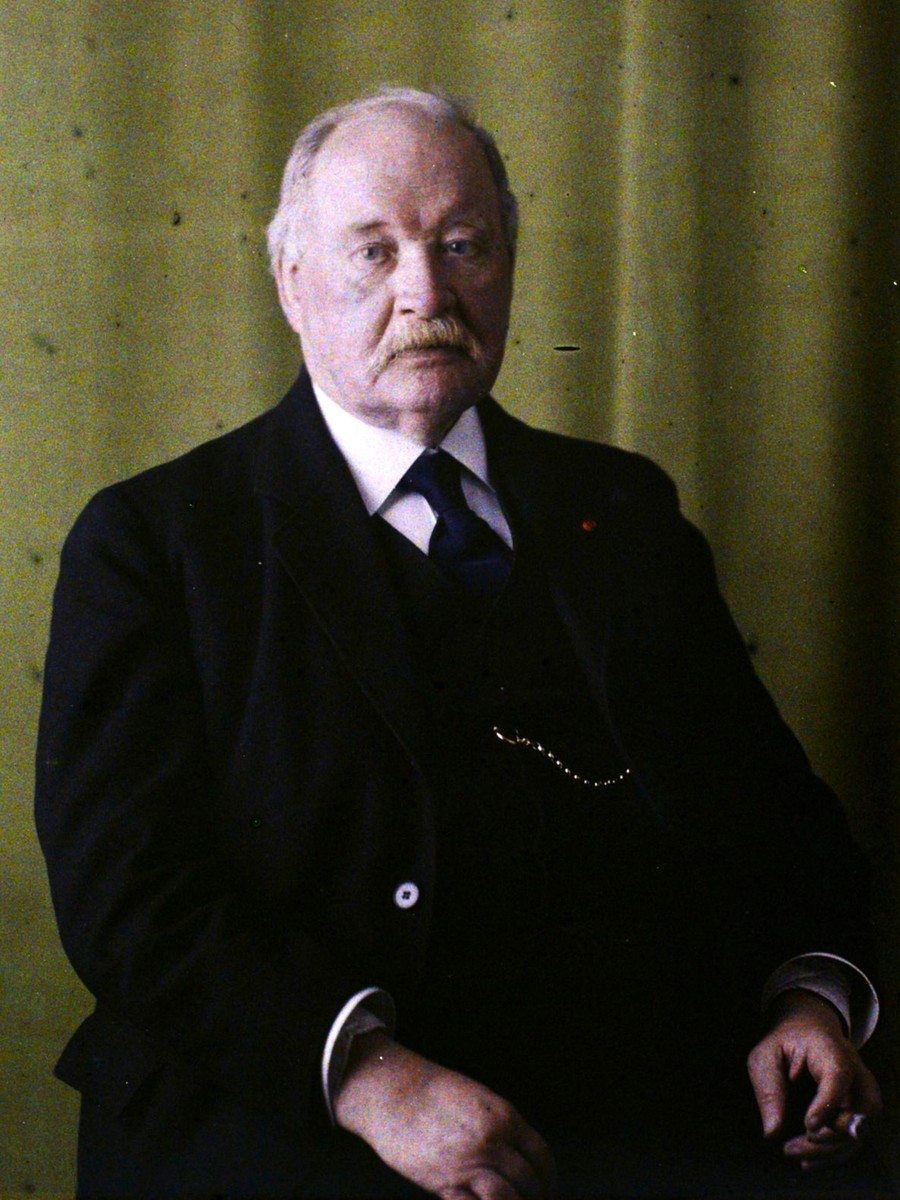

Auguste Leon, Albert Kahn Museum, Archives of the Planet, 10 May 1922, public domain (CC-00) · Autochrome photograph of Svante Arrhenius taken by Auguste Leon on 10 May 1922 at Albert Kahn's property in Boulogne, France (Archives of the Planet, Albert Kahn Museum, Hauts-de-Seine departmental collections, inventory A31436). The collection page states the licence as freely reusable (CC-00, public domain), the operator and the date; the Commons file '1922 Svante Arrhenius.jpg' carries a public-domain tag. Original download 1186 x 1582, reduced (downscaled only) to 900 x 1200. Caveat: the collection title names him 'Monsieur Svante Arrhenius' but the on-plate note spells the name differently; identity rests on the museum's own title. · Public domain (CC-00, Albert Kahn Museum)
화학자 · 19세기
스반테 아레니우스
1859–1927
주요 업적 분야
아직 성격 매칭에 포함되지 않았습니다 — 기록된 근거가 성격 모델 전체를 다루기에는 충분하지 않습니다. 이 페이지의 다른 모든 내용은 자유롭게 확인하실 수 있습니다.
핵심 특성
주요 업적
1884년 박사 논문에서 물에 녹은 염이 전하를 띤 이온으로 분리된다고 제안했으며, 이 이론은 웁살라 교수진에게는 인정받지 못했으나 10년이 넘는 논쟁 끝에 1903년 노벨 화학상을 안겨 주었다.
1889년 온도가 반응 속도에 미치는 영향을 연구하여 에너지가 높은 활성화된 분자만 반응한다고 제안했으며, 이것이 활성화 에너지 개념과 그의 이름을 딴 방정식의 바탕이 되었다.
1896년 대기 중 이산화탄소 변화가 지표 온도에 미치는 영향을 계산해 두 배 증가 시 5~6도 상승을 추정했으며, 동시대 학자들은 대체로 이를 받아들이지 않았으나 20세기 후반에 다시 주목받았다.
삶의 장면들
1884년 논문이 최하 합격 점수를 받자 그는 논문을 인쇄해 클라우지우스, 반트호프, 오스트발트에게 보냈고, 오스트발트는 그를 만나러 웁살라까지 찾아왔다.
이는 학내의 냉담한 평가를 받은 뒤에도 외부의 판단을 구하며 밀고 나가는 태도와 부합한다. 끈기
그는 수십 년간 발터 네른스트의 노벨상에 이의를 제기했고 방법론을 두고 파울 에를리히와 다투었으며, 한 역사가는 그가 논쟁 속에서 오히려 힘을 얻는 것 같았다고 설명한다.
이는 공개적인 학문적 갈등에 대한 높은 내성과 부합한다. 갈등 감내
전환점
1905년 베를린의 교수직 제안을 거절하고 스톡홀름에 새로 생긴 노벨 물리화학연구소의 소장이 되었으며, 스웨덴 안팎의 연구자들이 그와 함께 일하러 왔다.
이는 해외의 명망 높은 자리보다 자국의 독립적인 거점을 택하는 선택과 부합한다. 자율성 욕구
비슷한 인물
전체적인 프로필이 이 사람과 닮은 사람들이에요.


에이다 러브레이스

라빈드라나트 타고르

마야 안젤루

마이모니데스

앨런 튜링
출처
- Svante Arrhenius (Q80956), verified live via the Wikidata API (2026-10-24): label 'Svante August Arrhenius', description 'Swedish astronomer, chemist and physicist (1859-1927)', born 1859-02-19, died 1927-10-02, Korean label in Hangul. Orientation only; not used as support for any row.
- Nobel Prize in Chemistry 1903, Award Ceremony Speech by Dr. H.R. Tornebladh, President of the Royal Swedish Academy of Sciences (NobelPrize.org), read in full. CANONICAL SIGNIFICANCE SOURCE: explains that Arrhenius's electrolytic dissociation theory (salts split into charged ions in solution) put the relation between electricity and chemical affinity on a quantitative footing, that it was little understood at his 1884 doctorate, that acceptance took a struggle of more than ten years and many experiments, and that van't Hoff's theory depended on his. Award-body speech: admiring and retrospective.
- Svante Arrhenius, Biographical (NobelPrize.org, 1903 Nobel Prize in Chemistry), read in full: education and thesis (1884), reception by the Uppsala faculty versus Pettersson and Ostwald, the first docentship in physical chemistry in Sweden, study visits with Ostwald, Kohlrausch, Boltzmann and van't Hoff, declining a Giessen chair in 1891, professorship and rectorship at Stockholm, the Nobel Institute for Physical Chemistry from 1905, textbooks and popular books, interests in the CO2 climate effect, panspermia and the northern lights, Royal Society election and medals. Official biography; factual and admiring.
- Complete Dictionary of Scientific Biography entry 'Arrhenius, Svante August' (Encyclopedia.com), read in full: the original entry by H. A. M. Snelders (thesis, the 1889 paper on the temperature dependence of the inversion of cane sugar and the activation-energy idea, cosmic physics, the 1896 carbonic acid memoir) and the new supplement by Sverker Sorlin, which draws on Elisabeth Crawford's 1996 biography and is more critical: describes his career worries, the modest Uppsala assessment of his dissertation, Ostwald and van't Hoff rescuing his career, a later 'countermyth' of undiscovered genius, his expansive and polemical style, the quarrels with Nernst and Ehrlich, the short-lived or whimsical ideas such as panspermia, and the almost nil reception of the greenhouse paper until 1938. Independent historians; includes critical judgements. Private-life passages (marriages, divorce, custody) were read but excluded.
- 'Svante August Arrhenius', Encyclopedia of World Biography (Gale, via Encyclopedia.com), read in full: thesis granted the lowest passing grade, Ostwald and others as supporters, election to the Swedish Academy of Sciences 'with strong opposition' and professorship 'over strong objections', first Swede to win the chemistry Nobel Prize, the Debye-Hueckel modification of his strong-electrolyte views in 1923, and his spread into immunochemistry, cosmic physics and a proposed universal language. General reference biography.
- Spencer Weart, 'The Discovery of Global Warming: The Carbon Dioxide Greenhouse Effect', section on Arrhenius and Chamberlin (AIP Center for History of Physics), read: Arrhenius's 1896 laborious numerical computation (halving CO2 could lower European temperature by 4-5 C; doubling would raise it 5-6 C), his reliance on Hogbom's estimates, his view that warming was not a problem and far from his main point about the ice ages, the 1908 book revision, and the reasons contemporary experts dismissed the calculation as oversimplified. Institutional history of science; critical of both the model and the claim that he discovered global warming.
- Albert Kahn Museum, Archives of the Planet (Hauts-de-Seine departmental collections), autochrome record 'Monsieur Svante Arrhenius', inventory A31436, operator Auguste Leon, 10 May 1922, with the collection page's licence line 'freely reusable (CC-00), public domain', and the Wikimedia Commons file '1922 Svante Arrhenius.jpg', checked for the portrait only.