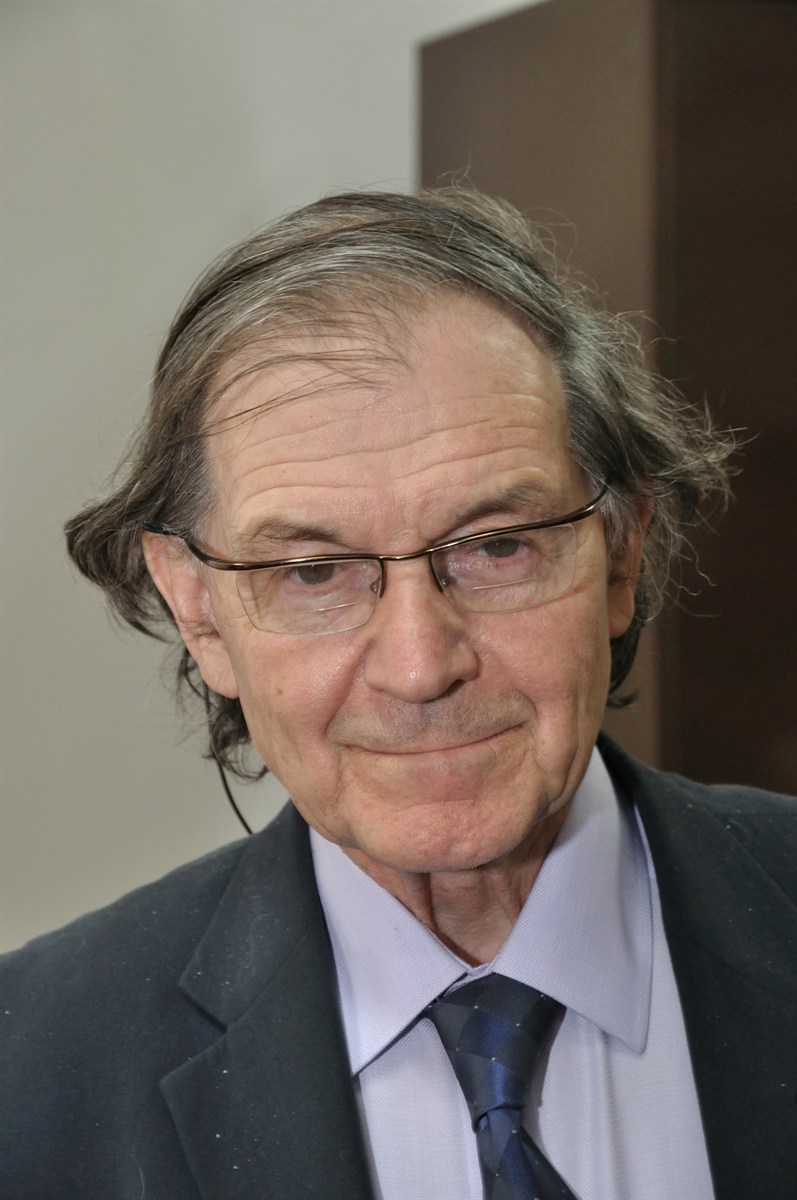

Photo: Biswarup Ganguly, 2011, CC BY 3.0 · Wikimedia Commons, 'Roger Penrose 9558.JPG' -- photograph by Biswarup Ganguly, taken 7 January 2011 (the photographer's sibling files of that date are named for Science City, Kolkata) and uploaded to Commons by the photographer himself ('Own work', 10 January 2011, a single file version, Nikon D90); published under CC BY 3.0 (originally also GFDL) with attribution required. Original 2848 x 4288 pixels (6,455,603 bytes; the downloaded file's SHA-1 1719fc78 matches the Commons record); saved here downscaled once to 797 x 1200 pixels (no crop, never upscaled). · CC BY 3.0
물리학자 · 현대
로저 펜로즈
b. 1931
주요 업적 분야
아직 성격 매칭에 포함되지 않았습니다 — 기록된 근거가 성격 모델 전체를 다루기에는 충분하지 않습니다. 이 페이지의 다른 모든 내용은 자유롭게 확인하실 수 있습니다.
핵심 특성
주요 업적
1965년 1월 로저 펜로즈는 블랙홀이 실제로 만들어질 수 있음을 증명한 논문을 발표했다. 그는 구대칭을 가정하지 않고 '갇힌 곡면(trapped surface)'이라는 개념을 도입한 뒤 위상수학적 방법을 써서, 일반 상대성 이론 안에서는 갇힌 곡면이 한번 생기면 특이점을 향한 붕괴를 막을 수 없음을 보였다. 스웨덴 왕립과학아카데미는 이 논문이 아인슈타인 이후 일반 상대성 이론에 대한 가장 중요한 기여로 지금도 평가받는다고 밝혔으며, 2020년 펜로즈에게 노벨 물리학상의 절반을 수여했다.
펜로즈는 스티븐 호킹과 함께 이 결과를 우주론으로 넓혔다. 노벨 물리학위원회는 1970년 두 사람의 연구가 합리적인 가정 아래에서 빅뱅 모형에는 과거의 특이점이 불가피함을 보였다고 설명한다. 맥튜터에 따르면 두 사람은 울프 물리학상을 함께 받았고, 왕립학회는 이 상의 사유로 우주론적 특이점의 필연성을 보인 점을 든다. 위원회는 또 무한한 공간과 시간을 유한한 그림 안에 담아내는 등각 변환 기법, 곧 그의 이름이 붙은 펜로즈 도표를 굽은 시공간 연구에 없어서는 안 될 도구로 꼽는다.
펜로즈는 왕립학회가 양자론의 핵심 도구라고 평가하는 트위스터 이론을 창안했고, 자신의 이름이 붙은 비주기적 타일링도 발견했다. 맥튜터에 따르면 그는 여러 해에 걸친 작업 끝에 타일 두 종류만으로 비주기적 타일링을 찾아냈고, 왕립학회는 펜로즈 타일링이 이후 준결정에서 실험적으로 관측되었다고 적는다.
삶의 장면들
노벨 물리학위원회가 전하는 펜로즈 본인의 회상에 따르면, 블랙홀이 만들어질 수 있음을 보이는 열쇠는 1964년 가을 런던에서 동료와 걷다가 떠올랐다. 대화를 멈추고 골목길을 건너던 순간 한 생각이 불쑥 떠올랐고, 그날 오후 늦게 그 생각을 기억 속에서 다시 찾아냈다. 그가 갇힌 곡면이라고 부른 이 생각은 그가 무의식중에 찾고 있던 열쇠였다. 위원회는 펜로즈가 이 이야기를 두 권의 책에서 직접 들려준다고 덧붙인다.
표준적인 계산을 확장하기보다 새로운 개념을 고안해 문제를 푸는 방식과 일치한다. 창의적 독창성
1994년 펜로즈는 케임브리지의 아이작 뉴턴 연구소에서 스티븐 호킹과 토론을 벌였고, 이 토론은 1996년 『The Nature of Space and Time』이라는 책으로 출간되었다. 맥튜터는 펜로즈의 발언을 인용한다. 호킹은 자신이 실증주의자라고 했고 펜로즈는 자신을 실재론자라고 하며, 이 토론을 보어와 아인슈타인의 논쟁에 견주어 호킹을 보어에, 자신을 아인슈타인에 비유했다.
가까운 학문적 협력자를 상대로도 자신의 철학적 입장을 내세우는 태도와 일치한다. 독립적 사고
전환점
1989년부터 펜로즈는 마음에 관한 또 하나의, 논란이 큰 연구 줄기를 더했다. 『황제의 새 마음』(The Emperor's New Mind, 1989)과 『마음의 그림자』(Shadows of the Mind, 1994)에서 그는 의식 작용이 계산으로 환원될 수 없다고 주장했고, 마취과 의사 스튜어트 해머로프와 함께 의식이 미세소관 속 양자 상태의 중력 유도 붕괴에서 비롯된다는 가설을 내놓았다. 스탠퍼드 철학 백과사전은 이에 대한 영향력 있는 비판을 전한다. 맥스 테그마크는 이런 상태가 1조분의 1초도 못 되어 결어긋남을 일으킨다고 추산했고, 1995년에는 그러시와 처칠랜드와 지상 논쟁이 있었다. 백과사전은 그러면서도 이 가설을 서둘러 찬양하거나 가볍게 일축해서는 안 된다고 결론짓는다.
논란이 큰 장기 연구를 이어 가면서 비판에 지면으로 답하는 태도와 일치한다. 끈기
비슷한 인물
전체적인 프로필이 이 사람과 닮은 사람들이에요.


에이다 러브레이스

마야 안젤루

라빈드라나트 타고르

레오나르도 다빈치

앨런 튜링
출처
- Roger Penrose (Q193803) -- verified live via the Wikidata API (2026-10-16): English label 'Roger Penrose', description 'English mathematical physicist, recreational mathematician and philosopher', born 8 August 1931, no date of death, citizenship United Kingdom, Korean label present. Orientation only; not used as support for any row.
- Royal Swedish Academy of Sciences, press release 'The Nobel Prize in Physics 2020' (6 October 2020; nobelprize.org) -- read in full: the prize 'for the discovery that black hole formation is a robust prediction of the general theory of relativity', one half to Roger Penrose and the other half jointly to Reinhard Genzel and Andrea Ghez; Penrose 'used ingenious mathematical methods' in a proof that black holes are a direct consequence of general relativity; in January 1965 he proved that black holes really can form and described them in detail, with a singularity at their heart; and his article 'is still regarded as the most important contribution to the general theory of relativity since Einstein'; plus laureate data (born 1931 in Colchester, Ph.D. 1957 at Cambridge, professor at Oxford). Institutional award-body evaluation, admiring and factual in tone. CANONICAL SIGNIFICANCE SOURCE (his primary historical contribution; used for the cards and orientation and never alone for a behavioural row).
- Nobel Committee for Physics (Royal Swedish Academy of Sciences), 'Popular science background: Black holes and the Milky Way's darkest secret' (6 October 2020; nobelprize.org) -- read in full: to prove that black hole formation is stable Penrose needed to expand the methods used to study relativity with new mathematical concepts; the Committee's retelling of his own recollection that the answer came in autumn 1964 on a walk with a colleague in London, when, stopping to cross a side street, an idea flashed into his mind that he later searched for in his memory, the idea he called trapped surfaces; and that the topological methods he introduced are now invaluable. Institutional account; the anecdote is the Committee's relay of his recollection, so it is self-sourced at one remove. The passages on the other two laureates and on the Milky Way were not used.
- Nobel Committee for Physics, 'Scientific Background on the Nobel Prize in Physics 2020: Theoretical foundation for black holes and the supermassive compact object at the galactic centre' (6 October 2020; 21-page PDF on nobelprize.org) -- the Penrose sections (pp. 4-7) read in full: Wheeler discussed gravitational collapse with Penrose after the quasar discoveries and Penrose began to think about it in late 1964; he set out to analyse collapse without assuming spherical symmetry, assuming only a positive energy density, and 'had to invent new mathematical methods and make use of topology'; the key concept was the trapped surface (a closed surface from which all orthogonal light rays converge toward the future); once one has formed, collapse to a singularity cannot be prevented (1965); Penrose diagrams, which use conformal transformations to bring infinite regions into a finite picture, are 'indispensable tools'; the result is 'heralded as the first post-Einsteinian result in general relativity'; Penrose with Hawking later showed that a past singularity is inevitable in the Big Bang model under reasonable assumptions (Hawking 1965; Hawking and Penrose 1970); and the name 'black hole' stuck after his discoveries. The observational sections on the other two laureates were not used. Authoritative technical account by the prize committee; no criticism of Penrose appears.
- Royal Society, Fellows Directory entry 'Sir Roger Penrose OM FRS' (royalsociety.org; elected 1972) -- institutional profile read in full: outstanding research in pure mathematics and theoretical physics; his work on singularities and black holes; contributions exploring possible connections between physics and consciousness, set out in best-selling books such as The Emperor's New Mind (1989); his invention of twistor theory, 'a key tool in quantum theory'; the cosmic censorship hypothesis; Penrose tiling, 'since observed experimentally in quasicrystals'; past President of the International Society on General Relativity and Gravitation; knighted 1994, Order of Merit 2000; and the citations of his Copley Medal ('beautiful and original insights into many areas of mathematics and mathematical physics'), Royal Medal, Wolf Prize ('the necessity for cosmological singularities') and Nobel Prize. Brief, admiring institutional profile in a Fellowship directory; the page gives no years for the medals, so none is used here.
- J. J. O'Connor and E. F. Robertson, 'Roger Penrose', MacTutor History of Mathematics archive, University of St Andrews (page last updated September 2009, with a later note on the 2020 Nobel Prize) -- scholarly biography read in full for career and work: early papers on generalised matrix inverses, semigroups and the embedding of manifolds; relativity and cosmology from 1959; the 1965 theorem proved by topological methods; twistor theory and the Spinors and Space-time volumes with Wolfgang Rindler (1984, 1986); The Emperor's New Mind (1989) and Shadows of the Mind (1994); the 1994 debate with Hawking at the Isaac Newton Institute, in which Penrose calls himself a realist and Hawking a positivist; non-periodic tilings taken up as a Cambridge graduate student and pursued over many years from a large set of tiles to six and finally two; posts at Birkbeck College (1964-73) and as Rouse Ball Professor at Oxford (1973-98); and award citations including President Martin Rees's statement that Penrose 'has been producing original and important scientific ideas for half a century'. Secondary biography built on interviews and citations, admiring in tone; its passages on family and marriage were not used, and its year for the Copley Medal (2005) conflicts with a web-search result (2008), so no Copley year is used.
- Science Media Centre (London), 'expert reaction to Nobel prize for physics', 6 October 2020 -- roundup of reactions from UK physicists, read in full: Martin Rees ('amazingly original and inventive', with 'creative insights for more than 60 years'; Penrose, more than anyone else, triggered the renaissance in relativity in the 1960s through new mathematical techniques, and with Hawking did more than anyone since Einstein to deepen knowledge of gravity); David Wands ('a brilliant and original thinker' with 'unique geometrical insight'); Jerome Gauntlett ('a highly original and profound development' that introduced new mathematical methods); Toby Wiseman ('beautiful mathematics'); and Marco Bruni and Laura Nuttall on his influence. Independent expert tributes on the day of the award: several named physicists at different universities, admiring in tone and specific about the work rather than about his working habits.
- Harald Atmanspacher, 'Quantum Approaches to Consciousness', Stanford Encyclopedia of Philosophy (first published 30 November 2004; substantive revision 13 May 2024) -- scholarly reference article read for the section on Penrose and Hameroff and the surrounding discussion: Penrose's proposal, developed in two books (1989, 1994), that elementary conscious acts are non-computable and tied to gravitation-induced reductions of quantum states, with Hameroff's microtubule proposal (Hameroff and Penrose 1996); influential criticism by Tegmark (2000), who estimated that superpositions in microtubules would decohere in under a trillionth of a second, and the response by Hagan and colleagues; a 'heated debate' with Grush and Churchland (1995) and the reply by Penrose and Hameroff; the verdict that the scenario 'should neither be too quickly celebrated nor offhandedly dismissed'; and that three decades on it has inspired work across research groups. Independent scholarly voice, neutral to sceptical on the consciousness proposals and silent on his mathematical physics; the experimental papers it lists were not opened.
- Peter Woit, 'Penrose at The Portal', Not Even Wrong (blog by a Columbia University mathematician), 6 March 2020 -- an independent mathematician's post, read in full: calls Penrose one of the great figures of theoretical physics whose work 'has not followed fashion but exhibited a striking degree of originality', sets out the basic idea of twistors, and relays Penrose's own podcast account of how he found twistors in 1963 while being driven from San Antonio to Austin by a quiet colleague (a written version is cited from Penrose's own article). Strongly admiring of twistor theory and critical of string-theory fashion; a self account relayed by an admirer, used only for the 'not fashion' characterisation and the twistor origin; the podcast itself was not heard.
- Wikimedia Commons file page 'Roger Penrose 9558.JPG' (with the Commons API record and the category listing of the photographer's other Penrose files) -- checked for the portrait's licence: photograph by Biswarup Ganguly, taken 7 January 2011, source 'Own work', uploaded by the photographer on 10 January 2011 as a single version, published under CC BY 3.0 (originally also GFDL) with attribution required; no restriction template. Not used for any scoring.