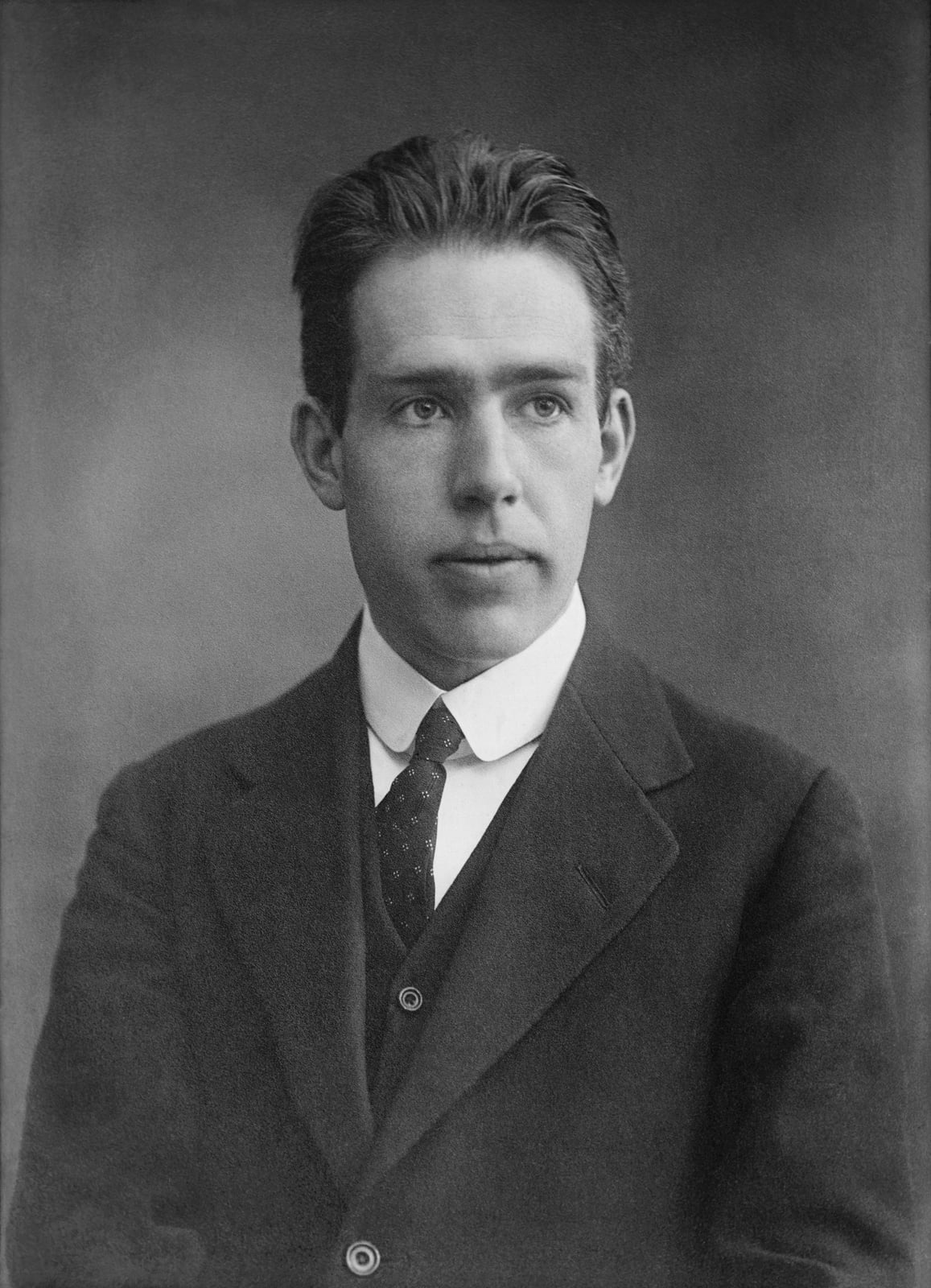
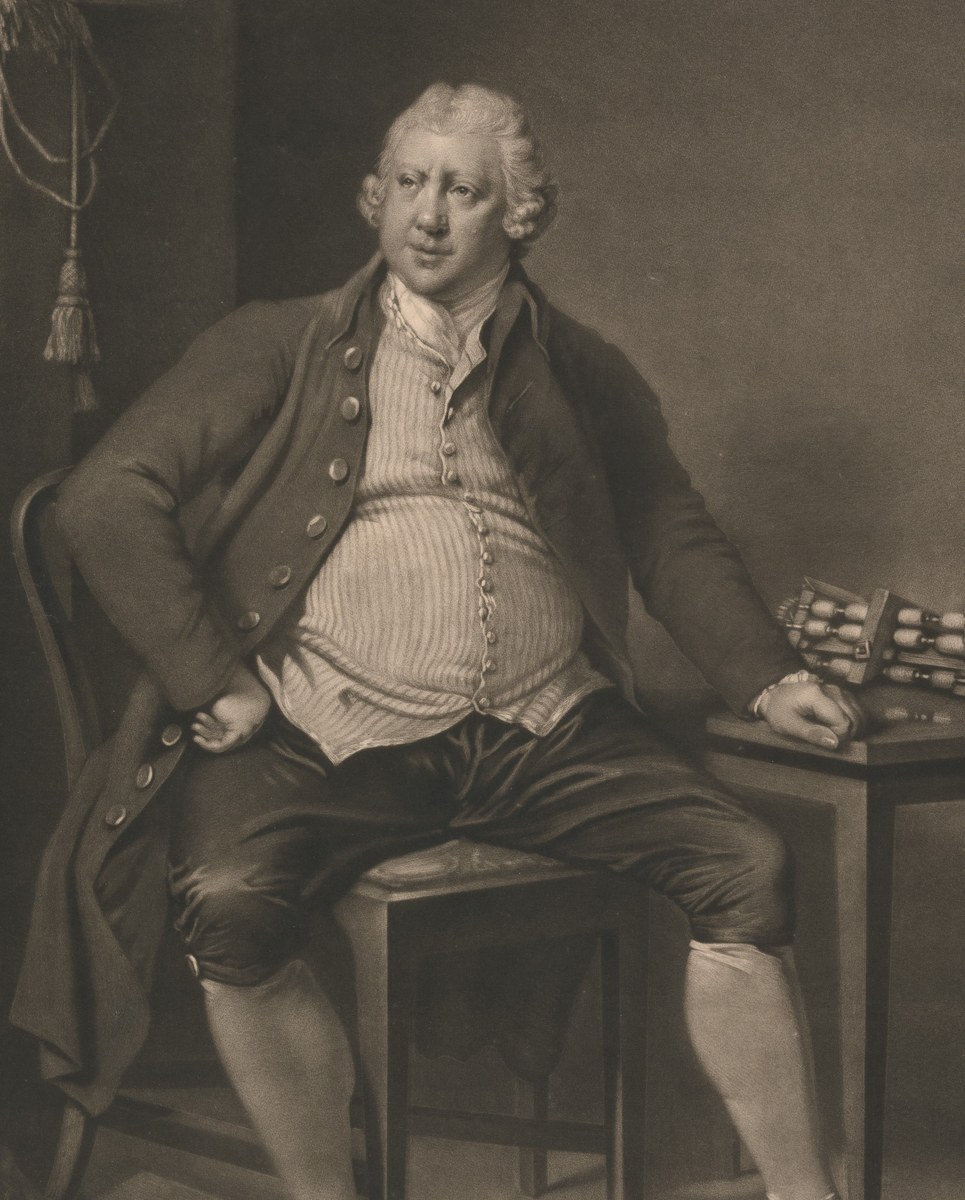

John Raphael Smith (engraver) after Joseph Wright of Derby, 'Sr Richard Arkwright', mezzotint, 1801. Yale Center for British Art, Paul Mellon Collection, B1978.43.1115 (Public Domain). Cropped and downscaled. · Mezzotint 'Portrait of Richard Arkwright' by John Raphael Smith, published 5 May 1801 after the 1790 portrait painting by Joseph Wright of Derby, held by the Yale Center for British Art (Paul Mellon Collection, accession B1978.43.1115), whose item record gives Copyright Status 'Public Domain'. The print's own lettering reads 'Painted by Joseph Wright, R.A. 1790', 'Engraved by J. R. Smith, Mezzotinto Engraver to H.R.H. the Prince of Wales, May 5, 1801' and 'Sr Richard Arkwright'. The file is a head-and-knees crop of the museum's 4765 x 6828 pixel image (crop 3328 x 4139) downscaled to 965 x 1200 with no upscaling; the lettered margin is outside the crop. · Public domain: the Yale Center for British Art item record states Copyright Status 'Public Domain' for this print; the engraver died in 1812 and the painter in 1797, and the print was published in London in 1801 (public domain by age)
사업가 · 근세
리처드 아크라이트
1732–1792
주요 업적 분야
아직 성격 매칭에 포함되지 않았습니다 — 기록된 근거가 성격 모델 전체를 다루기에는 충분하지 않습니다. 이 페이지의 다른 모든 내용은 자유롭게 확인하실 수 있습니다.
핵심 특성
주요 업적
1771년부터 수력 방적 공장인 크롬퍼드 공장을 운영하고 1769년과 1775년의 특허로 더웬트 밸리 공장 지대 세계유산의 중심이 된 공장 체제를 세운 영국의 면방적 사업가이다. 과학박물관 그룹은 그를 발명가라기보다 남의 아이디어를 개량한 사람으로 보며, 사업 수완을 가장 큰 재능으로 꼽는다.
다른 지역에서 노동자를 모집하고 숙소를 지어 크롬퍼드를 공장 마을로 키웠으며 여러 주로 공장을 넓혔다. 1782년에는 종업원이 5,000명이 넘는다고 스스로 어림했고, 노동자 중에는 여성과 아동이 많았다.
특허 사용권을 팔고 침해자를 고소했으나, 토머스 하이스 등의 증인이 그가 남의 아이디어를 가져다 썼다고 증언하면서 1785년 특허가 취소되었다. 그럼에도 사업은 이어졌고, 1786년 기사 작위를 받았으며 약 50만 파운드의 재산을 남겼다.
삶의 장면들
1781년 그는 특허 침해로 아홉 개 회사를 고소했으나 모던트 대령을 상대로 한 첫 소송은 명세서가 불충분하다는 이유로 졌고, 1785년의 재판에서도 배심원단이 그에게 불리한 평결을 내렸다.
이는 공개적 패배를 감수하면서도 다투는 주장을 거듭 법정에서 밀어붙인 사람의 면모와 일치한다. 갈등 감내
크롬퍼드에서 일손이 모자라자 그는 연립 주택과 여관을 짓고 대가족을 둔 직공을 비롯한 노동자를 다른 지역에서 모집했다.
이는 계획을 바꾸는 대신 주택을 짓고 인력을 모집해 노동력 부족을 해결한 사람의 면모와 일치한다. 자원 활용 성향
전환점
1771년 그는 노팅엄의 말 동력 공장 이후 제디다이아 스트럿, 새뮤얼 니드와 동업하여 크롬퍼드에서 수력 방적으로 옮겼으며, 세계유산 설명서는 이 공장을 아크라이트 체제의 바탕으로 본다.
이는 동업자가 자본을 대자 검증된 아이디어를 더 큰 규모의 다른 동력으로 옮긴 사람의 면모와 일치한다. 기회 감지
비슷한 인물
전체적인 프로필이 이 사람과 닮은 사람들이에요.
출처
- Richard Arkwright (Q294153), verified live via the Wikidata API (2026-11-05): English label 'Richard Arkwright', description 'textile entrepreneur; developer of the spinning frame (known as the water frame)', Korean label 리처드 아크라이트, died 3 August 1792, born 23 December 1732 (a second, imprecise 1732 value also present), citizenship Great Britain. Orientation only; not used as support for any row.
- Derwent Valley Mills World Heritage Site, 'Statement of Outstanding Universal Value' (read in full). CANONICAL SIGNIFICANCE SOURCE: credits Arkwright with the new technology for spinning cotton, says the 'Arkwright System' was truly established after his water-powered mill at Cromford (1771, with a larger mill in 1776-77), calls the valley the birth of the factory system and the model for factories worldwide, and names Cromford among the first modern industrial settlements. World Heritage management statement; celebratory about the site and silent on disputes over his patents.
- Science Museum Group collection, people record 'Richard Arkwright 1732-1792' (biography read in full): English inventor and cotton manufacturer from Preston, a barber and wig-maker first; patents of 1769 (spinning machine) and 1775 (preparation and spinning machinery); judged 'more of an improver of other people's ideas than an inventor' whose greatest talent was business; patent disputes led to trials and the patents were retracted late in his life; one of the wealthiest men in England at death. Museum biography with an explicitly measured view of his originality.
- Linda Hall Library, 'Scientist of the Day: Richard Arkwright' (read in full): water frame patented 1769; Cromford factory of 1771; the page argues his true contribution was the factory system rather than the frame; most of what was original in his patents was the work of other men; patents overturned in court in 1781 and 1785 without much affecting his fortune; he pursued infringers vigorously in court; contemporary accounts describe him as difficult and arrogant; the factories' costs included women and children working 12-hour days. Library blog essay, mixed in tone.
- Grace's Guide to British Industrial History, page 'Richard Arkwright' (read in full): 1767 work with the Warrington clockmaker John Kay; partnerships in Nottingham (1768) and with Strutt and Need (1770); the 1769 and 1775 patents; Cromford (1771) with cottages built and workers recruited from outside the district; licensing and enforcing patents from 1778; mills at Birkacre (ill-fated), Bakewell, Wirksworth and elsewhere and failures at Alport and in Manchester; the Crown action of 1785 at which Thomas Highs testified that Arkwright had taken others' ideas and the patents were revoked; Masson Mill bought alone in 1780; partnership with Strutt and Need ended in 1782; knighted 1786. Says there is 'strong evidence' that Highs, not Arkwright, invented the frame. Archive compilation; the whistling saying is attributed to him without a source.
- Dictionary of National Biography (1885), entry 'Arkwright, Richard (1732-1792)' by T. F. Henderson (Wikisource text, read in full; the 1904 errata revise some statements): models made with Kay in 1767, patent of 3 July 1769, Nottingham mill, Cromford with Need and Strutt from 1771, the 1775 combined-machine patent, licences sold to spinners, an estimated 5,000 employees and 200,000 pounds of capital by 1782, the sacking of his Chorley mill in 1779, nine infringement suits in 1781 (the first lost on an insufficient specification), a 1782 'Case' to Parliament that went nowhere, the jury verdict against him on 25 June 1785 and cancellation of the patents on 14 November, credit to him for the factory system's routine, cleanliness and discipline, a Boulton and Watt engine installed at Nottingham in 1790, knighted 1786. Judges the specification deliberately obscure and Kay's and Highs's testimony inconsistent while noting the rivals' claims were not wholly disproven. Victorian standard biography; includes Carlyle's remark on the portrait.
- Revolutionary Players (Lunar Society heritage project), 'Sir Richard Arkwright, industrialist' (read in full): poor Preston origins; hired Kay and other craftsmen; Cromford partly financed by Strutt and Need; workforce including children recruited from across Derbyshire; quotes James Watt calling him 'one of the most self sufficient Ignorant men I have ever met with' and Matthew Boulton calling him 'A Tyrant and more absolute than a Bashaw'; Erasmus Darwin's praise of the roller spinning process; reads Wright's portrait as showing self-satisfaction. Independent contemporary-rival voices (Watt and Boulton were competitors in their own line); the portrait reading is the author's interpretation and is not used for any row.
- Belper Research, 'Richard Arkwright' (local-history biography read in full): argues he was a sharp-witted businessman rather than an inventive genius; Kay's dispute with him ended their partnership after the 1769 patent; Cromford workforce housed in new cottages with a school, chapel and inn; 6 a.m. to 7 p.m. hours and a majority of child workers at Lumford in 1786-88 (given as two-thirds of 1,900); armed guards and a cannon at Cromford in the 1779 unrest; Strutt left the partnership after Need's death (1781) worried about expansion and the patent disputes; accuses him of using Kay's, Highs's and Hargreaves's work without credit; notes factories (silk mills) existed before Cromford. Local-history site with a clear critical point of view and some internal inconsistencies; dates are cross-checked against the other sources before use.