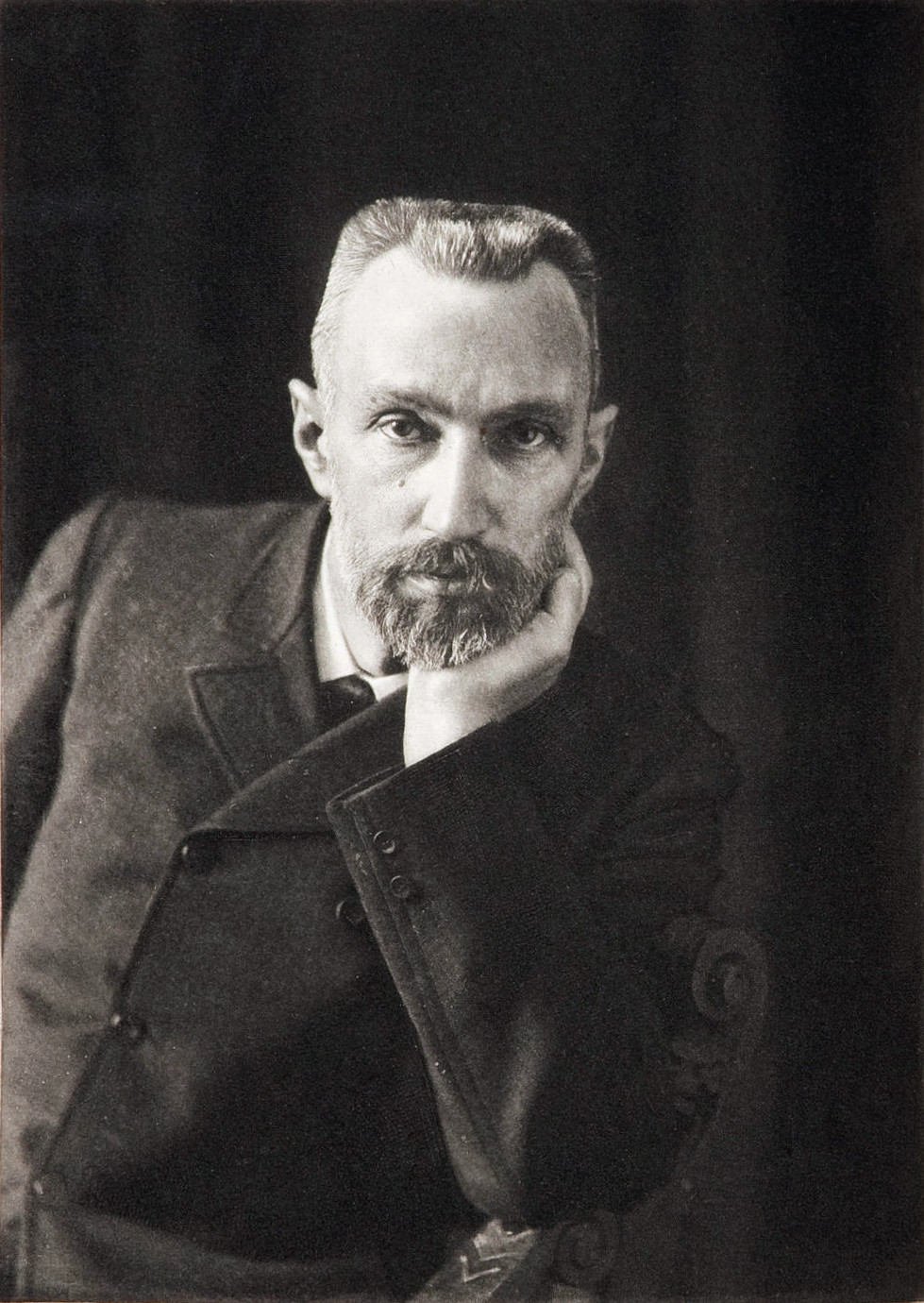

Unknown photographer, heliogravure by Dujardin, 'Pierre Curie in 1906'; published in Marie Curie, Traite de radioactivite (1910) and Pierre Curie (1923); public domain · Wikimedia Commons, 'Pierre Curie by Dujardin c1906.jpg' -- photographic portrait of Pierre Curie, dated 1906 in the frontispiece caption ('Pierre Curie in 1906', heliogravure by Dujardin, printed by Ch. Wittmann) of Marie Curie's 'Pierre Curie' (Macmillan, 1923; confirmed in the Internet Archive scan opened for the biography source), and also reproduced in her 'Traite de radioactivite' (Gauthier-Villars, 1910) per the Commons record; original Commons file 979 x 1380 pixels, saved unchanged (no scaling). The photographer is unknown; 'Dujardin' on Commons is the heliogravure printer. Rights basis: published in 1910 and 1923, before 1931 (public domain in the United States) with an unknown photographer and more than 70 years since publication (public domain in France and the EU); Commons tags it PD-old. An alternative Wellcome Collection scan (M0000112, credited to E. Pirou) was NOT used because Wellcome's own catalogue page labels the item 'In copyright' despite a CC BY digitisation licence, which is a conflicting institutional notice. · Public domain (published 1910 and 1923; unknown photographer)
물리학자 · 19세기
피에르 퀴리
1859–1906
주요 업적 분야
아직 성격 매칭에 포함되지 않았습니다 — 기록된 근거가 성격 모델 전체를 다루기에는 충분하지 않습니다. 이 페이지의 다른 모든 내용은 자유롭게 확인하실 수 있습니다.
핵심 특성
주요 업적
그는 마리 퀴리와 함께 1898년 폴로늄과 라듐의 발견을 발표했고, 1903년 두 사람은 방사능 연구로 앙리 베크렐과 노벨 물리학상을 나누어 받았다.
1880년 그는 형 자크와 함께 압력을 받은 특정 결정에 전하가 나타나는 압전 현상을 발견했고, 이를 측정하는 석영 전위계와 저울도 만들었다.
그는 물질의 자기적 성질이 특정 온도에서 달라진다는 것을 보였고(오늘날 퀴리점), 약한 자화와 온도의 관계를 나타내는 법칙을 찾았으며, 1894년에는 물리 현상의 대칭성에 관한 법칙을 제시했다.
삶의 장면들
1880년 그와 자크는 주석박, 풀, 철사, 보석 세공용 톱 같은 소박한 재료로 석영, 황옥, 로셸염 등 여러 결정을 시험했고, 압력이 전하를 일으킨다는 것을 확인했다.
이는 소박한 장치를 직접 만들어 착상을 시험하는 습관과 부합한다. 자원 활용 성향
자기 연구 중에 그는 강한 반자성체와 자기 전도체를 찾아보았으나 찾지 못했고, 아내의 기록에 따르면 이런 탐색은 발표하지 않았다.
이는 발표보다는 예상 밖의 가능성 자체를 좇는 태도와 부합한다. 호기심
전환점
1898년 그는 자신의 결정 연구를 제쳐 두고 피치블렌드 속 미지의 방사성 물질을 찾던 마리 퀴리의 연구에 합류했고, 이는 폴로늄과 라듐의 발견으로 이어졌다.
이는 유망한 문제를 함께 풀기 위해 자신의 연구 방향을 바꾸는 태도와 부합한다. 협업 성향
비슷한 인물
전체적인 프로필이 이 사람과 닮은 사람들이에요.
출처
- Pierre Curie (Q37463) -- verified live via the Wikidata API (2026-10-11): English description 'French physicist and chemist (1859-1906)', born 15 May 1859, died 19 April 1906, Korean label present; the entity carries its name under the language-neutral 'mul' label, with no separate English label. Distinct from Marie Curie (a different entity and an existing production person). Orientation only; not used as support for any row.
- Nobel Foundation, 'Pierre Curie - Biographical', Nobel Prize in Physics 1903 (nobelprize.org; text written at the time of the award, from Les Prix Nobel) -- CANONICAL SIGNIFICANCE SOURCE: his early crystallography with his brother Jacques and the discovery of piezoelectricity, his theories of symmetry, magnetism and the Curie point, the apparatus he built, and the radium and polonium work done with his wife under hardship, for which they shared half the 1903 prize. Work record only; says nothing about behaviour beyond hardship and teaching load. Read in full.
- Marie Curie, 'Pierre Curie' (translated by Charlotte and Vernon Kellogg, Macmillan, New York, 1923; Internet Archive scan, OCR text) -- FAMILY source: his widow's biography, written from her memories, his brother Jacques's recollections and his own notes. Describes his crystal and magnetism research, instruments, doctoral thesis, habit of pursuing unforeseen phenomena without publishing, decision to set aside crystals to join her radium work, teaching, refusal of honours, and quotes tribute passages by Gernez, Jean Perrin, Cheneveau and Paul Langevin, so the Perrin and Langevin accounts are read second-hand through her selection. One admiring perspective, never used as sole support. Read the career, research, tribute and Nobel-era chapters; the personal and family chapters were not used.
- 'Curie, Pierre', Complete Dictionary of Scientific Biography (Charles Scribner's Sons, 2008; via Encyclopedia.com) -- scholarly reference biography. Gives the three periods of his work (crystal physics with Jacques, isolated work on symmetry and magnetism, radioactivity with Marie), the 1894 statement of the symmetry laws now called Curie's principle, the magnetism thesis, his 'never hasty' publication, indifference to career and refusal of decoration in 1903, Lord Kelvin's early recognition, and the later industrial use of piezoelectricity by his student Langevin. Read through the career, personality and piezoelectricity/symmetry sections; the radioactivity and magnetism sections later in the entry were skimmed, not read in full.
- American Physical Society, 'March 1880: The Curie Brothers Discover Piezoelectricity', APS News 'This Month in Physics History', March 2014 -- institutional history column. Describes the brothers testing crystals with tinfoil, glue, wire and a jeweller's saw, the converse effect predicted by Lippmann and confirmed by them, Curie's law and the Curie point, his experimental approach to seances as a physics question, his not engaging in academic politics, and his rejection for a mineralogy post and the Academy in 1903. Read in full; its remarks on his death and family were not used.
- ESPCI Paris - PSL, 'History and Heritage of ESPCI Paris' -- institutional history of the school where he worked from 1882 to 1904-05 (shown as 'Pierre Curie' among its notable people), recording that the Curies' radioactivity work brought it renown and that the school keeps their original instruments. Orientation and institutional confirmation only; thin on his behaviour. Read in full.