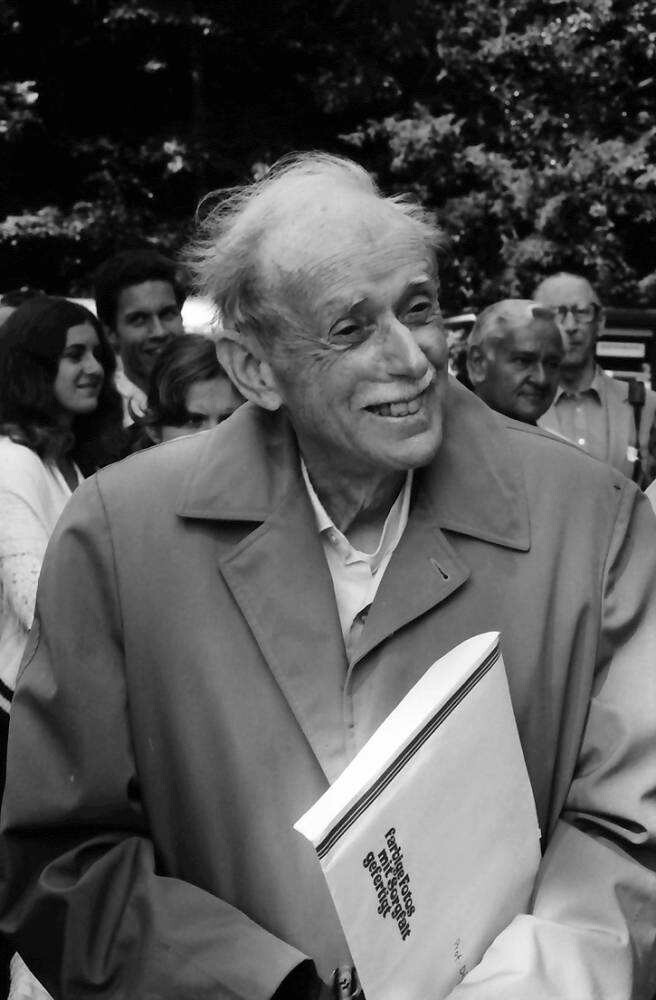
Willy Pragher, Landesarchiv Baden-Wuerttemberg, Staatsarchiv Freiburg, W 134 Nr. 119172a, CC BY 3.0 DE · Wikimedia Commons, '32. Tagung 1982 Physiker; Mainau Paul Dirac - W134Nr.119172a - Willy Pragher.jpg' -- photograph by Willy Pragher (1908-1992) at the 1982 Mainau/Lindau Nobel laureates' meeting, held by the Landesarchiv Baden-Wuerttemberg, Staatsarchiv Freiburg (signature W 134 Nr. 119172a); original file 656 x 1000 pixels, saved unchanged (no scaling). · CC BY 3.0 DE
물리학자 · 20세기
폴 디랙
1902–1984
주요 업적 분야
아직 성격 매칭에 포함되지 않았습니다 — 기록된 근거가 성격 모델 전체를 다루기에는 충분하지 않습니다. 이 페이지의 다른 모든 내용은 자유롭게 확인하실 수 있습니다.
핵심 특성
주요 업적
1925년 그는 비가환 대수에 바탕을 둔 양자역학 체계를 독자적으로 만들어 냈고, 1930년에는 《양자역학의 원리》에서 이 이론 전체를 체계적으로 정리했다.
1928년 그가 세운 전자의 파동방정식은 수학적으로 서로 어긋나던 양자론과 특수상대성이론을 하나로 이었다.
그의 구멍 이론은 전자와 질량이 같고 전하가 양인 입자가 있어야 한다고 보았고, 양전자는 1932년과 1933년에 실험으로 확인되었다. 그는 1933년 노벨 물리학상을 공동 수상했다.
삶의 장면들
전쟁이 끝난 뒤에도 그는 재규격화가 큰 성공을 거두었는데도 왜 만족하지 못하는지를 거듭 설명했고, 물리학자들이 올바른 해밀토니안을 찾아야 한다고 촉구했다.
학계 대부분이 다른 길로 나아간 뒤에도 좋은 이론에 대한 자신의 기준을 지킨 태도와 일치한다. 독립적 사고
1963년 <사이언티픽 아메리칸> 기고에서 그는 슈뢰딩거의 발견을 예로 들며, 방정식이 실험과 맞는 것보다 아름다운 것이 더 중요하다고 주장했다.
수학적 아름다움을 연구의 길잡이로 삼은 이론가의 태도와 일치하며, 다이슨은 이것이 이후 큰 발견으로 이어지지 않았다고 평가한다. 미적 감각
전환점
1930년대 중반 이후 그의 논문 수는 줄었고, 슈웨버의 서평은 전쟁 뒤 그가 다시 혼자 연구하는 사람이 되었다고 묘사한다. 이는 케임브리지 모임과 유럽 동료들과 긴밀히 교류하던 시기와 대비된다.
가장 큰 성과는 동료들과 긴밀히 연결되어 있던 시기에 나왔고, 이후에는 주로 자신의 방식대로 연구한 학자라는 점과 일치한다. 자율성 욕구
비슷한 인물
전체적인 프로필이 이 사람과 닮은 사람들이에요.
출처
- Paul Dirac (Q47480) -- verified live via the Wikidata API (2026-10-10): English label 'Paul Dirac', description 'British theoretical physicist (1902-1984)', born 8 August 1902, died 20 October 1984, Korean label present. Orientation only; not used as support for any row.
- Nobel Foundation, 'Paul A.M. Dirac - Biographical', Nobel Prize in Physics 1933 (nobelprize.org; text written at the time of the award, from Les Prix Nobel) -- institutional account of his career, naming the noncommutative-algebra formulation of 1925, the relativistic electron equation of 1928, the hole theory of 1930 and its positron prediction, and his two books. Work record only; says nothing about behaviour beyond travel and posts. Read in full.
- P. A. M. Dirac, 'Theory of Electrons and Positrons', Nobel Lecture, 12 December 1933 (nobelprize.org PDF from Nobel Lectures, Physics 1922-1941) -- SELF source used only as work evidence: how the negative-energy solutions of his equation led to the hole theory and positrons, and his proposal that negative protons could exist and that a universe of mirror-image stars is conceivable. Read in full; never used as sole support for a behavioural claim.
- Silvan S. Schweber, review of Helge Kragh's 'Dirac: A Scientific Biography' (Cambridge University Press, 1990), Physics Today, April 1991, pp. 99-100 (AIP PDF) -- INDEPENDENT scholarly review by a historian of physics. Describes three periods of Dirac's output, his strong ties to Cambridge circles and correspondents in 1924-34, his hands-on experimental isotope-separation work encouraged by Kapitza, wartime collaboration, and his postwar isolation and repeated dissatisfaction with renormalization; also notes limits of the book. Read in full; the review's childhood-psychology paragraph was deliberately not used.
- Freeman Dyson, 'Silent Quantum Genius', review of Graham Farmelo's 'The Strangest Man', The New York Review of Books, 25 February 2010 -- PEER witness and critic: a leading physicist who attended Dirac's Cambridge lectures in 1941 and knew him afterwards. Assesses Dirac as the boldest thinker of the quantum revolution, describes his concentration on one problem at a time, his verbatim lectures from his own book, his doctrine of mathematical beauty and why Dyson thinks it left the second half of his career comparatively sterile, and his refusal to join debates on interpreting quantum mechanics. Read in full; the review's discussion of family, marriage and the autism question was deliberately not used and no diagnosis of any kind is scored or implied.
- Babak Ashrafi, review of Graham Farmelo's 'The Strangest Man: The Hidden Life of Paul Dirac, Mystic of the Atom', Physics Today, December 2009 -- independent review by a historian of science. Notes his engineering-then-mathematics training and his combination of pragmatic and rigorous approaches, and that he worked and collaborated little but impressed those he did work with. Read in full; its paragraphs on childhood and on a posthumous diagnosis (which the reviewer himself questions) were not used.
- MacTutor History of Mathematics (University of St Andrews), 'Paul Dirac' biography -- scholarly secondary biography drawing on the Dalitz and Peierls Royal Society memoir, the Royal Society obituary and a Higgs appreciation. Used for the 1925 Poisson-bracket insight, the 1933 Lagrangian paper later built on by Feynman, his book-based lectures, that he took very few research students, and honours. Read in full; its personal-life paragraphs were not used.
- P. A. M. Dirac, 'The Evolution of the Physicist's Picture of Nature', Scientific American, May 1963, as quoted at length in Peter Woit, 'Not Even Wrong' blog post of 24 May 2021 -- SELF source (his own stated view that beauty in equations matters more than fit to experiment, contrasting Heisenberg's and Schroedinger's routes) read through a mathematician's blog extract, not the original magazine page. Work-philosophy evidence only; never sole support.
- Landesarchiv Baden-Wuerttemberg (Staatsarchiv Freiburg), Willy Pragher photograph collection (W 134), terms of use and Wikimedia Commons category notice -- used only to check the portrait's licence (CC BY with attribution of photographer and archive signature). Not used for scoring.