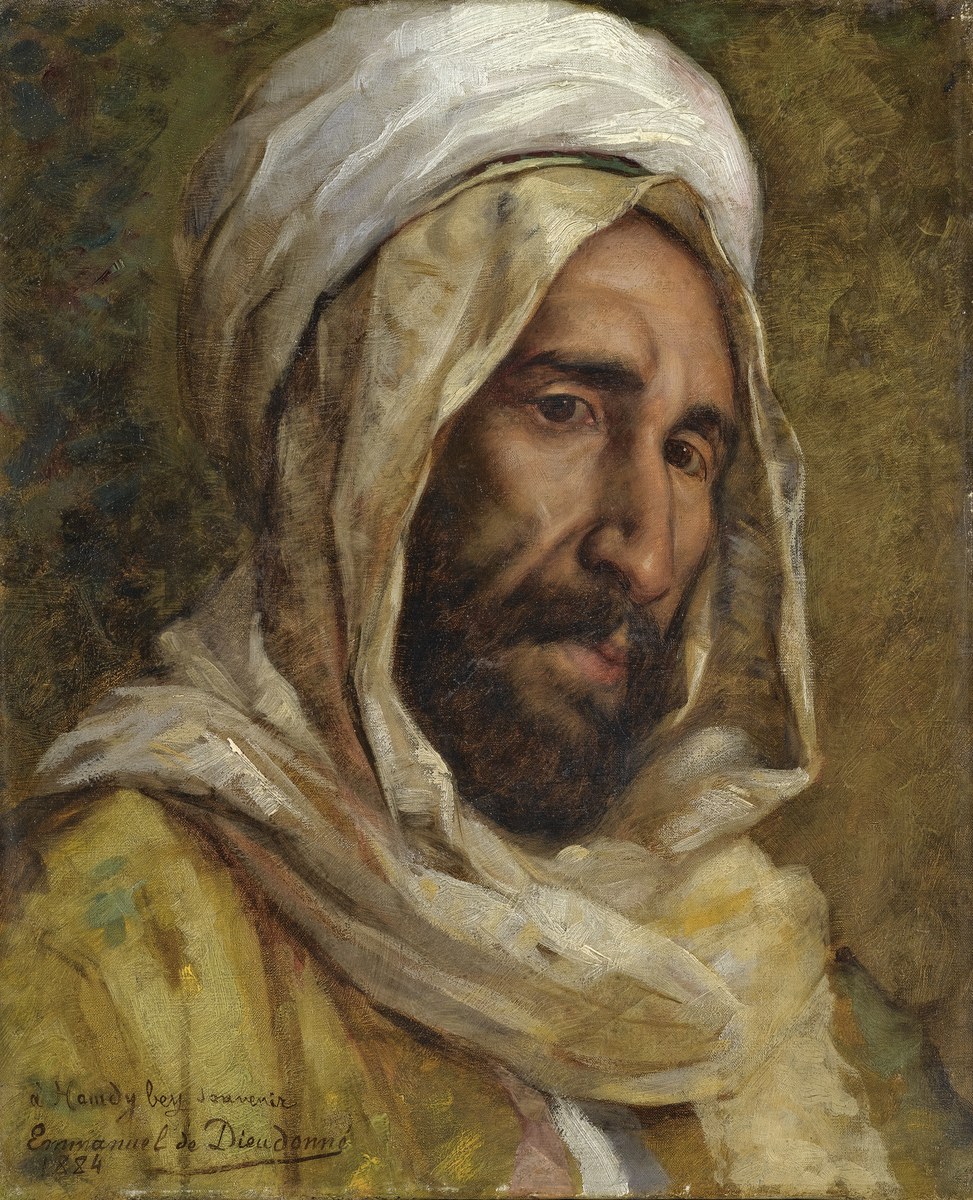
Emmanuel de Dieudonne, Portrait of Osman Hamdy Bey, 1884, oil on canvas; image via Wikimedia Commons from the Sotheby's catalogue; public domain by age · Oil portrait of Osman Hamdi Bey painted in 1884 by the Orientalist painter Emmanuel de Dieudonne, who inscribed it at lower left 'a Hamdy bey souvenir / Emmanuel de Dieudonne / 1884' (dedicated to Hamdy Bey); oil on canvas, 45.5 x 38 cm, last recorded in the 2012 Sotheby's sale 'An Eye for Opulence: Art of the Ottoman Empire' (lot 327), where the catalogue identifies the sitter and cites Eldem 2010, p. 171. The original photograph on Wikimedia Commons is 3,244 x 4,000 pixels and was downscaled once to 973 x 1,200; nothing was upscaled. Shown as a painted portrait by a fellow painter, not as a documented sitting. Caveats: the record holder is an auction house, the present owner is not stated, and the sitter is identified by the dedication and the cataloguer, not by a painted name. · Public domain (painting of 1884 by an artist who died in 1889; faithful photograph of a two-dimensional work)
핵심 특성
주요 업적
1881년 오스만 제국 황실박물관 관장이 되어 이를 이스탄불 고고학 박물관으로 키웠으며, 1891년 문을 연 새 건물을 짓게 하고 유물의 해외 밀반출을 막는 법령을 추진했다.
시돈 등지의 발굴을 이끌어 1887년 왕실 묘지에서 석관들을 찾아 이스탄불로 옮겼고, 1892년 테오도르 레나크와 함께 시돈 발굴 보고서를 펴냈다.
화가로서 파리에서 제롬과 불랑제에게 배웠고 《거북이 조련사》(1906)로 가장 잘 알려져 있으며, 1882년 이스탄불에 미술 아카데미를 세웠다.
삶의 장면들
1887년 시돈 근처에서 한 마을 사람이 유적을 발견하자 그는 왕실 묘지를 발굴했는데, 서구 논평가들은 주로 무슬림으로 이뤄진 그의 팀이 이를 해낼 수 있을지 의심했으며, 출토된 석관들은 이후 이스탄불로 옮겨졌다.
이 일화는 까다로운 현장 발굴을 외국 전문가에게 맡기지 않고 직접 책임지는 태도와 일치한다. 선제적 행동력
박물관장으로서 소장품을 목록화하고 고고학·미술 도서관을 만들었으며 사진을 곁들인 박물관 도록을 제작했는데, 한 박물관 고고학자는 이것이 튀르키예 최초라고 미들이스트아이에 말했다.
이 도록 작업은 소장품을 꼼꼼히 기록하고 관리하는 접근과 일치한다. 디테일 지향
전환점
1881년 외국인 관장 두 명의 뒤를 이어 황실박물관 관장에 임명된 그는 이후 박물관 건립, 발굴 지휘, 그림 작업으로 경력을 나누어 이어 갔다.
이 임명은 여러 분야에 걸친 경력으로 이어진 전환점으로, 그런 폭넓은 행보와 일치한다. 분야 횡단성
비슷한 인물
전체적인 프로필이 이 사람과 닮은 사람들이에요.


라빈드라나트 타고르

에이브러햄 링컨

마야 안젤루

벤저민 프랭클린

미켈란젤로
출처
- Osman Hamdi Bey (Q1190012), verified live via the Wikidata API (2026-11-05): label 'Osman Hamdi Bey', description 'Ottoman statesman, academic and artist (1842-1910)', born 30 December 1842, died 24 February 1910, Korean label 오스만 함디 베이. Orientation only; the 'statesman' description is context and is not scored.
- Encyclopaedia Britannica, 'Osman Hamdi Bey' (article read in full, about 250 words, by the Britannica editors). CANONICAL SIGNIFICANCE SOURCE: says he founded the Archaeological Museum of Istanbul and became its director in 1881, put forward legislation to regulate archaeological finds and stop antiquities being smuggled abroad, secured the Sidon sarcophagi including the so-called Alexander sarcophagus, and co-wrote Une Necropole royale a Sidon (1892) with Theodore Reinach; also a painter and art expert.
- Republic of Turkiye Ministry of Culture and Tourism, 'Istanbul Archaeological Museums' (official museum page, read via a page summary of about 250 words; the page was not opened in full). States that Osman Hamdi Bey's appointment as director in 1881 began a new era in Turkish museology, that he found the Sidon royal necropolis in 1887-1888 and brought many sarcophagi to Istanbul, that the classical museum building by Alexander Vallaury opened in 1891, and that the Academy of Fine Arts building dates from 1883.
- Yusuf Selman Inanc, 'Osman Hamdi Bey: Artist, archaeologist and protector of Ottoman heritage', Middle East Eye, 22 June 2022 (article read in full, about 2,000 words). Journalistic account with quotations from a museum archaeologist (admiring institutional voice): director of the Imperial Museum from 1881 after two foreign directors, the museum catalogue with photographs and library, the Sidon excavation of 1887, the 1881 commission of the museum building with Vallaury, the School of Fine Arts of 1882, excavations 1883-1895, and the doubt that Western commentators expressed about whether his team could carry out the Sidon work.
- Nikhil Swaminathan, 'Squabbling Over a Sumerian City', Archaeology Magazine (Archaeological Institute of America) 64(2), March/April 2011 (review of the University of Pennsylvania Museum exhibition 'Archaeologists and Travelers in Ottoman Lands'; read in full, about 500 words). Independent, more critical voice on the Nippur excavations: describes him as director of the Imperial Museum and author of laws limiting foreign excavations, and says the Penn project leader arranged honorary degrees and exorbitant purchases of his paintings to gain access to sites and artifacts.
- Wendy Shaw, 'Hamdi Bey, Osman (1842-1910)', Routledge Encyclopedia of Modernism, 2018 (publisher abstract of about 200 words read; the full entry is behind a paywall and was not opened). Scholarly summary: founding director of the Imperial Academy of Fine Arts, the most powerful director of the Imperial Museum, an important arts legislator, the first Ottoman archaeologist and one of the most skilful and prolific painters of the Ottoman era, whose allegorical paintings (The Man with the Tortoises, 1906) reflect on Ottoman identity and Orientalist style.
- Edhem Eldem, 'Making Sense of Osman Hamdi Bey and His Paintings', Muqarnas 29, 2012 (only the Academia.edu preview with figure captions and short extracts was read, about 700 words; the article itself was not opened in full). Used for two details only: a French magazine's 1905 caption calling one of his Salon paintings among the best of the Salon, and the 1869 illustration from Le Tour du monde that Eldem links to the Tortoise Trainer; the preview also shows that scholars contest what his paintings mean.
- Osman Hamdi Bey, Wikipedia (read in full). Orientation only, never counted as support for any row.
- Sotheby's, lot 327, 'Portrait of Osman Hamdy Bey' by Emmanuel de Dieudonne, sale 'An Eye for Opulence: Art of the Ottoman Empire' (2012; lot page read in full). Used for the portrait only, not for any trait row: records the dedication, signature and date on the canvas, the size (45.5 by 38 cm) and a literature reference to Eldem 2010, p. 171.