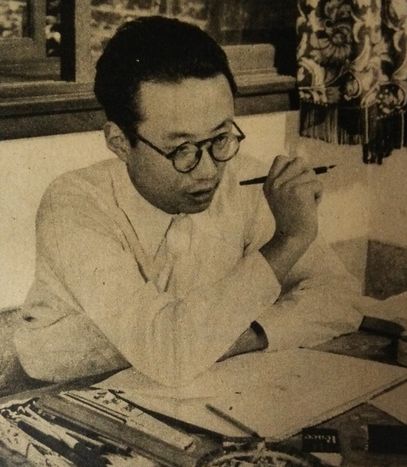

Asahi Shimbun company, Asahi Graph, 10 June 1953, public domain · Photograph of Osamu Tezuka from the Asahi Graph issue of 10 June 1953, credited to the Asahi Shimbun company, scanned and hosted on Wikimedia Commons as 'Tezuka Osamu.JPG'. Rights basis: published in Japan in 1953, before 1 January 1958, so public domain in Japan under the transitional rule for old photographs and therefore public domain in the United States (Japanese copyright expired before the 1996 restoration date); Commons tags it as an old-photograph public-domain file with no US-restoration warning. Same basis as the Asahi Graph photograph used for another Japanese subject in this roster. Saved at the Commons original size of 407 x 467, no resizing and no upscaling. Caveat: the individual photographer is not named, and the basis depends on the 1953 publication date given on the file page, which I could not check against the magazine itself. The Wikidata lead (a 1951 photograph, 595 x 508, unknown author) was rejected because its only source is a 1989 book and no earlier publication is documented. · Public domain (Japan, published before 1958)
예술가 · 20세기
데즈카 오사무
1928–1989
주요 업적 분야
아직 성격 매칭에 포함되지 않았습니다 — 기록된 근거가 성격 모델 전체를 다루기에는 충분하지 않습니다. 이 페이지의 다른 모든 내용은 자유롭게 확인하실 수 있습니다.
핵심 특성
주요 업적
일본에서 '만화의 신'으로 불리며 전후 만화를 바꾸었고, 약 15만 장의 원고를 그리며 《아톰》, 《정글 대제》, 《불새》 같은 장기 연재작을 만들었다.
그의 만화를 원작으로 한 《아톰》은 일본 최초의 텔레비전 애니메이션 시리즈로 소개되며, 그는 이를 만들기 위해 무시 프로덕션을 세웠다.
의학 학위를 받았지만 그래픽 아트의 길을 택했으며, 그의 이야기는 휴머니즘과 전쟁에 대한 거부로 특징지어진다.
삶의 장면들
매주 30분짜리 《아톰》을 만들기 위해, 그는 본인의 설명에 따르면 스태프에게 그림 수를 줄이고 선으로 움직임의 부족을 가리자고 말했다.
이는 제작상의 제약 속에서 현실적인 저비용 방식을 찾아내는 모습과 부합하지만, 그 자신의 설명이다. 자원 활용 성향
그는 1954년 《불새》를 시작해 세상을 떠날 때까지 이어 갔으며, 한 평자의 표현으로는 과거와 미래, 현재를 오가며 4,000쪽에 이르는 이야기이다.
이는 수십 년에 걸쳐 하나의 장기 프로젝트를 이어 간 지속적인 헌신과 부합한다. 끈기
전환점
1951년 의과대학을 졸업하고 1960년 의사 면허를 땄지만, 그는 의학 대신 그래픽 아트의 길을 택했다.
이는 전통적인 직업의 길 대신 그림과 이야기에 전념하기로 한 결정과 부합한다. 분야 횡단성
비슷한 인물
전체적인 프로필이 이 사람과 닮은 사람들이에요.


마야 안젤루

에이브러햄 링컨

라빈드라나트 타고르

마크 트웨인

루이 파스퇴르
출처
- Osamu Tezuka (Q193300), verified live via the Wikidata API (2026-10-31): label 'Osamu Tezuka', description 'Japanese cartoonist and animator (1928-1989)', Korean label present, image 'Osamu Tezuka 1951 Scan10008-2.JPG'. Orientation only; not used as support for any row.
- EBSCO Research Starters, 'Osamu Tezuka', article by Jennifer R. Coker (2024; read in full). CANONICAL SIGNIFICANCE SOURCE: pioneering figure in comics and animation, known in Japan as the god of comics; inspired by Walt Disney; chose graphic arts over medicine; works characterized by humanism and rejection of war; Phoenix series; Astro Boy described as Japan's first animated television series; about 150,000 pages drawn; awards at Venice, Asia and Zagreb festivals. Encyclopedic summary that gives the Mushi/Tezuka Productions founding as 1961, which differs from the company's own dating.
- Encyclopedia.com, 'Tezuka, Osamu 1928-1989' (Gale reference entry, read in full): lists works and awards, quotes Frederik Schodt on his humanism and on the many manga artists and animators who worked with him, records that his animation company was bankrupted by network budget limits before the success of Phoenix, that he never excelled as a businessman, and that his widow declined to act over the similarity between The Lion King and Kimba. Reference entry compiled from reviews and Schodt, mixed admiring and critical.
- Tezuka Productions, company profile and chronology (read in full; promotional insider source run by his own studio): debut 1946, first story manga New Treasure Island in 1947, about 150,000 manuscript sheets, about 700 titles, more than 1,000 characters and about 60 animation works; chronology of Astro Boy (1963), Jungle Emperor Leo, Phoenix in COM magazine (1966), the Kodansha Manga Award (1977); anecdote that he first refused paperback editions because he cared about page format. Counted as insider evidence only.
- Google Arts & Culture exhibit 'Tezuka Osamu the Dawn of TV animation', by Tezuka Productions (read in full; insider curation quoting his own words): his 1958 move into animation with Toei, the 1961 studio, the 1962 film Tales of the Street Corner, and his account of making weekly 30-minute Astro Boy episodes by cutting the number of pictures. Self-report and promotional; used only for his own described method.
- ImageTexT journal, review of Natsu Onoda Power's 'God of Comics: Osamu Tezuka and the Creation of Post-World War II Manga' by Tof Eklund (2021; read in full): independent scholarly review that credits the book with surveying about 150,000 pages of output, shows him at the forefront of shonen manga and arguably shojo manga, notes his vexed relationship with anime and varied depiction of women, and warns that the book overplays his importance and canonizes him. Counter-voice source on a scholarly book (the book itself was not opened).