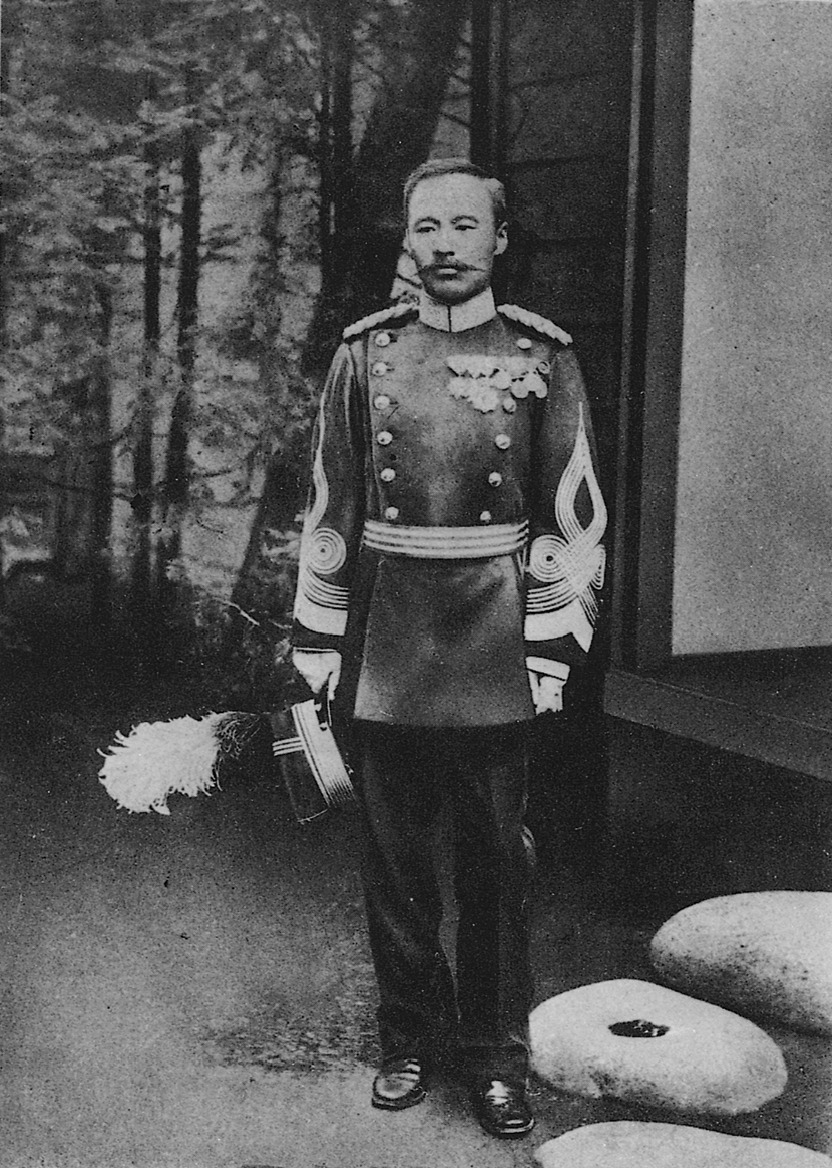
Ohashi Otowa, 1899, reproduced in Mori Junzaburo, 'Ogai Mori Rintaro' (1942); National Diet Library, Japan, Portraits of Modern Japanese Historical Figures · Full-length photograph of Mori Ōgai in army surgeon's uniform with plumed hat in hand, in the garden in front of the Kanchoro tea room, taken in June 1899 on the day before he left for Kokura, by Ohashi Otowa (1869-1901). The printed caption in the 1942 book 'Ogai Mori Rintaro' by Mori Junzaburo (Marui Shoten; National Diet Library Digital Collection record, access restriction Public Domain Mark) names the sitter, date, place and photographer; the same image is shown as the first of five portraits on the National Diet Library's exhibition page for MORI Ogai (file 0342_1.jpg). Rights basis: the photograph was taken in 1899 and the named photographer died in 1901 (Japanese Wikipedia, orientation only), so it is public domain by age in Japan, and as a Japanese work already out of copyright in 1996 it was not restored in the United States; the National Diet Library's exhibition states that all images in the exhibition are in the public domain and may be reused including commercially with source citation. The page does not carry a separate item-level statement for each photograph, so the rationale rests on photographer, date and age as well as that institutional statement. The file is the halftone reproduction as served by the library at 884 x 1281 pixels, cropped only to remove the printed caption and the border (832 x 1168 pixels); no scaling or upscaling. · Public domain (photograph of 1899 by Ohashi Otowa, died 1901; National Diet Library states all images in its exhibition are in the public domain)
작가 · 20세기
모리 오가이
1862–1922
주요 업적 분야
아직 성격 매칭에 포함되지 않았습니다 — 기록된 근거가 성격 모델 전체를 다루기에는 충분하지 않습니다. 이 페이지의 다른 모든 내용은 자유롭게 확인하실 수 있습니다.
핵심 특성
주요 업적
근대 일본 문학을 만든 작가의 한 사람으로, 베를린 체험을 바탕으로 한 1890년 단편 《무희》는 앞 세대의 비개성적 소설에서 벗어나 자전적 글쓰기의 유행을 열었고, 장편 《기러기》(1911~13)는 그의 가장 인기 있는 작품이 되었다.
번역과 비평으로 유럽 문학을 일본어권에 들여왔다. 번역 시집 《오모카게》(1889), 안데르센의 《즉흥시인》(1892~1901 간행), 괴테의 《파우스트》, 1909년 그의 번역으로 상연된 입센의 《존 가브리엘 보르크만》이 있으며, 쓰보우치 쇼요와는 연극의 목적을 두고 지면에서 논쟁했다.
집필과 함께 의사이자 의무 행정가로도 활동했다. 1884~88년 독일에서 위생학을 공부했고 1897년 위생학 교과서를 공저했으며 1907년 육군 의무국장에 올랐고, 1912년 이후에는 역사 소설과 《시부에 주사이》 같은 평전을 썼으며 만년에는 제실박물관장도 맡았다.
삶의 장면들
1909년 그의 소설 《ヰタ・セクスアリス》가 잡지 《스바루》에 실렸다가 해당 호가 판매 금지되었고, 육군 차관은 그를 질책한 뒤 앞으로 소설은 필명으로 발표해 달라고 요청했다.
이는 상급자의 압력에도 도발적인 작품을 발표하려 했던 모습과 부합하지만, 이후의 요청에는 따랐다는 점도 함께 보여 준다. 갈등 감내
1909년부터 1914년까지 잡지 《스바루》에 칼럼 〈찌르레기 통신〉을 연재하며 유럽과 북미의 문화·과학 동향을 간결하게 소개했고, 독일 유학 이후에도 오랫동안 독일의 신간과 정기간행물을 계속 받아 보았다.
이는 공직의 요구를 넘어서는, 해외 동향에 대한 지속적이고 자발적인 관심과 부합한다. 호기심
전환점
1884년 육군의 파견으로 위생학을 공부하러 독일에 간 그는 4년간 독일 문학과 철학을 탐독하고 극장과 미술관을 찾았으며, 1888년 귀국해 일본의 의학과 문학을 함께 근대화하는 일에 나서 1889년 《오모카게》로 문단에 데뷔했다.
이는 한 직무상의 파견을 두 번째 분야로 들어가는 문으로 삼아 평생 병행해 간 모습과 부합한다. 분야 횡단성
비슷한 인물
전체적인 프로필이 이 사람과 닮은 사람들이에요.


아리스토텔레스

힐데가르트 폰 빙엔

에이다 러브레이스

루이 파스퇴르

레오나르도 다빈치
출처
- Mori Ōgai (Q356960), verified live via the Wikidata API (2026-11-02): label 'Mori Ōgai', description 'Japanese novelist and army physician (1862-1922)', born 1862-02-17, died 1922-07-08/09 (two values), Korean label 모리 오가이. Orientation only; not used as support for any row.
- Encyclopaedia Britannica, 'Mori Ōgai' (full article read, about 400 words). CANONICAL SIGNIFICANCE SOURCE: one of the creators of modern Japanese literature; studied medicine in Tokyo and in Germany 1884-88; 'Maihime' (The Dancing Girl, 1890) departed from the impersonal fiction of earlier generations and initiated a vogue for autobiographical revelation; Gan (The Wild Goose, 1911-13) his most popular novel; translated Andersen's Improvisatoren; after 1912 turned to historical fiction on the samurai code.
- National Diet Library, Japan, 'MORI Ogai', in the digital exhibition Portraits of Modern Japanese Historical Figures (page read in full, including the site's 'About This Site' page). Staff-written biographical note: literary man and army surgeon; University of Tokyo medical graduate 1881; study in Germany 1884-88; promoted surgeon general in 1907 and head of the Army Ministry's Medical Division, the highest post for army surgeons; head of the Imperial Museum and the Zushoryo from 1917; novelist, critic and translator while holding public office; list of representative works (Maihime, Gan, Sansho-Dayu, Takasebune, Shibue Chusai, translation Sokkyo shijin).
- Otsuka Miho, 'Mori Ōgai: The Polymath Intellectual Who Made Literary History', Nippon.com, 'Shapers of Japanese History' series, 8 July 2022 (read in full, about 2,200 words). Education in Japanese, Chinese and Western learning; army surgeon from 1881; German study 1884-88 and continuing import of European publications; Omokage (1889), Maihime (1890), the magazine Shigarami-zoshi and his critical skirmishes; translations of Goethe, Andersen and Faust; the 1897 hygiene textbook; Kokura posting 1899-1902; the banned Vita Sexualis (1909); the 1910 story 'Tower of Silence'; the turn to historical stories after 1912; critical biographies of Shibue Chusai and Hojo Katei; work as head of the Imperial Household Museum and historical research on era names. Passages on family and cause of death were read and are not used.
- Ogai Portal, Humboldt-Universitat zu Berlin (Mori Ogai Memorial Center), 'Examining Japanese Modernity 1906-1912' (page read in full, about 2,500 words, with a dated chronology of his life 1906-1912). Staff Surgeon General and head of the Army Ministry's medical department in 1907; a Beriberi Disease Investigation Commission set up in 1908 on his suggestion with him as interim head; poetry circles and the Subaru magazine he supported; the Mukudori tsushin column on European and North American cultural and scientific trends (1909-14); the Vita Sexualis ban and reprimand; request to publish fiction under a pseudonym; his 1908 petition proposing an Academy of Arts; Ibsen's John Gabriel Borkman in his translation staged 1909; first Japanese reference to Rilke. Family events in the chronology were read and are not used.
- Thomas Schneider, 'Traditionalism and Modernization: The Case of Mori Ogai', Comparative Civilizations Review 52 (Spring 2005), BYU ScholarsArchive (open-access scholarly article, first part read, about 3,000 words). Argues that Ogai's turn from fiction to history in his last decade (explained in his 1915 essay 'History as It Is and History Ignored') was a considered response to the problems of modernization rather than a retreat; draws on Kato Shuichi and J. Thomas Rimer; notes that Ogai 'has yet to achieve any satisfactory reception in the West' (Rimer). Political-science framing; discussion of nationalist slogans was read and is not scored.
- 'Short History of Epidemiology for Noninfectious Diseases in Japan. Part 1: Selected Diseases and Related Episodes from 1880 through 1944', Journal of Epidemiology, via PubMed Central (beriberi section read, about 1,800 words). CRITICAL / COUNTER-VOICE: reports Rintaro Mori's 1888-91 assessments of the navy surgeon Takaki Kanehiro's dietary experiment (that it lacked a control group; that the army ration was nutritionally adequate), his small six-soldier diet trial, and that the army director general relied on his report and did not change rations; notes that the historian Shun'ichi Yamamoto judged Mori's reasoning physiologically defensible but not relevant to beriberi prevention. Also records that Mori coined the Japanese term for epidemiology in 1889.
- Nakayama, beriberi in the Japanese military, The Pharos (Alpha Omega Alpha medical honor society), Autumn 2021, pp. 9-14 (PDF read in full, about 4,000 words). CRITICAL / COUNTER-VOICE: states that Rintaro Mori, as head of the Second Army medical bureau in the Sino-Japanese War, rejected requests to supply barley after the army's medical officers learned of Takaki's navy results, and that one medical officer ignored the restriction; places this inside the wider beriberi toll. Retold by a surgeon-historian, so treated as a secondary account of a disputed responsibility.
- Kevin Wetmore, 'Mori, Ogai (1862-1922)', Routledge Encyclopedia of Modernism (2016), publicly visible abstract only (about 250 words; the full text is behind an institutional login and was not opened). Describes him as army surgeon, translator, novelist, dramatist and literary theorist; important for translations (especially of Ibsen) and critical writings; his print debates with his rival Tsubouchi Shoyo, who advocated Realism while Mori saw a universal ideal behind literature.
- National Diet Library Digital Collection record for 'Ogai Mori Rintaro' by Mori Junzaburo (Marui Shoten, 1942), the book from which the portrait photograph was taken; the record's access restriction reads 'PDM' (Public Domain Mark). Used for the portrait only, not for any trait row.