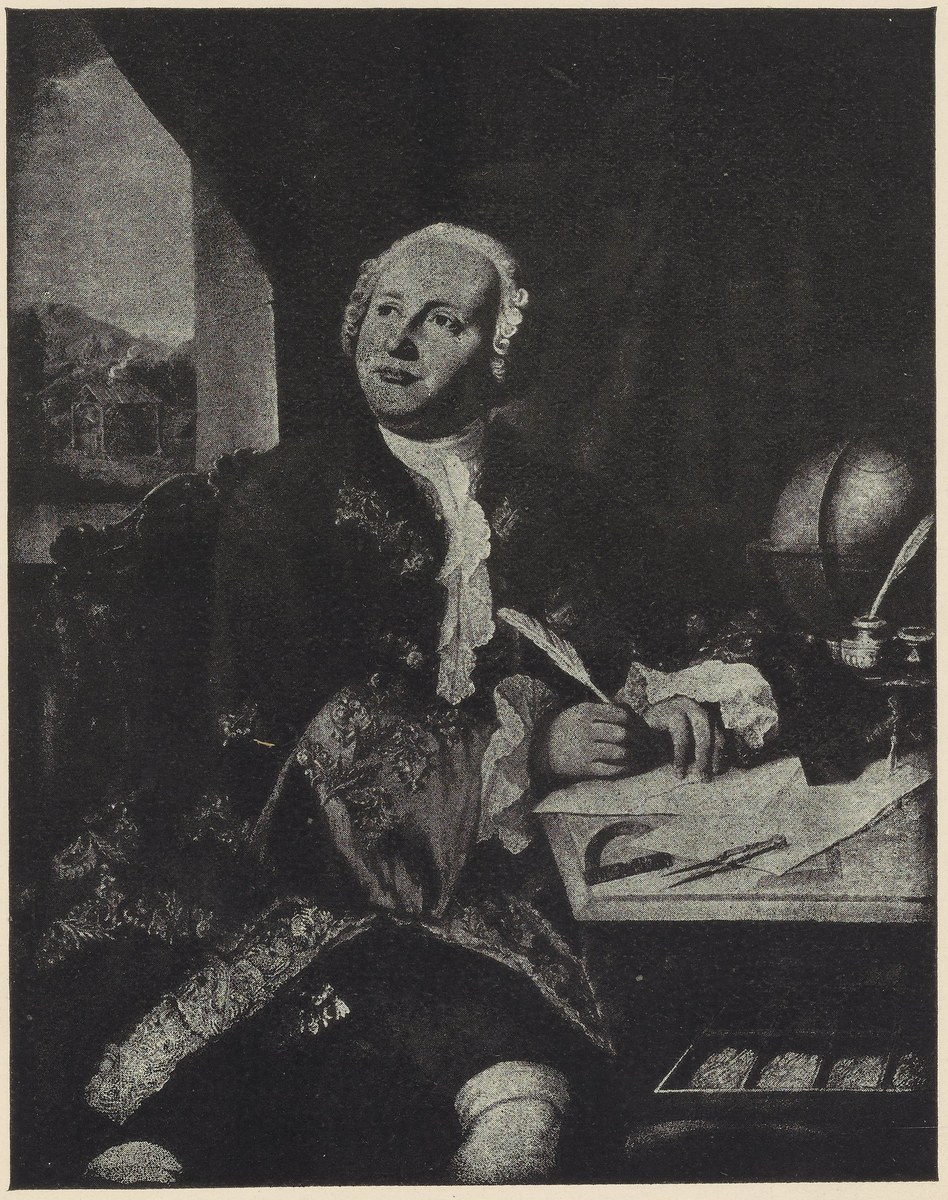

After Georg Kaspar Prenner, portrait of Mikhail Lomonosov, reproduced in Alexander Smith, Intermediate Text Book of Chemistry (New York: The Century Company, 1919), courtesy of the Science History Institute, public domain · Halftone reproduction of a portrait painting of Mikhail Lomonosov after Georg Kaspar Prenner, printed as the frontispiece of Alexander Smith's Intermediate Text Book of Chemistry (The Century Company, New York, 1919), from the Science History Institute's digital collections; the book page is captioned 'M. W. Lomonossov, Russian author, statesman, and chemist, 1711-1765'. The institute's record dates the painting 1787 and lists the rights as Public Domain Mark 1.0. The file used is the institute's 2,880 x 4,343 pixel derivative, cropped to the plate and downscaled once to 948 x 1,200 pixels; nothing was upscaled. A reproduction of a later painting after another artist's work, not a documented sitting. Caveat: the date and the location of the painting that was reproduced are not stated on the record, so the picture is shown as a depiction, not a certified lifetime likeness. · Public domain (Science History Institute Public Domain Mark 1.0; 1919 US publication)
화학자 · 근세
미하일 로모노소프
1711–1765
주요 업적 분야
아직 성격 매칭에 포함되지 않았습니다 — 기록된 근거가 성격 모델 전체를 다루기에는 충분하지 않습니다. 이 페이지의 다른 모든 내용은 자유롭게 확인하실 수 있습니다.
핵심 특성
주요 업적
1745년부터 상트페테르부르크 과학아카데미의 화학 교수로서 화학 실험실을 세우고, 원자·분자론적 설명과 정량적 방법, 열을 분자 운동으로 보는 견해를 주장했으며, 물질 보존의 원리를 제시하고 1761년 금성 태양면 통과를 관측하여 금성에 대기가 있다고 결론지었지만, 라부아지에에 대한 선취권은 역사가들 사이에 논란이 있다.
그는 모스크바에 대학을 세워야 한다고 거듭 주장했고, 이반 슈발로프에게 보낸 그의 편지가 모스크바 대학 설계의 토대가 되어 1755년 칙령으로 철학·법학·의학 세 학부를 갖춘 대학이 창립되었으며, 이 대학은 지금 그의 이름을 쓴다.
그는 시인이자 러시아어 연구자로서 과학 어휘를 정비하는 데 기여했고, 1739년의 〈호틴 점령에 부친 송가〉는 혁명적인 작품으로 평가되며 벨린스키 같은 비평가는 근대 러시아 시가 이 작품에서 시작되었다고 보았다.
삶의 장면들
1761년 금성 태양면 통과 때 그는 자기 집 옥상에서 관측하다가 금성이 들어오기 전 태양 가장자리가 흐려지는 것을 보고 눈의 피로 탓일까 하여 눈을 떼었다가 다시 보아 검은 부분을 확인했으며, 흐림과 금성이 나갈 때의 돌출부를 굴절로 설명하여 금성에 대기가 있다고 추론했고 보고서는 제출 후 두 주 안에 인쇄되었다.
이 일화는 결론을 내리기 전에 자신의 관측을 다시 확인하는 습관과 부합한다. 실험 성향
1761년 금성 통과 전에 그는 아피누스의 준비가 미흡하다고 판단하여 크라실니코프와 쿠르가노프가 아카데미 천문대에서 관측하도록 하라고 명령했으나 아피누스는 거부하고 다른 곳에서 관측했는데, 이는 1759년 수은 응고 결과에 대한 아피누스의 미승인 서신을 로모노소프가 문제 삼으면서 시작된 불화의 한 대목이었다.
이 흐름은 과학적·제도적 문제를 두고 영향력 있는 동료와 공개적으로 맞서는 것을 마다하지 않는 태도와 부합한다. 갈등 감내
전환점
1730년 12월, 열아홉 살의 그는 3루블과 외투 한 벌을 빌려 상단 행렬에 끼어 고향에서 얻을 수 없던 교육을 구하러 일부는 걸어서 1,170km를 가 모스크바에 도착했고, 1735~36년에는 상트페테르부르크 아카데미로 보내진 열두 명의 학생 가운데 한 명이 되어 이어 유학길에 올랐으며, 이로써 성직의 길에서 과학으로 방향이 바뀌었다.
이 여정과 그 뒤의 전개는 어려운 조건에서도 교육을 끝까지 추구하려는 결의와 부합한다. 끈기
비슷한 인물
전체적인 프로필이 이 사람과 닮은 사람들이에요.


월레 소잉카

아웅산 수치

무스타파 케말 아타튀르크

벤저민 프랭클린

카를 융
출처
- Mikhail Lomonosov (Q58720), verified live via the Wikidata API (2026-11-05): label 'Mikhail Lomonosov', description 'Russian polymath (1711-1765)', born 1711 (three day-level values recorded), died April 1765 (two values), citizen of the Russian Empire, many occupations, Korean label 미하일 로모노소프. Orientation only; not used as support for any row.
- Complete Dictionary of Scientific Biography, 'Mikhail Vasilevich Lomonosov' (entry read via Encyclopedia.com; the page was read in a summarised fetch, not word for word). CANONICAL SIGNIFICANCE SOURCE: chemist and physicist born 1711, studied at the St. Petersburg Academy, Marburg and the Freiberg mining academy (1736-41), appointed professor of chemistry at the Academy in 1745 where he built a chemical laboratory and taught one of the earliest courses in practical chemistry; argued that heat is a motion of the molecules of matter when most scientists treated it as a substance, stressed atomic-molecular explanation and quantitative measurement; observed the 1761 transit of Venus and concluded Venus has an atmosphere; contributed to the scientific study and vocabulary of Russian; wrote a controversial history of Russia. Critical voice: calls his 'domineering nature and quarrelsome disposition' a brake on his creative energies, says claims that he anticipated Lavoisier on conservation of mass are 'certainly exaggerated', and says much of his work was limited-circulation dissertations, unfinished or unpublished.
- William B. Ashworth Jr., 'Mikhail Lomonosov', Scientist of the Day, Linda Hall Library (19 November 2018; read in full, short post). Names him as the Academy's first native Russian appointee (the claim is not used because other sources differ), co-founder of Moscow University in 1755, the only one of hundreds of 1761 transit-of-Venus observers to see that the nimbus indicated an atmosphere, an early formulator of conservation of matter in reactions, founder of a glass factory for coloured mosaic elements, and poet and historian; says he was unappreciated in Russia for fifty years after his death. Short, admiring, unsourced characterisations; used only for orientation on breadth.
- Robert P. Crease and Vladimir Shiltsev, 'Fueling Peter's Mill: Mikhail Lomonosov's Educational Training in Russia and Germany, 1731-1741', Physics in Perspective (preprint read in full, about 84,000 characters). Scholarly article built on letters from Wolff, Schumacher, Henckel and others: his 1730 journey to Moscow on borrowed money, the false claim of noble origin that nearly got him expelled, selection among twelve students for the St. Petersburg Academy in 1735-36, study under Christian Wolff at Marburg, debts, brawling and a fine paid by Wolff, the 1739-40 quarrels with Henckel at Freiberg and his departure without authorisation, the 1739 'Ode on the Taking of Khotin' and his blunt criticism of Trediakovsky's verse rules. Both authors are admirers (Shiltsev wrote the translations below); Henckel's own accusations are one-sided and are not used.
- Vladimir Shiltsev (Fermilab), 'Lomonosov's Discovery of Venus Atmosphere in 1761: English Translation of Original Publication with Commentaries' (read in full, 16 pages). Translation of Lomonosov's own 1761 report (submitted 4 July, 250 copies printed 17 July 1761, German version printed in August) with a scholarly commentary: he observed from his own house with a 4.5-foot refractor, was a key organiser of the Academy's 1761 transit programme (eight observers in Russia), judged Aepinus's preparations unsatisfactory and ordered him to let Krasilnikov and Kurganov use the Academy observatory, which Aepinus refused (a feud); Sharonov's comparison of the observers, which found Lomonosov alone gave the correct physical explanation. A sympathetic commentator; the 2012 reconstruction supports the observation.
- Vladimir Shiltsev, 'Mikhail Lomonosov. Meditations on Solidity and Fluidity of Bodies (1760). English translation and commentary' (commentary read in full). Documents the December 1759 mercury-freezing experiments with Braun, Lomonosov's protest that Aepinus's communications abroad had not been approved by the Academy (the start of their feud), his corpuscular model, and its own cautions: the experimental readings and the predicted density ratio did not hold, Soviet scholars 'somewhat hyperbolically' overstated his role in the conservation laws, but the 1756 sealed-vessel lead experiment still looks like a real early demonstration, while Pomper and others are sceptical. Sympathetic, but explicit about the limits.
- Moscow State University, History of the University, 'The Founding of Moscow University' (page read in full). Says the foundation was made possible by Lomonosov's efforts, that his letter to I. I. Shuvalov laid the groundwork for the blueprint, that the three faculties (philosophy, law, medicine) opened to conform to his scheme, that he favoured merit over birth, and that the decree was signed on 12 January 1755 (old style) with inauguration on 26 April; Shuvalov, the Empress's favourite, advanced the project. An institution describing its own founder.
- Vladimir Shiltsev, Physics Today (vol. 65, issue 2, 2012), as reposted on 3 Quarks Daily (only the excerpt was read, not the full article). Says he was both theorist and experimenter, often pursued a topic for years or decades, held that phenomena arise from the mechanical interactions of tiny particles, coined 'physical chemistry' in 1752, and in 1756 heated lead plates in an airtight vessel and found the total weight unchanged. Partly read; admiring.
- Science History Institute Digital Collections, 'Frontispiece: Portrait of Mikhail Vasilʹevich Lomonosov', from Alexander Smith, Intermediate Text Book of Chemistry (New York: The Century Company, 1919); record opened live, rights 'Public Domain Mark 1.0'. Used for the portrait only, not for any trait row.