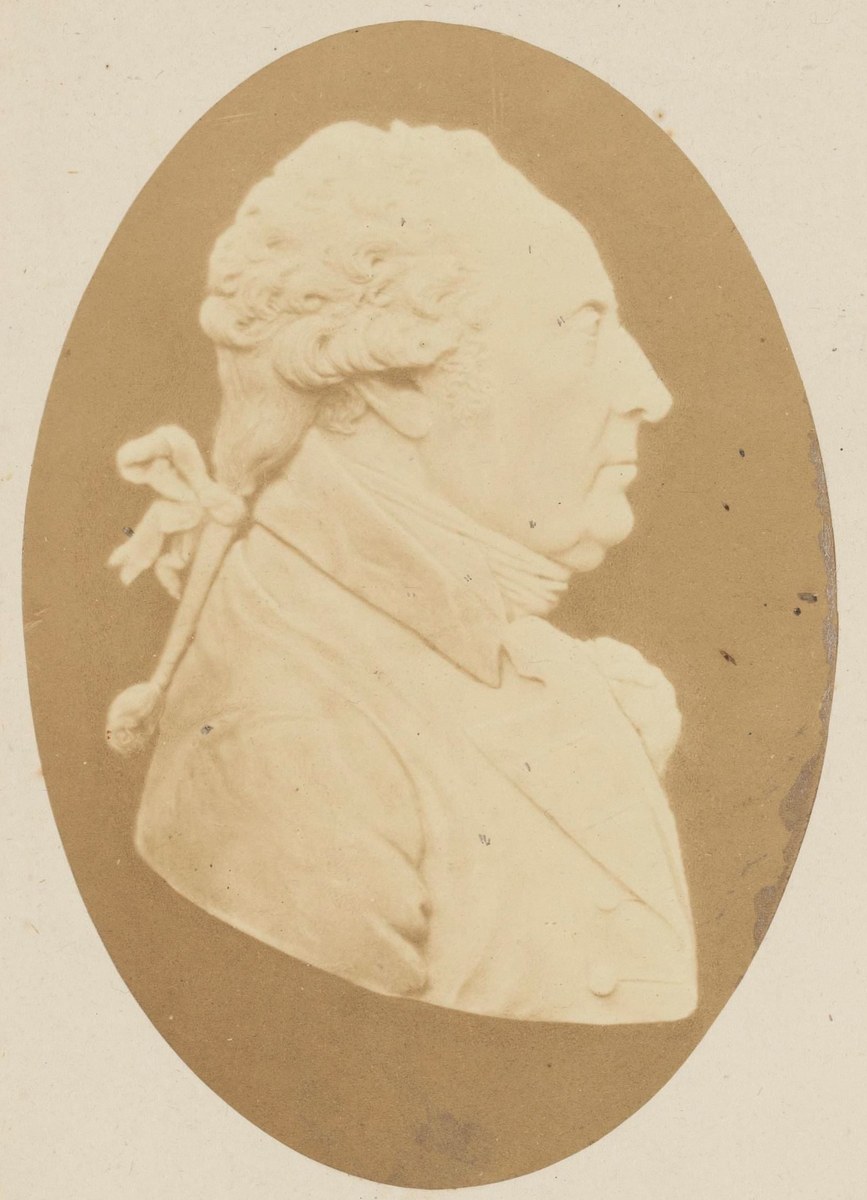

Henry Joseph Whitlock (photographer), photograph of a lifetime wax medallion of Matthew Boulton, frontispiece in Langford, 'A Century of Birmingham Life', vol. 2, 1868. Rijksmuseum, Amsterdam, RP-F-2001-7-65B-1 (Public Domain). Cropped and downscaled. · Albumen photograph by Henry Joseph Whitlock of Birmingham, named on the print, of a wax medallion of Matthew Boulton 'modelled from life' then owned by Mr John Rabone Junior, pasted in as the frontispiece of volume 2 of John Alfred Langford's 'A Century of Birmingham Life' (Birmingham, 1868), held by the Rijksmuseum, Amsterdam (object number RP-F-2001-7-65B-1, 'Portret in was van Matthew Boulton op 24 juni 1787'), dated by the museum c. 1858 - in or before 1868. The printed caption under the oval reads 'From a Wax Medallion modelled from life in the possession of Mr. John Rabone Junr' and 'Photographed by Mr. H. J. Whitlock, Birmm', and the sitter's signature 'Matthew Boulton' and the date '24th June 1787' are printed above it. The file is the oval portrait cropped from the museum's 5834 x 4590 pixel scan of the open book (crop 1560 x 2160) and downscaled to 867 x 1200 with no upscaling. · Public Domain Mark 1.0 and CC0 as stated in the Rijksmuseum's own item record; the wax relief is from the 1780s and the photograph was made and published in Birmingham in the 1860s (public domain by age)
사업가 · 근세
매슈 볼턴
1728–1809
주요 업적 분야
아직 성격 매칭에 포함되지 않았습니다 — 기록된 근거가 성격 모델 전체를 다루기에는 충분하지 않습니다. 이 페이지의 다른 모든 내용은 자유롭게 확인하실 수 있습니다.
핵심 특성
주요 업적
1775년 제임스 와트의 동업자가 되어 와트의 증기기관을 소호에서 상업 생산으로 이끈 버밍엄의 제조업자이다. 그는 존 로벅의 특허 지분을 채무 정산으로 넘겨받았으며, 1800년까지 영국과 해외에 설치된 기관은 500대에 가까웠다.
1762년 버밍엄 근교에 소호 공장을 세워 단추, 버클, 셰필드 도금 제품, 오르몰루 같은 작은 금속 제품을 만들었으며, 디자인·생산·판매를 직접 통제하고 노동 절감 기계를 갖추었다. 버밍엄 박물관은 이 업종이 버밍엄을 '세계의 장난감 가게'로 만드는 데 이바지했다고 설명한다.
1788년 증기력으로 움직이는 소호 조폐소를 세우고, 금속 가치가 액면가에 맞는 1797년 영국 구리 주화(카트휠 페니 포함)를 찍었다. 해외 조폐소와 런던 왕립조폐국용 기계도 공급했다.
삶의 장면들
와트 특허 연장 운동에서 볼턴은 '기관 법안의 지지자 명단'에 77명과 소수파 귀족들을 올려 두고 에드먼드 버크가 이끄는 반대에 맞섰으며, 결국 법률로 특허 기간이 연장되었다.
이는 사업상의 목적을 이루기 위해 인맥을 체계적으로 움직인 사람의 면모와 일치한다. 설득력
1772년 존 로벅이 파산하자 볼턴은 1,200파운드 채권의 정산으로 와트 기관 특허의 로벅 지분을 넘겨받았고, 『영국인명사전』에 따르면 자기 자본과 빌릴 수 있는 돈을 모두 쏟아부어 기관이 수익을 내기 전에 파산할 뻔했다.
이는 검증되지 않은 사업에 자기 자원을 거는 것을 마다하지 않은 태도와 일치한다. 위험 감수
전환점
1775년 소호에서 작은 금속 제품을 만들어 온 그는 와트의 증기기관 사업 동업자가 되었으며, 과학박물관 그룹은 이 사업이 그의 가장 수익이 큰 사업이었다고 기록한다.
이는 수요가 크다고 판단한 새 기술로 사업의 무게를 옮긴 제조업자의 면모와 일치한다. 기회 감지
비슷한 인물
전체적인 프로필이 이 사람과 닮은 사람들이에요.
출처
- Matthew Boulton (Q469269), verified live via the Wikidata API (2026-11-05): English label 'Matthew Boulton', description 'English manufacturer, industrialist, business partner of James Watt (1728-1809)', Korean label 매슈 볼턴, born 3 September 1728, died 17 August 1809, citizenship Great Britain and the United Kingdom. Orientation only; not used as support for any row.
- Science Museum Group collection, people record 'Matthew Boulton 1728-1809', biography read in full. CANONICAL SIGNIFICANCE SOURCE: he took over the family toy-trade business at 21, built the Soho works near Birmingham in 1762, took over Roebuck's share of Watt's first engine patent in 1769, became Watt's partner in 1775, foresaw great industrial demand for steam power and urged Watt to design the double-acting rotative engine (patented 1782), set up a copper-coinage mint at Soho and later supplied complete mints overseas, and by 1800 almost 500 engines had been installed; the mint 'appears to have given him most satisfaction' although the engines were most profitable. Institutional biography, celebratory in tone, no criticism.
- Birmingham Museums, 'Local historic people: Matthew Boulton' (page read in full). Soho Manufactory begun 1762 on the toy trade that helped Birmingham become 'the toy-shop of the world'; partnership with James Watt from 1775; coin manufacturing by accurate machining; key member of the Lunar Society, which met at Soho House. Local institutional page; internally inconsistent on his birth year (1718 and 1728) and marriages, so only its uncontested business facts are used; no criticism.
- Dictionary of National Biography (1886), entry 'Boulton, Matthew' by H. T. Wright Wood (Wikisource text, read in full). Soho opened 1762; Boulton sought to raise the artistic quality of his goods and hired agents to find fine metal and pottery models; after Roebuck's failure in 1772 he took Roebuck's share of the engine patent in settlement of a 1,200-pound claim; on his advice an Act extended the patent term; he put all his capital and what he could borrow into the enterprise and nearly went bankrupt before it paid; set up steam coining presses at Soho in 1788; coinage for the East India Company and others, a new British copper coinage in 1797; Soho a meeting place for scientists. Victorian standard biography, admiring; says little on workers or finances.
- Grace's Guide to British Industrial History, page 'Matthew Boulton' (read in full). Collates a PhD thesis on the Soho Mint (Sue Tungate, 2010) crediting him with qualities of leadership, perseverance and technical insight, a 1923 Hadfield assessment of the Boulton, Watt and Murdoch partnership, and business facts: Soho not profitable for years from 1762 to 1775; labour-saving devices and interchangeable components; design, production and marketing brought under his own control; in the 1770s a sickness and injury benefit fund financed by 1/60th of wages; clean, well-lit works and no employment of young children; own capital and borrowing committed to the engine venture; 1772 Roebuck share; mechanical painting venture failed; Soho Mint from 1788. Secondary compilation; the benefit-fund and workshop details are as stated by the page, not independently checked.
- Westminster Abbey, commemoration page 'Matthew Boulton' (read in full): described as an entrepreneur of the Industrial Revolution and founding member of the Lunar Society; floor stone unveiled October 2014 inscribed 'Pioneer of the Industrial Revolution'. Commemorative institutional page; limited behavioural content.
- Eric Robinson, 'Matthew Boulton and the Art of Parliamentary Lobbying', The Historical Journal 7(2), 1964, pp. 209-229 (Cambridge University Press): only the publisher's page extract, reference notes and metadata were opened (the full article is not available). The extract says the extension of Watt's patent was the most important single event in the Industrial Revolution and documents Boulton's methods in getting it through Parliament: a 'List of Friends on the Engine bill' naming 77 persons plus the minority lords, opposition led by Edmund Burke, and a note that Boulton was wrong in thinking the Assay Office aims could be secured by Crown charter rather than an Act. Scholarly, independent of the museum voices; only the extract was read.
- Coin World, 'UK's Cartwheel coins reflect Industrial Revolution impact' (read in full): in June 1797 Boulton received royal permission to strike copper coins at his Soho mint; steam power let him and Watt make round coins of identical weight, faster and with more definition than the screw press; his stated aim was to restore confidence in small change with coins whose metal was worth face value (penny 28.35 g, twopence 56.7 g); the penny circulated widely while the twopence was judged too heavy and clumsy. Numismatic trade press; independent of the museum voices and includes a practical criticism of one coin.
- Linda Hall Library, 'Scientist of the Day: Matthew Boulton' (read in full): factory at Soho, partnership with Watt from 1775 under an exclusive patent until 1800, steam-driven coining presses, fine copper coins, the 1797 cartwheel penny; includes an 1860s print of distinguished men of science that shows him with Watt and Dalton. Library blog; adds little behavioural detail.
- History News Network, review of the Matthew Boulton exhibition at Birmingham Museum and Art Gallery (read in full): partnership offered to Watt in 1775, Soho Mint founded 1788 and about 45 million coins struck 1797-1799, Boulton's name overshadowed by Watt's, quotes his 1776 letter to James Boswell ('I sell here, Sir, what all the world desires to have - POWER'). Wholly celebratory exhibition review; no criticism.
- Michele Boldrin and David K. Levine, 'James Watt, Monopolist' (Mises Institute, excerpt from Against Intellectual Monopoly, 2008; read in full). COUNTER-VOICE: argues that Boulton and Watt used litigation against Hornblower, refused to license the separate condenser (a quoted view of economic historian F. M. Scherer) and used Boulton's parliamentary connections to win the 1775 extension over Burke's objection, thereby retarding steam-engine improvement. Advocacy for a thesis about patents; used only for what the firm did, not for its motives or effects.
- George Selgin and John L. Turner, 'Strong Steam, Weak Patents, or the Myth of Watt's Innovation-Blocking Monopoly, Exploded', Journal of Law and Economics 54(4), 2011 (abstract read via the RePEc record; full text unavailable): disputes the claim that Watt's patent held back high-pressure steam until it expired in 1800, arguing other causes such as safety beliefs and that the monopoly may have spurred Trevithick. Independent scholarly counter to the advocacy source; abstract only.