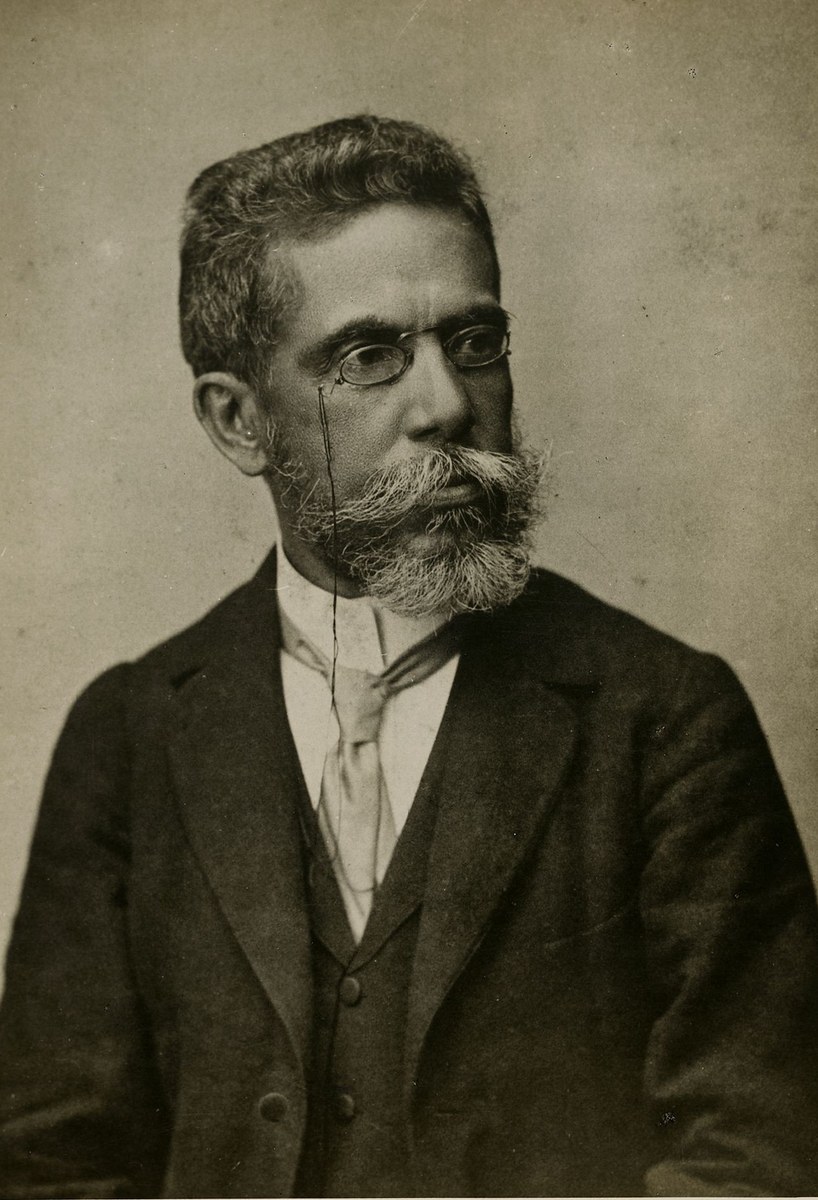

Photographer unknown, c. 1896, Fundacao Biblioteca Nacional (Brazil), via Wikimedia Commons (public domain) · Wikimedia Commons file 'Machado de Assis aos 57 anos.jpg', a studio portrait photograph of Machado de Assis at about 57 (circa 1896) from the iconography collection of the Fundacao Biblioteca Nacional, Brazil; photographer unknown; original 1263 x 1852 pixels, downscaled to 818 x 1200 with no cropping. Public domain by age: an anonymous photograph of about 1896 is outside copyright in the United States (published before 1931, or unpublished and older than 120 years) and in Brazil; the library's own item page states no terms. · Public domain (anonymous photograph, c. 1896)
핵심 특성
주요 업적
브라질 문학원과 참고 문헌들이 브라질 최고의 작가로 평가하는 그는 《브라스 쿠바스의 사후 회고록》(1881)을 계기로 감상적 낭만주의에서 아이러니하고 서술이 모호한 소설로 방향을 바꾸었다.
대표작으로 《브라스 쿠바스의 사후 회고록》(1881), 《킨카스 보르바》(1891), 《동 카스무로》(1899)가 있고 200편이 넘는 단편도 썼으며, 비평가들은 그의 아이러니와 자기 지시적 기법이 후대 라틴아메리카 작가들의 길을 닦았다고 본다.
인쇄소 견습공 출신의 독학자였던 그는 1897년 브라질 문학원이 개원할 때 초대 원장으로 선출되어 세상을 떠날 때까지 이끌었으며, 동시에 약 40년간 공직에도 몸담았다.
삶의 장면들
1892년 그는 다른 부처 소관으로 사실상 이중 복권인 카드 판매 계획의 특허가 관보에 실린 것을 보고, 자신의 장관을 통해 문제를 제기해 결국 특허가 취소되도록 했다.
이는 자기 소관이 아닌 문제에도 나서는 태도와 부합하지만, 동기는 한 호의적 전기 작가의 해석에 의존한다. 선제적 행동력
1876년 법학 교육을 받지 않은 그는 부서 과장으로서 항소되지 않은 판결 이후의 노예 등록 문제에 의견서를 썼고, 자문받은 관리들의 의견이 갈렸으나 그의 견해가 받아들여졌다.
이는 독립적인 직무상 판단과 부합하지만, 이 일화는 하나의 기록 기반 전기에 의존한다. 독립적 사고
전환점
1880년 《브라질 평론》에 연재되고 1881년 단행본으로 나온 《브라스 쿠바스의 사후 회고록》은 그의 문학 경력에 새로운 방향을 열어 걸작의 시기를 시작하게 했다.
이는 초기의 낭만주의적 방식에서 더 독창적인 서사 방식으로의 의도적 전환과 부합한다. 창의적 독창성
비슷한 인물
전체적인 프로필이 이 사람과 닮은 사람들이에요.
출처
- Machado de Assis (Q311145), verified live via the Wikidata API (2026-10-31): label 'Machado de Assis', description 'Brazilian writer (1839-1908)', born 21 June 1839, died 29 September 1908, Korean label present. Orientation only; not used as support for any row.
- Wikipedia, 'Machado de Assis', fetched for orientation (dates, the existence of contemporary criticism of his public silence on abolition). Orientation only; never counted as support for any row.
- Academia Brasileira de Letras, 'Machado de Assis' biography page (in Portuguese), read in full: states that he founded chair 23 of the Academy and presided over it for more than ten years, was elected its president when it was installed on 28 January 1897 and devoted himself to it until his death; traces his path from a printer's apprentice at the Imprensa Nacional to journalist, poet, playwright, short-story writer, chronicler and novelist; dates Posthumous Memoirs of Bras Cubas (1881) as the book that gave his career a new direction and calls the masterpiece phase that followed escaping any school, making him the greatest writer of Brazilian letters. CANONICAL SIGNIFICANCE SOURCE: the institution he founded and led, so admiring and partly self-affiliated.
- Gale reference biography 'Assis, Joaquim Maria Machado de' (Encyclopedia.com copy, updated 2018), read in full: overview calling him thought by many to be Brazil's greatest writer; his civil-service career; the move from sentimental Romanticism to ironic fiction with Posthumous Memoirs of Bras Cubas (1881), Quincas Borba (1891) and Dom Casmurro; his refusal of the realist and naturalist values of his contemporaries in favour of eighteenth-century narrative models; first president in perpetuity of the Brazilian Academy of Letters; critics' view that his irony and self-reference cleared ground for later Latin American writers; over two hundred short stories. Reference article; its personal-health remarks were not used.
- Raymundo Magalhaes Jr., 'Machado de Assis funcionario publico', Revista do Servico Publico 56(2), 2005 (reprint of the 1981 article; in Portuguese), read in full: archival account of his forty-year civil-service career (from the Diario Oficial in 1867 and the Agriculture Ministry from 1873 to director-general of accounting), his 1876 legal opinion on the registration of enslaved people under the 1871 law, his 1892 intervention against a patent for a disguised lottery scheme, the 1890s press denunciation he did not answer, and that he died without retiring. Written by his established biographer, so admiring; useful because it rests on dated official records.
- Pesquisa FAPESP, 'Velho Machado' (February 2004; in Portuguese), read in full: science-journalism report on historian Sidney Chalhoub's book 'Machado de Assis historiador', presenting his argument that the novelist and the head of the Agriculture Ministry's second section (1870 to 1880) shared a view of the slaveholding elite, and that the official worked to subject private power to the rule of law. Independent journalism summarising one scholar's thesis.
- Daniel Piza, review of Sidney Chalhoub's 'Machado de Assis, historiador', O Estado de S. Paulo, 23 November 2003 (copy hosted by Unicamp's CECULT; in Portuguese), read in full: a critic-biographer's assessment that is partly critical (he calls some of Chalhoub's readings forced, notes the book's gaps and warns against reducing Machado to an unmasker of the elite) while accepting that Machado's 1876 legal opinion defended the spirit of the law on behalf of freedpeople and that earlier critics already read him against the issues of his time. Provides the counter-voice on interpretation.
- Interview with historian Sidney Chalhoub, Aedos journal (UFRGS; in Portuguese), read in full: the author of 'Machado de Assis historiador' explains how he reads Machado's fiction as social history and states how his reading differs from those of Roberto Schwarz and John Gledson, whose work he credits as intellectual debts. Scholarly interview; shows that critics disagree about how Machado represented slavery and dependants, and is used only for that disagreement, not for any row.