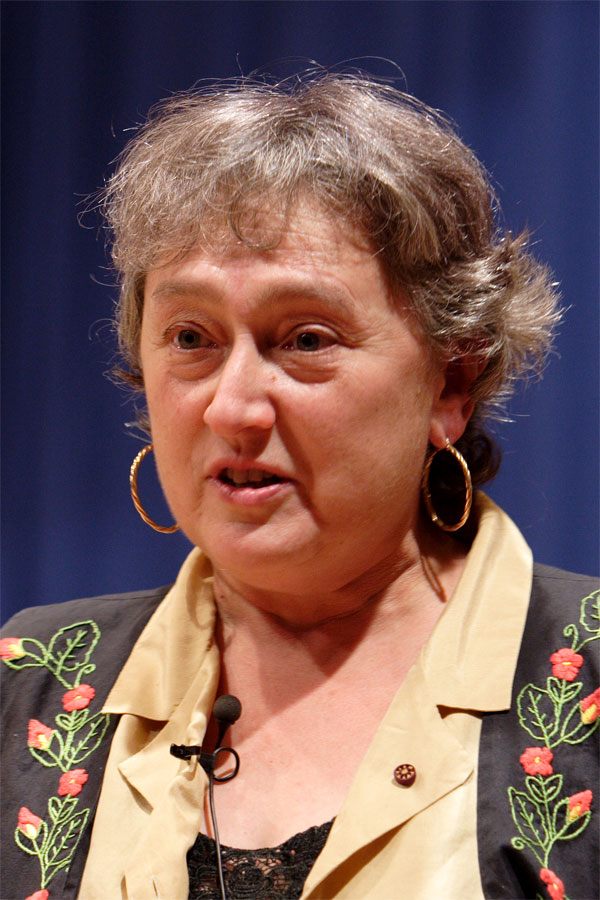

Photo: Javier Pedreira (Wicho), 2005, CC BY-SA 2.5 · Wikimedia Commons, 'Lynn Margulis.jpg' -- photograph by Javier Pedreira (Wicho) taken 9 November 2005 (EXIF-confirmed) at the III Congress on scientific communication in La Coruna, self-published by the photographer under CC BY-SA 2.5. Original 600 x 900 pixels (SHA-1 85400a7f matches the Commons record); saved unchanged, never upscaled. · CC BY-SA 2.5
생물학자 · 20세기
린 마굴리스
1938–2011
주요 업적 분야
아직 성격 매칭에 포함되지 않았습니다 — 기록된 근거가 성격 모델 전체를 다루기에는 충분하지 않습니다. 이 페이지의 다른 모든 내용은 자유롭게 확인하실 수 있습니다.
핵심 특성
주요 업적
마굴리스는 1967년 『이론생물학 저널』에 실린 논문에서 미토콘드리아와 엽록체가 숙주 세포에 흡수된 세균에서 유래했다고 주장해, 1905년 콘스탄틴 메레시콥스키가 제안했던 공생설을 되살렸다. 크놀과 EBSCO는 이 논문이 게재되기 전 약 15개 학술지에서 거절당했다고 전하며, EBSCO는 그가 이 일로 '엄청난 적대'를 겪었다고 쓴다.
크놀은 그가 이 아이디어를 세포·분자 차원으로 다시 서술해 검증 가능하게 만들었고, 이후 연구가 두 세포 소기관 모두 막으로 싸여 있고 자체 DNA를 지닌다는 점을 보여 주었다고 쓴다. 엽록체 유전자는 자유 생활 시아노박테리아와, 미토콘드리아는 프로테오박테리아 안쪽 계통과 묶인다. 크놀은 이를 20세기 과학의 큰 진전으로 꼽는다. 그는 1983년 미국 국립과학원 회원으로 선출되었고 1999년 국가과학메달을 받았다.
마굴리스는 제임스 러브록의 가이아 가설을 지지하고 이를 협력에 기반한 대안 생물학과 엮어, 공생이 새로운 종의 기원을 이끈다고 주장했다. 크놀은 대다수 생물학자가 이제 협력의 더 큰 역할을 인정하지만 공생이 종분화를 이끈다는 데 동의하는 이는 드물고, 편모가 공생 세균에서 유래했다는 그의 주장은 강한 지지를 얻지 못했다고 쓴다. 『타임스 하이어 에듀케이션』은 리처드 도킨스가 공개적으로 적대적이었고 대부분의 과학자가 가이아를 불필요하다고 보았다고 전한다.
삶의 장면들
마굴리스의 1967년 공생 기원 논문은 『이론생물학 저널』에 실리기 전 약 15개 학술지에서 거절당했고, EBSCO에 따르면 그는 과학계의 적대에도 불구하고 이 이론을 발표하고 옹호하기 위해 널리 다녔다.
거절당한 아이디어를 여러 해 동안 꾸준히 살려 낸 노력과 일치한다. 끈기
크놀은 마굴리스가 협력과 공생을 중심으로 한 대안 생물학을 세우며 진화론의 기본 전제 일부를 거부했고, 편모가 공생 세균에서 유래했다는 주장은 강한 지지를 얻지 못했다고 쓴다. 그는 마지막 인터뷰에서 자신의 생각이 논란적이라기보다 옳다고 말했다고 한다.
분야 대부분에 맞서 진화에 대한 자기 관점을 고수한 태도, 그리고 엇갈린 결과와 일치한다. 독립적 사고
전환점
1967년 논문 뒤 마굴리스는 1970년 『진핵세포의 기원』과 1981년 『세포 진화에서의 공생』을 냈고, 크놀의 설명에 따르면 이후 엽록체와 미토콘드리아의 유전자 서열이 이 소기관들을 세균 계통 안에 자리매김했다. 이 아이디어는 거절당한 제안에서 『네이처』의 표현대로 복잡한 세포 진화의 결정적 단계로 널리 받아들여지는 이론이 되었다.
검증 가능한 증거가 쌓이면서 아이디어가 거절에서 수용으로 옮겨 간 흐름과 일치한다. 창의적 독창성
비슷한 인물
전체적인 프로필이 이 사람과 닮은 사람들이에요.
출처
- Lynn Margulis (Q234583) -- verified live via the Wikidata API (2026-10-23): English label 'Lynn Margulis', description 'American evolutionary biologist (1938-2011)', born 5 March 1938, died 22 November 2011, citizenship United States, Korean label '린 마굴리스', English and Korean Wikipedia sitelinks present. Orientation only; not used as support for any row.
- Andrew H. Knoll, 'Lynn Margulis, 1938-2011' (Proceedings of the National Academy of Sciences 109(4):1022, January 2012; PubMed Central), read in full: obituary by a Harvard palaeobiologist -- Chicago degree at 18 and Berkeley PhD six years later, two decades at Boston University then Distinguished University Professor at UMass; the 1967 'On the origin of mitosing cells' paper rejected by some 15 journals first, Merezhkovsky's 1905 forerunner, her restating of the idea in cell and molecular terms so it became testable, and the later DNA evidence for chloroplasts and mitochondria (counted by Knoll as one of the great advances of 20th-century science); her claim about the symbiotic origin of flagella never gained strong support; her backing of Lovelock's Gaia hypothesis and an 'alternative biology' of cooperation that put her in lasting conflict with evolutionary biologists; she also questioned HIV's role in AIDS; a 'fountain of ideas' who could infuriate colleagues; her advocacy of science education, especially in less developed countries; her remark that she considered her ideas 'right' not controversial. CANONICAL SIGNIFICANCE SOURCE. Insider obituary in an academy journal, admiring but openly critical in places. Its passages on her maternal manner and family were not used.
- EBSCO Research Starters, 'Lynn Margulis' (ebsco.com), read in full: schooling and positions (Chicago, Wisconsin, Berkeley PhD 1965, Brandeis postdoc, Boston University from 1965, UMass Amherst); the 1967 Journal of Theoretical Biology paper rejected by fifteen journals, her renaming of the Merezhkovsky and Kozo-Polyansky idea as endosymbiotic theory; the 1970 book and serial endosymbiosis theory; later data supporting it (organelle DNA resembling bacterial DNA); the claim that flagella and cilia came from spirochetes; her work with Lovelock on Gaia; the 'enormous hostility' her revival of the theory drew, and that she travelled widely to defend it; awards (National Medal of Science, Darwin-Wallace Medal, Guggenheim). Reference overview; the page's reference to 'Lynn Sagan' as author is its own naming inconsistency; its passages on family were not used.
- Susan Young, 'Lynn Margulis dead at 73' (Nature news blog, 23 November 2011), read in full: obituary notice with her degrees, UMass professorship, 1983 election to the National Academy of Sciences and 1999 National Medal of Science; endosymbiosis described as initially met with scepticism but now widely accepted; a quotation from UMass dean Steve Goodwin that she believed in 'pushing it to the limits' while conventional scientists tended to 'stop a little too soon' and made connections others wouldn't. Short contemporaneous notice; its family details and cause of death were not used.
- Andrew Robinson, 'Earth mother, microbe lover' (Times Higher Education 'Worldly wise' interview profile, 3 July 1998), read in full: her serial endosymbiosis and symbiogenesis claims, five-kingdom classification versus Woese's rival scheme, Gaia as 'symbiosis as seen from space' and her denial of goddess implications; E. O. Wilson calling her 'one of the most successful synthetic thinkers in modern biology'; Richard Dawkins openly hostile and refusing to share a platform, most scientists regarding Gaia as unnecessary or mystical; her paper rejected 15 times and lost by Science; her view that the textbook version of mitochondria is dogmatic; her blunt, combative style in interview. Contemporaneous profile based on an interview, so some content is self-description (not used alone). Its passages on feminism and personal opinions were not used.
- Robert Thorson, ''Rebel' Earth Mother Probed Life's Secrets' (University of Connecticut Department of Earth Sciences blog, posted 19 July 2021; column drafted around 2012), read in full: tribute column that summarises endosymbiosis and the rejection of the 1967 paper by more than a dozen journals, her National Academy election (1983), National Medal of Science (1999) and Darwin-Wallace Medal (2008); her Gaia position (rejecting the Earth-as-organism comparison as unscientific); and quotes John Archibald's Current Biology obituary calling her 'amusing, exasperating, enlightening', favouring holistic over reductionist approaches, increasingly dogmatic and criticised and praised in equal measure. The Archibald obituary itself was not opened (quoted at second hand). Popular column, partly admiring and partly critical.
- National Center for Science Education, 'Lynn Margulis dies' (ncse.ngo, 23 November 2011), read in full: short notice reporting that endosymbiotic theory beginning with her 1967 paper is now broadly accepted for mitochondria and chloroplasts but not for every organelle she proposed, and that symbiogenesis and Gaia were unconventional mechanisms that antievolutionists have misrepresented; she rejected creationism. Used only to corroborate the partial acceptance of her claims. Advocacy organisation notice; nothing beyond that was used.
- Wikimedia Commons file page 'Lynn Margulis.jpg' (with the Commons API record), checked for the portrait's licence: photograph by Javier Pedreira (Wicho), taken 9 November 2005 at a science-communication congress in La Coruna (EXIF date 2005-11-09), self-published by the photographer under CC BY-SA 2.5; 600 x 900 original. Not used for any scoring.