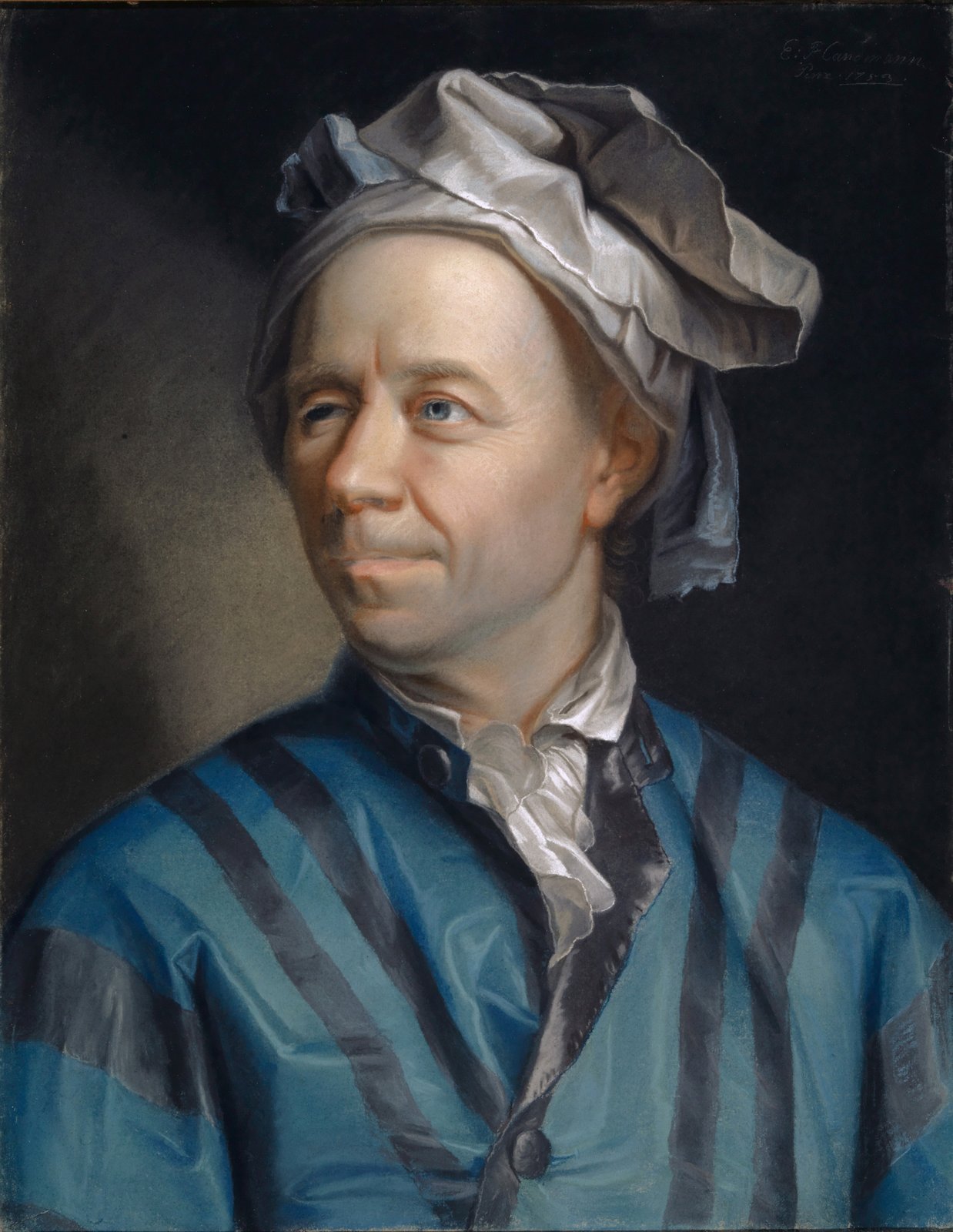
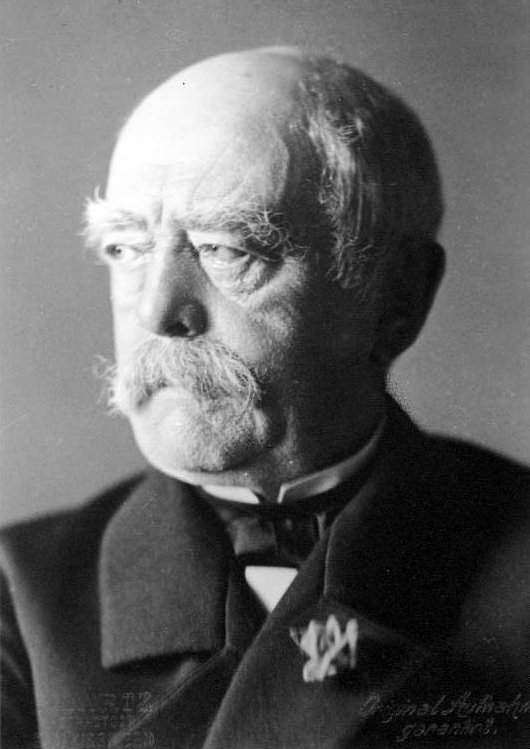
Jakob Emanuel Handmann, Portrait of Leonhard Euler, 1753, Kunstmuseum Basel (photograph: Martin P. Bühler); public domain via Wikimedia Commons · Jakob Emanuel Handmann, pastel on paper, 1753, Kunstmuseum Basel (inv. 276), via Wikimedia Commons · Public domain
핵심 특성
주요 업적
MacTutor는 오일러가 1735년까지 자연수 제곱의 역수를 모두 더한 값이 π²/6임을 보였다고 기록한다. 이 문제는 베르누이 가문의 세 수학자를 비롯한 당대 일류 수학자들이 풀지 못한 것이었다. 그는 이어 더 높은 짝수 거듭제곱의 합도 구했고, 1739년에는 그 일반 계수를 베르누이 수로 나타냈다.
오일러는 『역학(Mechanica)』(1736~37)에서 진공과 저항 매질 속 질점의 운동, 중심력 아래의 운동, 곡면 위의 운동을 수학적 해석으로 다루었다. MacTutor는 유시케비치를 인용하며, 이전의 역학이 문제마다 별도의 접근을 요구하는 종합적·기하학적 방법에 주로 의존했다는 점과 대비시킨다. 콩도르세도 1783년 추도문에서 이 저작을 운동 연구에 해석학을 적용한 획기적 저작으로 꼽는다.
오일러의 달 운동 이론은 독일 천문학자 토비아스 마이어가 달 운행표를 만드는 데 쓰였다. 1765년 영국은 해상 경도 결정에 대한 이 운행표의 기여를 인정해 마이어의 미망인에게 3,000파운드를, 오일러에게는 이론적 기여에 대한 대가로 300파운드를 지급했다.
삶의 장면들
1736년 3월 13일 빈의 궁정 천문학자 조반니 마리노니에게 보낸 편지에서 오일러는 쾨니히스베르크 다리 문제를 시시하지만 눈여겨볼 만한 문제라고 불렀다. 기하학도 대수학도 셈하는 기술도 이를 풀기에 충분하지 않았기 때문이다. 그는 이것이 라이프니츠가 갈망했던 '위치의 기하학'에 속하는지 물으며, 다리의 수와 배치가 어떠하든 각 다리를 한 번씩만 건너는 순회가 가능한지를 곧바로 판정하는 간단한 규칙을 얻었다고 알렸다.
산책길 퍼즐을 특정 경로의 문제가 아니라 연결이 어떻게 배열되어 있는가의 문제로 다룬 것은 이 프로필의 시스템적 사고 항목과 부합한다. 다만 근거가 편지 한 통뿐이므로 이 습관의 윤곽만 보여 줄 뿐이다. 시스템적 사고
1755년 8월 12일 열아홉 살의 조제프루이 라그랑주는 오일러에게 극대·극소 문제를 푸는 해석적 방법을 보냈고, 오일러는 9월 6일 답장에서 깊은 인상을 받았다고 썼다. 한 분야 개관 논문에 따르면 오일러는 1756년 베를린 학술원에서 이 방법을 처음 발견한 영예는 라그랑주에게 돌아가야 한다고 밝혔다. 그는 라그랑주를 학술원 회원으로 추천했고 라그랑주는 1756년 9월 2일 선출되었다. 1766년 베를린을 떠날 때는 후임 수학부장으로 라그랑주를 추천했다.
한 가지 해석은, 오일러가 더 젊은 수학자의 더 나은 방법을 받아들이고 이를 공개적으로 밝힐 의향이 있었다는 것이며, 이는 믿음 수정 항목과 부합한다. 다만 자료가 보여 주는 것은 방법의 수정과 공적 인정이지 철회된 주장이 아니므로 이 해석의 폭은 크지 않다. 입장 수정 성향
전환점
1726년 가을 오일러는 상트페테르부르크 학술원의 생리학 조교수 자리 초청을 받아들여 의학 공부를 시작했고, 동시에 음향학에 관한 짧은 논문으로 바젤 대학의 물리학 교수직에도 응모했으나 후보로 추천받지 못했다. 그는 1727년 4월 5일 바젤을 떠났고, 도착 후에는 학술원 수학부에 배치되었으며, 스위스 시민권은 유지했지만 다시는 스위스로 돌아가지 않았다.
생리학 자리를 준비하다가 결국 수학 분야에서 일하게 된 경위는 적응력 항목과 부합한다. 다만 확인한 자료에는 어느 분야를 선호한 이유에 대한 오일러 본인의 설명이 없으므로, 이는 동기가 아니라 경위에 대한 해석이다. 적응력
비슷한 인물
전체적인 프로필이 이 사람과 닮은 사람들이에요.
출처
- Leonhard Euler -- orientation only (identity, dates, occupations, citizenships); fetched and skimmed; not used as support for any scored row.
- Leonhard Euler (Q7604) -- identity verified live through the Wikidata API: en label 'Leonhard Euler', description 'Swiss mathematician, physicist, and engineer (1707-1783)', ko label '레온하르트 오일러', born 15 April 1707, died September 1783, P18 images 'Leonhard Euler 2.jpg' and 'Leonhard Euler.jpg'. Orientation only.
- A. P. Yushkevich, 'Euler, Leonhard', Complete Dictionary of Scientific Biography (Scribner's; Encyclopedia.com copy hosted as PDF by MacTutor) -- independent scholarly reference biography (non-self, secondary). The Life section (childhood to death, about 300 lines) was read in full: the 1726 physiology invitation and 1727 move, the Petersburg and Berlin periods, the 1746 monadology pamphlet, the 1751-52 Koenig affair and the 1745 Robins translation, the disputes with d'Alembert, Daniel Bernoulli and Dollond, the 1766 return, and Euler's supervision of Russian students. The remaining ~700 lines (science sections) were not read.
- J. J. O'Connor and E. F. Robertson, 'Leonhard Euler', MacTutor History of Mathematics, University of St Andrews -- modern scholarly biography (non-self, secondary; it quotes Yushkevich/DSB and Calinger, and its Euler, Lagrange and Maupertuis pages share authors so count as one perspective). Read in full: the 1726-27 move and 1727-30 navy service, Berlin duties, Mechanica (1736-37), the Euler-Stirling-Maclaurin letters, the Mayer/longitude payment, the Russian Atlas and Euler's autobiographical account of Bernoulli's tutoring.
- Nicolas Fuss, Eulogy of Leonhard Euler, read at the St Petersburg Academy 23 October 1783 (English translation by John S. D. Glaus, hosted by MacTutor / The Euler Society) -- FIRSTHAND colleague account: Fuss was Euler's assistant and later married one of Euler's granddaughters, so this is an affiliated, admiring source and is weighted accordingly; it is one perspective. Read in full: the 1726-27 Petersburg move and naval fallback, Robins, Dollond, the monad pamphlet, the Koenig dispute, the lunar-theory recast, the Dioptrica correction and the character section.
- Marquis de Condorcet, Eulogy to M. Euler, Histoire de l'Academie Royale des Sciences 1783 (Paris 1786), pp. 37-68 (English translation by John S. D. Glaus, hosted by MacTutor / The Euler Society) -- contemporaneous eulogy by the secretary of the Paris Academy; secondhand and not affiliated with Euler's household, and it includes explicit criticism (the Koenig affair, Euler's physics). One perspective. Read in full apart from about a page of purely mathematical exposition: recreational problems and breadth of learning, the 'instinct' passage, the optics passage in which Euler abandons his first ideas, remaking of earlier work, the Lagrange passage, and the Koenig criticism.
- Euler Archive (MAA / Dartmouth), 'Euler's Correspondence with Giovanni Jacopo Marinoni' -- archive page quoting Euler's own letter to Marinoni of 13 March 1736 (OO1468, translation from Hopkins and Wilson, College Mathematics Journal, May 2004) about the Koenigsberg bridge problem and the 'geometry of position'. SELF-AUTHORED (Euler's own words; same perspective as any other Euler writing). The page is a short quotation with a letter list; the letter itself was not opened, and the Hopkins-Wilson article was paywalled and not read.
- Ed Sandifer, 'How Euler Did It: Estimating the Basel Problem', MAA Online, December 2003 (Euler Archive PDF) -- scholarly expository column (non-self; Sandifer is Secretary of the Euler Society, so an enthusiast-scholar). Read in full: Euler's numerical estimate 1.644924 of the Basel sum and his recognition that it is close to pi squared over six. Same author as src_euler_sandifer_2004 (one perspective).
- Ed Sandifer, 'How Euler Did It: Basel Problem with Integrals', MAA Online, March 2004 (Euler Archive PDF) -- same author as src_euler_sandifer_2003. Read (first pages, through the start of the 1741 derivation): Sandifer's statement that Euler seemed to recognise his infinite-product step as incomplete, wrote further papers (E 61) trying to justify it, and in 1741 published a different solution not depending on infinite products.
- Dora E. Musielak (Univ. of Texas at Arlington), 'Euler: Genius Blind Astronomer Mathematician', arXiv:1406.7397 -- modern secondary review of Euler's astronomy (non-self). Read closely: the Berlin period, the lunar-theory sections (1746 tables, 1751/1753 theory, second theory, 1775 paper), the Jupiter-Saturn prize episode (1748, 1750, 1752), the precession/d'Alembert credit passage, the Mayer longitude payment and the optics passage. Other sections were skimmed only.
- James Ferguson (Univ. of Victoria), 'A Brief Survey of the History of the Calculus of Variations and its Applications', arXiv:math/0402357 -- modest secondary survey (non-self) that quotes Euler's 1756 Berlin Academy acknowledgement of Lagrange and says Euler dropped his geometrical methods for Lagrange's analytic one. Read the Lagrange section; the rest skimmed. Lower-authority source, used only for that episode alongside MacTutor.
- J. J. O'Connor and E. F. Robertson, 'Joseph-Louis Lagrange', MacTutor -- (same authors as src_euler_mactutor). Read the early-career section: Lagrange's letters to Euler of 12 August 1755, Euler's reply of 6 September 1755, Euler proposing Lagrange for the Berlin Academy (elected 2 September 1756), and Lagrange's succession to Euler's post in 1766.
- J. J. O'Connor and E. F. Robertson, 'Pierre Louis Moreau de Maupertuis', MacTutor -- (same authors as src_euler_mactutor). Read the Berlin Academy section on the 1751 Koenig affair, including that Maupertuis was strongly defended by Euler.
- Linda Hall Library, 'John Dollond', Scientist of the Day -- independent library-institution profile; read in full. States that Newton and many others thought chromatic aberration irremediable and that some, like Leonhard Euler, disagreed, noting the eye as the reason.
- Grace's Guide, 'John Dollond' (reproduces an earlier encyclopedia entry, in the Britannica 1911 style) -- independent reference text; read in full. States that Euler in 1747 suggested achromatism might be obtained by combining glass and water lenses, and that Dollond disputed this in Philosophical Transactions (1753) relying on Newton, before experiments after Klingenstierna's intervention led to his 1757-58 results.