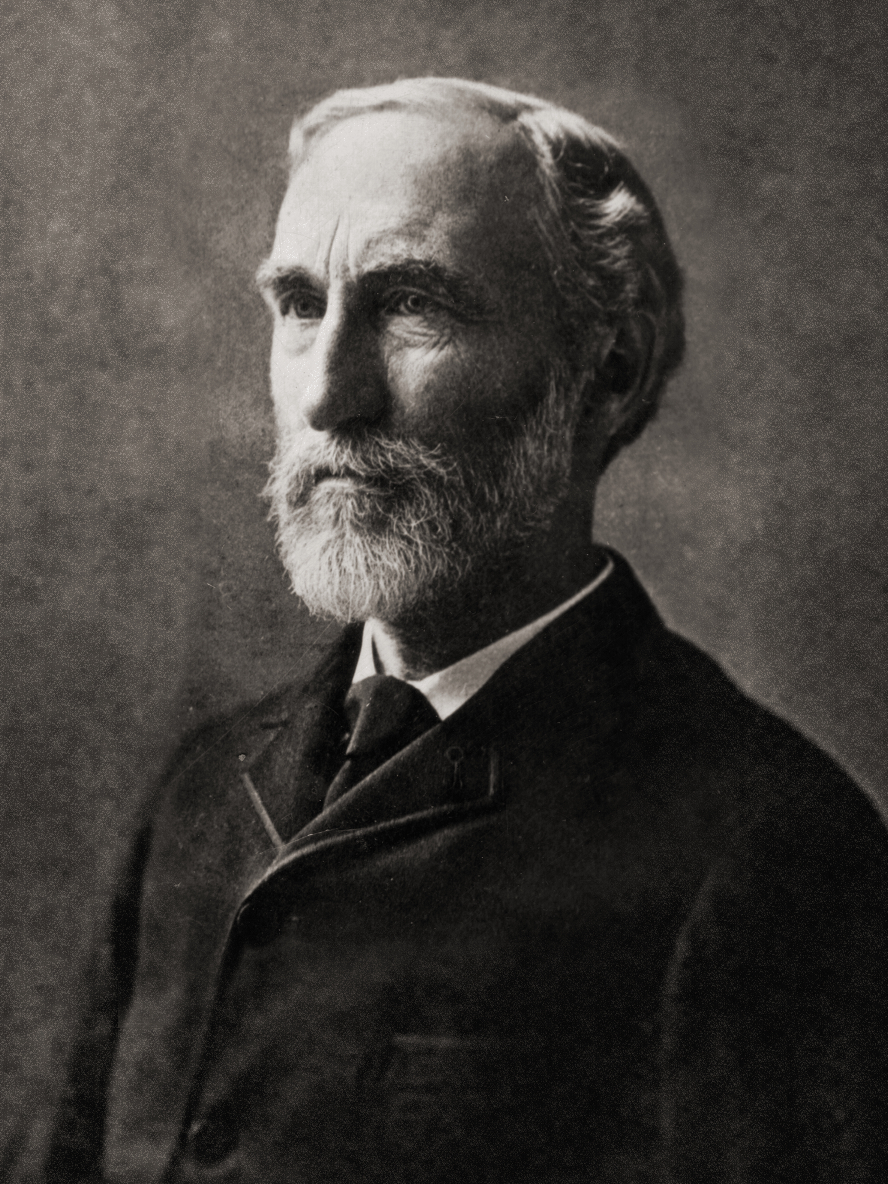
Photograph of Josiah Willard Gibbs by an unidentified photographer, frontispiece of The Scientific Papers of J. Willard Gibbs (Longmans, Green and Co., 1906), public domain, via Wikimedia Commons · Photographic portrait of Josiah Willard Gibbs made before his death in 1903 by an unidentified photographer, reproduced as the frontispiece ('with portrait') of The Scientific Papers of J. Willard Gibbs, edited by H. A. Bumstead and R. G. Van Name (Longmans, Green and Co., London and New York, 1906). The file is the 888 x 1184 pixel digitisation of that frontispiece on Wikimedia Commons, used as it is, with no cropping or enlargement. The basis is the documented 1906 publication of the book in New York and London, so the photograph is in the public domain in the United States as a work published before 1931; the photographer is not named, so no lifetime of an author is relied on. · Public domain (published 1906)
물리학자 · 19세기
조사이어 윌러드 기브스
1839–1903
주요 업적 분야
아직 성격 매칭에 포함되지 않았습니다 — 기록된 근거가 성격 모델 전체를 다루기에는 충분하지 않습니다. 이 페이지의 다른 모든 내용은 자유롭게 확인하실 수 있습니다.
핵심 특성
주요 업적
「불균일 물질의 평형에 관하여」(1876·1878)로 화학 열역학을 확립했다. 이 논문은 화학 퍼텐셜과 일반적인 평형 조건을 도입했고, 그의 상률은 훗날 제강과 암모니아 생산에 실제로 쓰였다.
학생들을 위해 벡터 해석을 발전시켰고, 이는 1881년과 1884년에 사적으로 인쇄된 뒤 1901년 제자 E. B. 윌슨이 교재로 출간했다. 1902년에는 『통계역학의 기본 원리』를 썼다.
1871년부터 세상을 떠날 때까지 예일대 수리물리학 교수로 재직했고 처음 9년은 급여 없이 일했으며, 1901년 왕립학회 코플리 메달을 받았다.
삶의 장면들
그는 방정식을 기계적 모형보다 기하학적 도형으로 나타내기를 좋아했는데, 모형은 현상과 완전히 들어맞는 경우가 드물고 그 어긋남이 그에게는 모형의 쓸모를 없앴기 때문이다.
이는 논리적으로 정확함을 유지하는 추상적 표현을 선호하는 성향과 일치한다. 시스템적 사고
그는 열역학 논문을 일반 독자를 위해 다시 쓰라는 권유를 물리쳤고, 후대의 한 저술가는 수식으로 빽빽한 이 논문이 끝까지 읽히는 경우가 드물다고 지적했다.
이는 더 많은 독자를 얻기보다 간결한 엄밀함을 앞세우는 태도와 일치한다. 설득력
전환점
1873년 34세에 첫 논문을 발표했고, 두 번째 논문 끝의 주석이 서로 다른 물질의 혼합물을 상태의 혼합물처럼 다룰 수 있음을 시사했으며, 이는 1876~1878년 화학 평형 논문으로 이어진 길이었다.
이는 하나의 방법을 단계적으로 더 일반적인 이론으로 확장해 가는 방식과 일치한다. 시스템적 사고
비슷한 인물
전체적인 프로필이 이 사람과 닮은 사람들이에요.
출처
- Josiah Willard Gibbs (Q153243), verified live via the Wikidata API (2026-10-31): label 'Josiah Willard Gibbs', description 'American scientist (1839-1903)', born 1839-02-11, died 1903-04-28, Korean label present. Orientation only; not used as support for any row.
- Charles S. Hastings, 'Biographical Memoir of Josiah Willard Gibbs, 1839-1903', National Academy of Sciences Biographical Memoirs, volume 6 (May 1909), read in full in the PDF text (it reproduces most of Henry Bumstead's review of the scientific work and adds a section on his character and academic life). CANONICAL SIGNIFICANCE SOURCE: the National Academy's memoir; it calls 'On the Equilibrium of Heterogeneous Substances' (1876 and 1878) his most important work and says it founded a new department of chemical science, and it covers his vector analysis, work on the electromagnetic theory of light and 'Elementary Principles in Statistical Mechanics'. A colleague's tribute, so admiring; its remarks on his lack of advocacy and slow recognition are the useful counterweights.
- Henry A. Bumstead, 'Josiah Willard Gibbs' (biographical sketch of 1903, reprinted in volume 1 of The Scientific Papers of J. Willard Gibbs, 1906), read in full in the Wikisource transcription: a former student and co-editor's account of his education, Yale chair from 1871, systematic and solitary way of working, careful but closed lectures, reluctance to publish his vector analysis, the controversial notes in Nature over quaternions, and the slow reception of his thermodynamics. Warm and partisan, and it overlaps with the National Academy memoir, so the two are not independent of each other.
- Fielding H. Garrison, 'Josiah Willard Gibbs and his Relation to Modern Science, I', Popular Science Monthly 74 (May 1909), read in full in the Wikisource transcription (part one of a series): an outside writer, an Army Medical Library assistant librarian, who calls his own account frankly journalistic. It calls Gibbs a mathematician rather than an experimenter, says his contribution was new ways of thinking, notes that the 1875-78 memoir has about seven hundred formulas and is rarely read in full, that its aim was not understood at first and that some theorems were later rediscovered by others, and that the general theory rested on earlier work by James Thomson and Horstmann. The most independent and most critical of the sources, though secondhand.
- Donald M. Fiene, 'Josiah Willard Gibbs', EBSCO Research Starter (2024), read in full: a scholar's overview listing his key works, the 1871 Yale chair that carried no salary for about nine years, Yale's counter to a Johns Hopkins offer, the obscure venue and terse style that kept him little known, the way Helmholtz and Planck independently reproduced some results, Ostwald's 1892 German translation, his refusal to rewrite the treatise for a general readership, and the later industrial use of the phase rule. Reference article for general readers; the salary figures are only summarised in it.
- Connecticut History (a CTHumanities project), 'Josiah Willard Gibbs's Impact on Modern Science' (15 February 2020, unsigned), read in full: his Yale degrees, 1871 chair, the two-part monograph published by the Connecticut Academy in 1875 and 1878, the 1901 Copley Medal and later honours, and the statement that much of his work received little recognition in his time. A state-humanities popular article; one caption in it contains a date error, so it is used only for the outline.
- Encyclopaedia Britannica, eleventh edition (1911), 'Gibbs, Josiah Willard' (unsigned in the transcription), read in full on Wikisource: a contemporary reference entry listing his Yale posts, the thermodynamic papers, the 1876 and 1878 memoir credited with founding a new branch of chemical science, the vector pamphlets of 1881 and 1884 and E. B. Wilson's 1901 textbook, the 1883-1889 optics papers, the 1902 statistical mechanics book and the 1901 Copley Medal. Short and respectful.