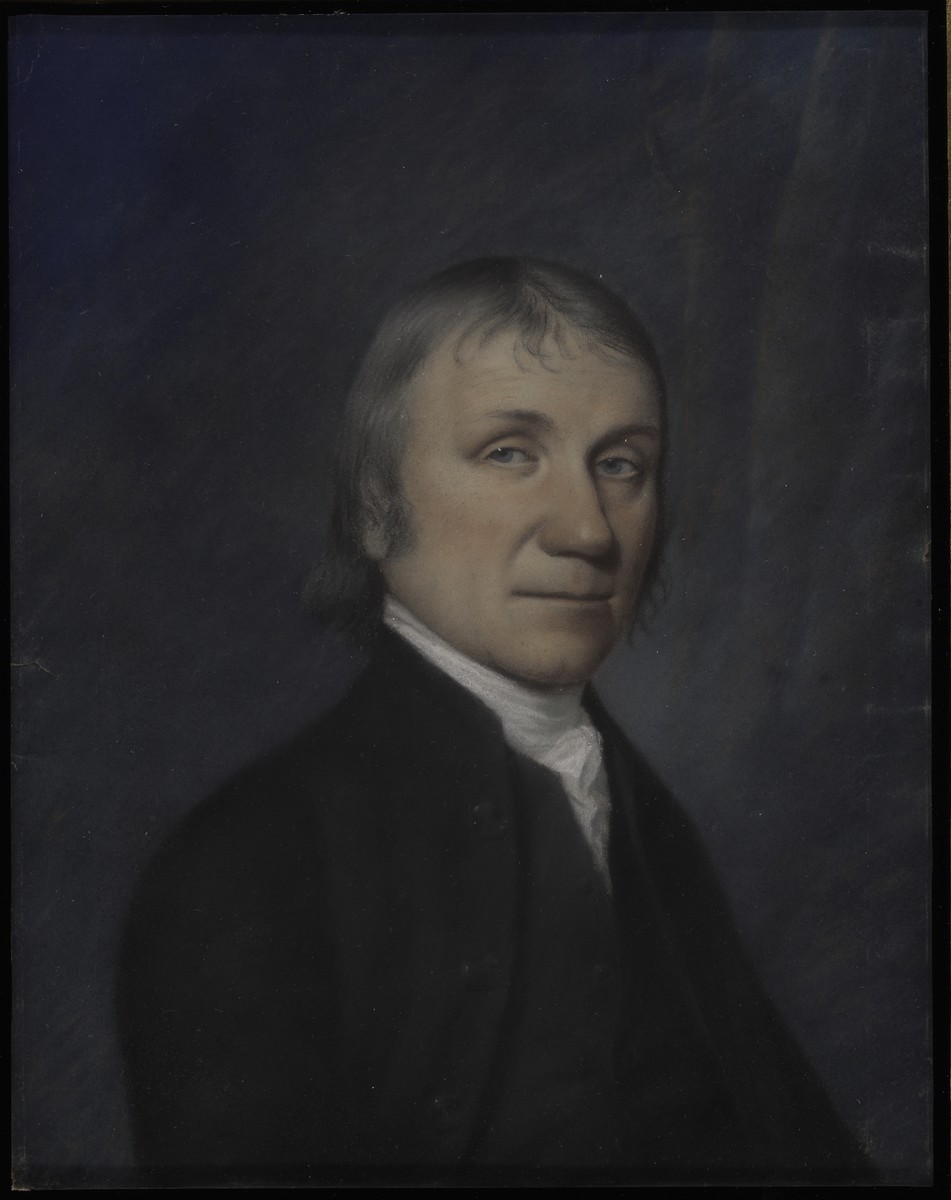
James Sharples, Joseph Priestley, 1797, pastel on paper, National Portrait Gallery, Smithsonian Institution, NPG.77.160 (CC0) · Wikimedia Commons, 'Joseph Priestley by James Sharples, 1797, pastel on paper, from the National Portrait Gallery - NPG-NPG 77 160.jpg' -- pastel on paper by James Sharples (c. 1751-1811), 1797, drawn from life in America, National Portrait Gallery, Smithsonian Institution (NPG.77.160); the museum's digital image is released under CC0 (Smithsonian Open Access). Original Commons file 5563 x 6385 pixels includes the museum frame and mat; cropped to the pastel itself (2710 x 3420 pixels) and downscaled once to 951 x 1200 (never upscaled). · CC0 1.0 (Smithsonian Open Access); work in the public domain
화학자 · 근세
조지프 프리스틀리
1733–1804
주요 업적 분야
아직 성격 매칭에 포함되지 않았습니다 — 기록된 근거가 성격 모델 전체를 다루기에는 충분하지 않습니다. 이 페이지의 다른 모든 내용은 자유롭게 확인하실 수 있습니다.
핵심 특성
주요 업적
《전기의 역사와 현황》(1767)은 이 분야를 정리하고 자신의 실험을 더한 책으로, 그는 이 책으로 왕립학회 회원에 선출되었다.
그는 새로운 기체를 여덟 가지 이상 찾아냈고 탄산수를 만드는 방법을 고안했으며, 여섯 권짜리 《여러 종류의 공기에 관한 실험과 관찰》(1774~1786)에 수백 건의 실험을 정리했다.
1774년 그는 오늘날 산소라 부르는 기체를 분리해 '탈플로지스톤 공기'라 이름 붙였고, 이를 라부아지에에게 보여 주었으며 라부아지에는 이를 바탕으로 새로운 화학을 세웠다.
삶의 장면들
가열한 산화수은에서 얻은 새 공기 속에서 촛불이 힘차게 타는 것을 본 그는 쥐를 넣어 보았고 이어 직접 들이마셔 본 뒤, 지금까지 그 공기를 마신 것은 쥐 두 마리와 자신뿐이라고 적었다.
예상 밖의 결과가 나오면 시험할 수 있는 모든 것, 자기 자신까지 동원해 추가로 시험해 보는 연구자의 태도와 일치한다. 호기심
과학계가 플로지스톤 이론을 이미 버린 1797년에도 그는 《플로지스톤 이론의 확립》을 펴냈고, 세상을 떠날 때까지 이 견해를 지켰다.
당대의 증거가 쌓여 가는데도 자신의 틀을 지킨 태도와 일치하며, 역사가들은 이를 끈질김이자 대가가 큰 선택으로 읽는다. 입장 수정 성향
전환점
헥사곤 논문에 따르면 1789년 라부아지에의 《화학원론》이 나온 뒤 프리스틀리의 과학 활동은 새로운 발견보다 플로지스톤을 지키는 후위전 쪽으로 옮겨 갔다.
학계의 흐름이 자신에게 불리해지자 새로운 현상을 탐구하던 데서 기존 입장을 방어하는 쪽으로 활동이 바뀐 연구자라는 점과 일치한다. 입장 수정 성향
비슷한 인물
전체적인 프로필이 이 사람과 닮은 사람들이에요.
출처
- Joseph Priestley (Q159636) -- verified live via the Wikidata API (2026-10-10): English label 'Joseph Priestley', description 'English chemist, theologian, educator, and political theorist (1733-1804)', born 13 March 1733 (a second 24 March value reflects the calendar change), died 6 February 1804, Korean label present. Orientation only; not used as support for any row.
- Science History Institute, 'Joseph Priestley', Scientific Biographies (updated 2026 by John Powers) -- INDEPENDENT institutional history-of-science biography. Covers the history of electricity (1767), the identification of at least eight new airs, the nitrous air test, early experiments on plants refreshing air, the six-volume Experiments and Observations on Different Kinds of Air, the 1774 isolation of oxygen shown to Lavoisier, and his long defence of phlogiston against the new chemistry. Read in full; its sections on religion, dissent and the Birmingham riot were not used as personality evidence.
- James L. Marshall and Virginia R. Marshall, 'Joseph Priestley', The Hexagon of Alpha Chi Sigma (University of North Texas chemists), Summer 2005, pp. 28-33 -- secondary biographical article drawing on Schofield, Partington, Thomson and Davis; used for the electricity book, brewery-prompted gas studies, new gases found at Bowood, the oxygen visit to Lavoisier, the plant and blood experiments, and, most usefully, the scholarly assessments of why he clung to phlogiston (Partington's critical reading, Schofield's balanced one, Davis's view that his logic was self-consistent). Some of its general statements about his manner and reactions are the authors' impressions and were not used. Read in full.
- 'A Breath of Immoral Air: Joseph Priestley and the Discovery of Oxygen', Chapter 1 of a Wiley popular-science book on scientific breakthroughs (sample chapter PDF, John Wiley and Sons; author not shown on the pages read) -- popular narrative that quotes Priestley's own accounts of the 1774 experiment, the mice and the tasting of the new air, the soda-water work, the trough, and the later phlogiston pamphlet of 1797; also gives the Lavoisier and Scheele background. Popular-science level and partly dependent on Priestley's own words; used for dated experimental episodes cross-checked with the Institute and Hexagon articles. Read in full.
- Joseph Priestley, 'Experiments and Observations on Different Kinds of Air', volume I (1774; Project Gutenberg text of the London first edition) -- SELF source used only as work evidence: the Preface (immediate publication of results, openly stating his real views and mistakes, doubts multiplying with discoveries), the finding that vegetation restores air spoiled by burning candles, and the failed ice-and-fixed-air experiment. The volume containing the oxygen experiments (volume II) was not opened. Never used as sole support for a behavioural claim.
- NEH 'Humanities' magazine (Spring 2024, vol. 45 no. 2), 'Joseph Priestley Created Revolutionary Maps of Time' -- journalistic essay quoting Rosenberg and Grafton and Priestley's biographer Robert Schofield on his 1765 Chart of Biography, his output of roughly 150-200 publications, and Schofield's judgement that contemporaries were more profound and analytic but that Priestley made systematic and operational what had been fragmentary. Read in full; the passages on the digital-humanities project and on politics were not used.
- Linda Hall Library, 'Scientist of the Day: Joseph Priestley', 14 July 2015 (William B. Ashworth Jr., University of Missouri-Kansas City) -- short historian's entry noting his books on electricity, optics and gases and recording Georges Cuvier's eulogy line that he was a father of modern chemistry who refused to acknowledge his daughter; also mentions the Rembrandt Peale portrait. Read in full (very short). The Birmingham riot context was not used.
- National Portrait Gallery, Smithsonian Institution, object NPG.77.160, 'Joseph Priestley' by James Sharples, 1797, pastel on paper, sight size 23 x 17.8 cm (record read through the Smithsonian Open Access API, which marks the image CC0; the museum's web page returned a server error and a 403) -- used only to check the portrait's rights. Not used for scoring.