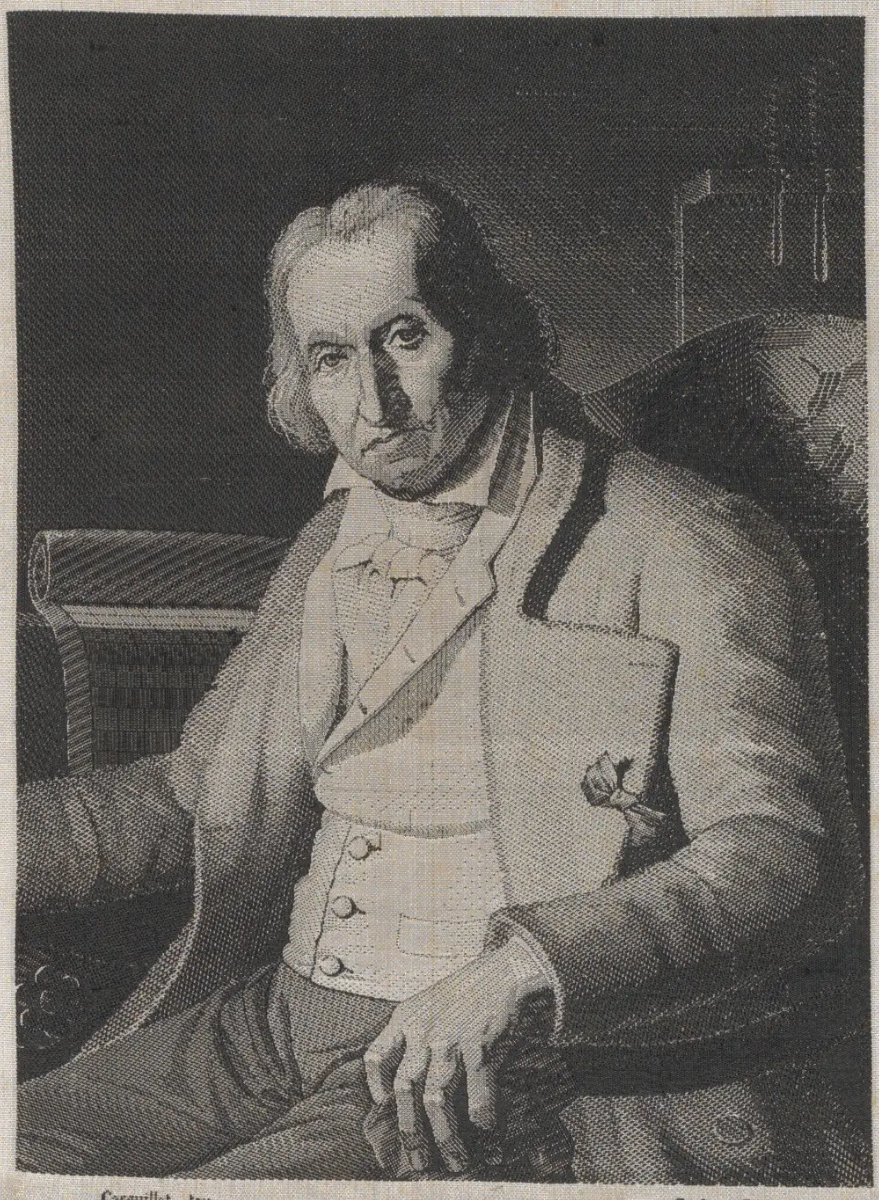

Francois Carquillat for Didier Petit et Cie, after Jean Claude Bonnefond, c. 1870-1880, Rijksmuseum, Amsterdam (RP-F-2013-22-61), public domain · Woven silk portrait 'A la memoire de J.M. Jacquard', woven by Francois Carquillat for Didier Petit et Cie after a print by Jean Claude Bonnefond (whose painted portrait was made for the city of Lyon in 1831), mounted in a nineteenth-century photograph album and catalogued by the Rijksmuseum, Amsterdam, as object RP-F-2013-22-61, dated c. 1870-c. 1880; the museum titles it 'Woven portrait of the weaver and merchant J.M. Jacquard'. A posthumous woven copy, not a portrait from life. Digital master 3420 x 4106 pixels; this copy is cropped to the woven picture and downscaled to 879 x 1200 (never enlarged). · Public Domain Mark 1.0 (Rijksmuseum item-level statement; the woven portrait and its sources are also public domain by age)
발명가 · 19세기
조제프마리 자카르
1752–1834
주요 업적 분야
아직 성격 매칭에 포함되지 않았습니다 — 기록된 근거가 성격 모델 전체를 다루기에는 충분하지 않습니다. 이 페이지의 다른 모든 내용은 자유롭게 확인하실 수 있습니다.
주요 업적
1804~05년에 자카르 장치를 선보였다. 이 장치는 교환 가능한 천공 카드로 베틀의 날실을 제어하여 원하는 어떤 무늬든 자동으로 짤 수 있게 한다.
보캉송의 초기 천공 카드 베틀과 1801년 파리에서 특허를 받고 선보인 자신의 베틀을 토대로 작업했으며, 리옹의 직조공들이 기계를 불태우고 그를 공격했음에도 1812년에는 프랑스에서 1만 1천 대의 자카르 베틀이 쓰이고 있었다.
찰스 배비지는 이 천공 카드를 자신이 구상한 해석기관의 입출력 매체로 채택했고, 허먼 홀러리스는 이후 인구조사 자료에 천공 카드를 사용했다.
삶의 장면들
1801년 파리 산업 박람회에 자동 베틀을 출품했고 같은 해 12월 23일 프랑스 특허를 받았다.
이는 기계를 공개 무대에서 시험하고 추가 개발에 앞서 권리를 확보하는 모습과 일치한다. 실험 성향
일자리를 잃을까 두려워한 리옹의 견직공들이 기계를 불태우고 자카르를 공격했지만, 베틀은 널리 쓰이게 되어 1812년에는 프랑스에서 1만 1천 대가 가동되고 있었다.
이는 노골적인 적대에도 발명을 포기하지 않는 모습과 일치하지만, 그 자신의 대응에 관해서는 자료가 거의 말해 주지 않는다. 끈기
전환점
파리에서 국립공예원에 소속되어 보캉송의 초기 베틀을 연구했고 1804~05년에 자신의 이름이 붙은 천공 카드 장치를 완성했다. 다만 보캉송 베틀 연구에 관한 설명은 확인되지 않았다고 '정보의 역사'는 지적한다.
이는 앞선 설계를 연구하며 기계를 단계적으로 다듬어 가는 모습과 일치한다. 실험 성향
비슷한 인물
전체적인 프로필이 이 사람과 닮은 사람들이에요.
출처
- Joseph Marie Jacquard (Q310833), verified live via the Wikidata API (2026-11-04): label 'Joseph Marie Jacquard', description 'French inventor', born 1752-07-07, died 1834-08-07, citizenship France, Korean label 조제프마리 자카르 (matches the Korean Wikipedia page title). Orientation only; not used as support for any row.
- Encyclopaedia Britannica, 'Joseph-Marie Jacquard' (Britannica Editors), article body read in full. CANONICAL SIGNIFICANCE SOURCE: born 1752 in Lyon, died 1834 at Oullins, French inventor of the Jacquard loom, which 'served as the impetus for the technological revolution of the textile industry'; he formed the idea in 1790, demonstrated an improved drawloom in 1801 (bronze medal), and in 1804-05 introduced the attachment that makes any loom using it a Jacquard loom, using interchangeable punch cards to control the weaving so that any pattern could be obtained automatically; in 1806 the loom was declared public property and he received a pension and a royalty on each machine; Lyon silk weavers, fearing job losses, burned machines and attacked Jacquard; by 1812 there were 11,000 in use in France; gold medal and Legion of Honour in 1819; spread to England in the 1820s; Babbage adopted its punched cards as the input-output medium for his proposed Analytical Engine and Hollerith used punched cards for census data. Scholarly reference; the article also mentions his Revolution-era service, which is not scored.
- Encyclopaedia Britannica, 'Jacquard loom' (Britannica Editors, revised by Erik Gregersen), article read in full: a device in special looms that controls individual warp yarns and lets looms weave intricate patterns such as tapestry, brocade and damask; developed in 1804-05 by Joseph-Marie Jacquard of France, soon spread, and 'improved on the punched-card technology of Jacques de Vaucanson's loom (1745)'; interchangeable punched cards controlled the weave so any desired pattern could be obtained automatically; the cards were adopted by Babbage for the Analytical Engine and by Hollerith for his census machine. Short technology article; independent entry from the biography but from the same publisher.
- J. A. N. Lee, 'Joseph-Marie Jacquard', Computer Pioneers, IEEE Computer Society History Committee (1995, updated 2013), read in full: father a silk weaver and mother a pattern maker, he worked as plasterer, cutler, type founder and soldier before turning to his father's loom; was summoned to Paris to the Conservatoire des Arts and studied Vaucanson's automatic loom (1745, itself based on Falcon's 1728 design); improved it with punched cards linked into a 'program' passing over a four-sided drum with needles lifting warp threads; Napoleon granted a pension in 1806 on condition he move to Lyon, where weavers' anger forced him to flee, but 'Jacquard persevered'; over 30,000 looms in Lyon by his death; Babbage is 'believed' to have drawn on it, and Lee notes Jacquard and Babbage used cards to store programs while Hollerith used them for data. Professional-society biography written from a computing-history viewpoint; some dates (a 1803 English fish-net commission) are not corroborated by the other sources and are not used.
- Catherine M. Crisera, 'Joseph Marie Jacquard', Science and Its Times (Gale), via Encyclopedia.com, read in full: little is known of his formative years; apprenticed in bookbinding, type-founding and cutlery, he inherited a small property that let him experiment with patterned weaves, was unsuccessful, lost his inheritance and returned to type-founding and cutlery work; he conceived the loom in 1790, was interrupted by the Revolution, introduced in 1801 a net-weaving loom described as an improved version of three earlier inventors' work, was sent to Paris to demonstrate it (bronze medal and a patent), studied at the Conservatoire des Arts et Metiers and perfected the pattern mechanism in 1804-05; weavers in Lyon burned machines and attacked him; 11,000 looms in France by 1812. Encyclopaedia-style secondary summary that says the early life is poorly documented.
- Jeremy Norman, 'Joseph-Marie Jacquard's Loom Uses Punched Cards to Store Patterns', History of Information (updated October 2026), read in full: the early career is poorly documented (apprenticed as bookbinder, or straw-hat maker, by different accounts); his first patent, No. 245 of 23 December 1801, for a machine to replace the draw-boy, was exhibited at the Paris industrial exhibition that year; the Cambridge History of Western Textiles says he did not finish his loom until 1805 and that it was only operational after 1810, with further improvements (a patent granted to M. Breton in 1815 for improving the 'Jacquard' mechanism); none of the accounts the author had read had examined the patent itself; Norman calls the claim of 30,000 looms in Lyon by 1834 'unverified and probably exaggerated'; the Jacquard method of storing information by punching or not punching standard hole positions is an important conceptual step toward Babbage's Analytical Engine, although the loom did no computation. The most sceptical source read.
- National Museums Scotland, 'The Jacquard loom: Innovation in textiles and computing' (short read on handloom T.1934.241), read in full: Jacquard first demonstrated the mechanism in 1801; thousands of laced punch cards, each row of holes corresponding to a row of the textile pattern, let the weaver produce unaided fabrics with patterns of almost unlimited size and complexity; recorded in the Scottish textile industry from the 1820s; Babbage was inspired by the Jacquard system to use punch cards to programme his Analytical Engine. Museum object text; about the mechanism and its spread, not about Jacquard's own conduct.