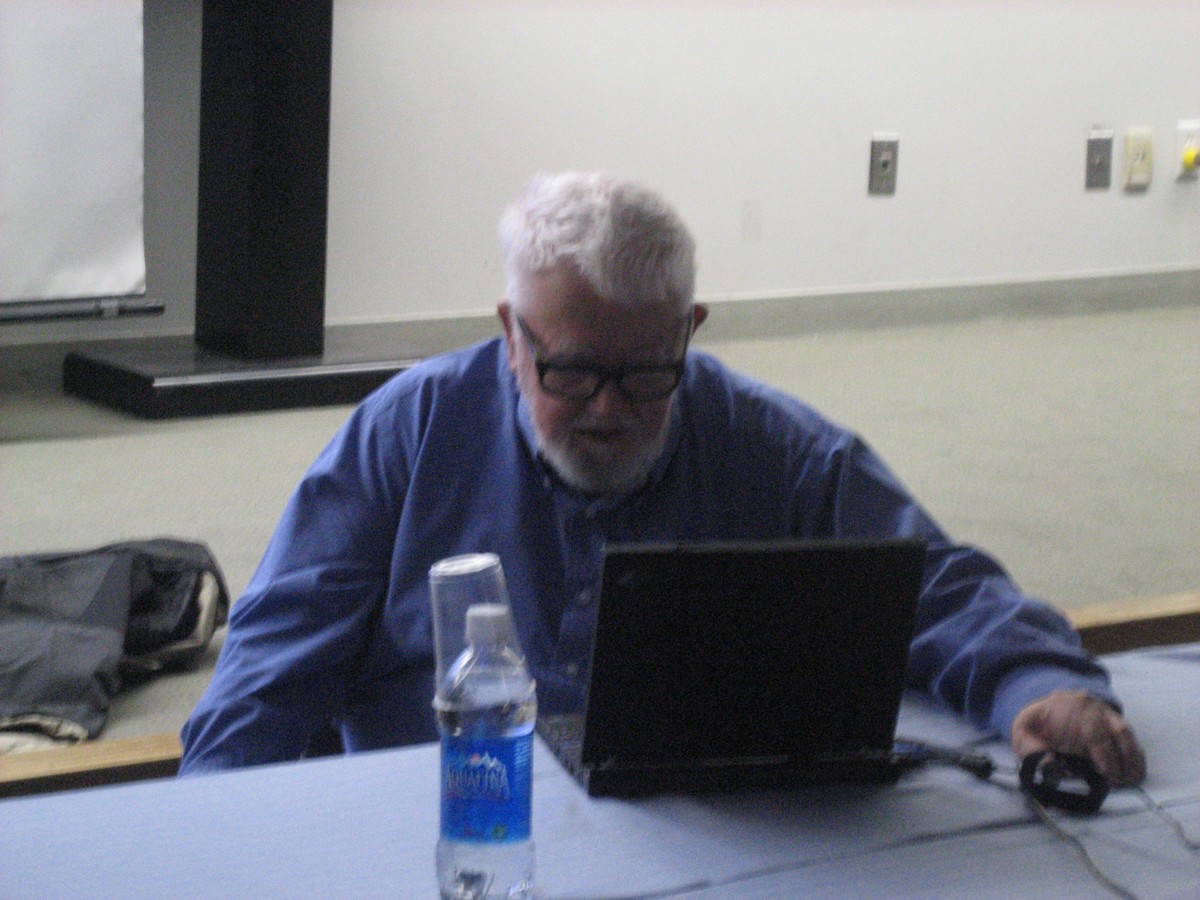
Photo: Tom Varco, 2006, CC BY-SA 3.0 · Wikimedia Commons 'John McCarthy 2006.jpg': photograph by Tom Varco (own work uploaded by the author), taken 21 April 2006 after a lecture at the University at Buffalo; licence CC BY-SA 3.0 stated by the author with attribution to 'Tom Varco' required (a notification request is not a condition). Original 1600 x 1200; downscaled once to 1200 x 900 (no upscaling). The Wikidata P18 image (Flickr 'null0', CC BY-SA 2.0) was NOT used: its Flickr source page now returns 404, so the licence could not be re-checked at the origin, and the author-uploaded file was legally clearer. · CC BY-SA 3.0
컴퓨터 과학자 · 현대
존 매카시
1927–2011
주요 업적 분야
아직 성격 매칭에 포함되지 않았습니다 — 기록된 근거가 성격 모델 전체를 다루기에는 충분하지 않습니다. 이 페이지의 다른 모든 내용은 자유롭게 확인하실 수 있습니다.
핵심 특성
주요 업적
1956년 다트머스 여름 워크숍을 제안한 1955년 문서를 써서 '인공지능'이라는 이름이 쓰이게 했고, 교토상이 그의 으뜸가는 업적으로 꼽은 논리 기반 상식 추론 연구를 수십 년간 이어갔다.
1958년 프로그램과 데이터가 같은 표기를 쓰는 프로그래밍 언어 리스프를 만들었고, 이는 인공지능 연구에 널리 쓰이게 되었다.
MIT에서 페르난도 코르바토와 함께 시분할 컴퓨팅을 추진했고, 스탠퍼드 인공지능 연구소를 세워 1965년부터 1980년까지 이끌었으며, 1971년 튜링상을 받았다.
삶의 장면들
크레비에는 다트머스 회의가 주최자인 매카시를 크게 실망시켰지만, 그가 아서 새뮤얼과 뉴웰·사이먼의 반대에도 참가자 대다수를 설득해 '인공지능'이라는 이름을 채택하게 했다고 전한다.
이는 행사 자체가 기대에 못 미쳤더라도 동료들을 설득해 공통된 틀을 세우는 모습과 일치한다. 설득력
스탠퍼드 동료 레스 언스트는 매카시가 자기 일에 몹시 집중해서 관심 없는 주제로 말을 걸면 말없이 돌아서기도 했다고 회상했다.
이는 대화의 편안함을 때로 희생하는 매우 강한 집중력과 일치한다. 몰입
전환점
1962년 매카시는 민스키와 함께 인공지능 그룹을 시작했던 MIT를 떠나 스탠퍼드에서 자신의 인공지능 연구소를 이끌게 되었고, 1965년부터 1980년까지 스탠퍼드 인공지능 연구소를 지휘했다.
이는 공동 운영하던 그룹에서 벗어나 자신이 선호한 논리 기반 접근을 중심으로 연구소를 꾸리려는 흐름과 일치한다. 선제적 행동력
비슷한 인물
전체적인 프로필이 이 사람과 닮은 사람들이에요.
출처
- John McCarthy (Q92739) -- verified live via the Wikidata API (2026-10-24): English label 'John McCarthy', description 'American computer scientist and cognitive scientist (1927-2011)', born 1927-09-04, died 2011-10-24, citizenship United States, Korean label '존 매카시', P18 image 'John McCarthy Stanford.jpg'. Orientation only; not used as support for any row.
- Computer History Museum, 'John McCarthy' Fellow profile (computerhistory.org), read in full: the museum's summary of the 1971 Turing Award citation field (artificial intelligence and timesharing systems), that he coined 'AI' in 1955 for a proposed Dartmouth summer workshop, invented the Lisp programming language in 1958, proposed timesharing at MIT, became founding director of the Stanford Artificial Intelligence Laboratory in 1965, and played in computer chess events including the 1967 Stanford-ITEP match; also records a computer-chess bet with David Levy that Levy won. CANONICAL SIGNIFICANCE SOURCE. Institutional profile, retrospective.
- Inamori Foundation, '1988 Kyoto Prize Laureates: John McCarthy' (kyotoprize.org), achievement digest and citation read in full: 'the Father of Artificial Intelligence'; Lisp, a language for symbolic processing, called the greatest invention of the century in computer science; his foremost achievement the study of common-sense reasoning, formalizing a logic of inference for machines; proposed the basic concept of time sharing; established the first AI research project at MIT in 1958 and the AI laboratory at Stanford; president of AAAI from 1983. Award-body citation, retrospective and admiring.
- Stanford Report, 'Stanford's John McCarthy, seminal figure of artificial intelligence, dies at 84' (news.stanford.edu, 25 October 2011), read in full: the 1955 Dartmouth proposal (first publication use of 'artificial intelligence'); LISP in 1958; time-sharing; the 1966 telegraph chess matches against Soviet rivals (two lost, two drawn); Les Earnest on time-sharing ('nobody except John'), on his intense focus and habit of turning away from uninteresting topics; Ed Feigenbaum, recruited by him, on his bluntness, kindness to students and focus on inventing; Bill Gosper on why he revived an interstellar-travel paper; his wish to bring scientific rigor to every aspect of life; director of the Stanford AI Lab 1965-1980. University obituary, written with colleague quotations; admiring. Family and personal-life passages deliberately not used.
- IEEE Computer Society, 'John McCarthy (1927-2011)' (history.computer.org), read in full: career chronology (Caltech, Princeton, Dartmouth, MIT, Stanford; director of the Stanford AI Laboratory 1965-1980), honours (1971 Turing Award, 1985 IJCAI Research Excellence Award, 1988 Kyoto Prize, 1990 National Medal of Science), his focus on formalizing common-sense knowledge, circumscription from 1978, and program-correctness work from the early 1960s. A factual pioneer profile with no behavioural detail; used only for chronology and research themes.
- MIT Technology Review, 'Computing Pioneer Dies' (technologyreview.com, 25 October 2011), read in full: the 1955 proposal with Minsky, Rochester and Shannon, Lisp's programs-and-data-in-one-notation design, Project MAC and time-sharing as a step toward utility computing, Minsky on the speed-up from time-sharing and on McCarthy pushing to get more people using fewer computers, Fernando Corbato on his articulate explanation of interactive computing and 'sharp and incisive mind', and McCarthy's 2006 slides admitting human-level AI was harder than it seemed in 1955. Journalistic obituary with named colleagues; admiring.
- Daniel Crevier, 'AI: The Tumultuous History of the Search for Artificial Intelligence' (Basic Books, 1993), McCarthy profile and the Dartmouth, LISP, time-sharing, MIT/Stanford and frame-problem passages read in full from a full-text copy of the book (pdf.stafforini.com): colleagues' view of his concentration; his long silences and Hans Moravec's comment that he communicates well mainly with graduate students in his areas; his high standards and short publication list; that the Dartmouth conference deeply disappointed him as organizer; that he persuaded participants to adopt the name 'artificial intelligence' over Samuel's and Newell and Simon's objections while laying no claim to coining the phrase; LISP drawing on IPL; years spent with Corbato convincing manufacturers to take time-sharing seriously; his faithfulness to formal logic as Minsky became the champion of the antilogic branch; his 1962 departure to head his own AI laboratory at Stanford; the founding goal of building a fully intelligent machine in a decade that Crevier says was not met. Journalistic history based on interviews with participants, independent of McCarthy; includes critical remarks. Political and family passages deliberately not used.
- Joseph Weizenbaum, 'A Response to John McCarthy' (16 April 1976, SAILDART archive copy of the Stanford AI Lab file WEIZEN.ANS), read in full: Weizenbaum's reply to McCarthy's review of his book 'Computer Power and Human Reason', accusing the review of misreading the book's main points, of attributing it to 'new left' ideology and of irrelevant political association, and disagreeing about machine-administered psychotherapy. An adversarial, partisan primary reply used only as the counter-voice on McCarthy's polemical manner in debate; McCarthy's own review text was NOT opened, so what it said is known only through this reply and Kuipers.
- Benjamin Kuipers, 'Reactions to Weizenbaum's Book' (web.eecs.umich.edu/~kuipers/opinions/Weizenbaum.html, written 1976 as an MIT AI Lab graduate student, annotated 2023), read in full: says the ACM SIGART Newsletter (June 1976) published his reaction with a 'much more negative review by John McCarthy' and a reply from Weizenbaum, and himself finds Weizenbaum's attacks on the AI community shrill while valuing some of his concerns. Third-party, neutral-to-critical on both sides; used only to corroborate that McCarthy's review was strongly negative.
- Wikimedia Commons file page 'John McCarthy 2006.jpg' (wikitext and API record), checked for the portrait's licence: photograph by Tom Varco ('Own' work), taken 21 April 2006 after a lecture at the University at Buffalo, CC BY-SA 3.0 with attribution to 'Tom Varco' required; original 1600 x 1200. Not used for any scoring.