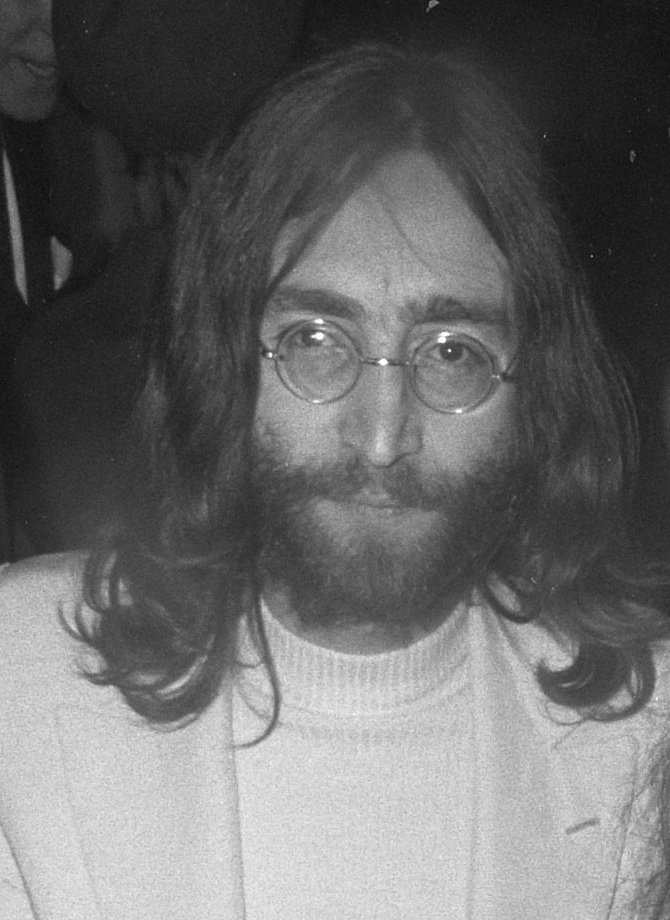

Photograph by Joost Evers / Anefo, Nationaal Archief (CC0; credit not required, given as a courtesy); cropped and converted to greyscale JPEG · Nationaal Archief, Fotocollectie Anefo, record 922-2494 (photograph taken at Schiphol airport, 31 March 1969); tightly cropped from the 2410 x 3672 original file on Wikimedia Commons, with other people and the second subject removed · CC0 1.0 Public Domain Dedication (Nationaal Archief record states rights holder 'Nationaal Archief, CC0')
음악가 · 현대
존 레논
1940–1980
주요 업적 분야
아직 성격 매칭에 포함되지 않았습니다 — 기록된 근거가 성격 모델 전체를 다루기에는 충분하지 않습니다. 이 페이지의 다른 모든 내용은 자유롭게 확인하실 수 있습니다.
핵심 특성
주요 업적
레논은 리버풀에서 쿼리멘(Quarrymen)을 결성하고 폴 매카트니를 불러들여, 비틀스의 바탕이 된 작곡 동반 관계를 시작했다. 송라이터스 명예의 전당은 「Love Me Do」, 「Please Please Me」, 「She Loves You」(1962~63)를 초기 성공작으로 꼽고, 이 그룹을 "한 세대에서 가장 영향력 있는 새로운 팝 그룹"이라 평하며, 「I Want to Hold Your Hand」가 영국 역사상 가장 많이 팔린 싱글이 되었다고 전한다.
1966년 레논의 곡들은 비틀스의 스튜디오 작업을 새로운 방향으로 이끌었다. 1966년 4월 『리볼버』를 위해 녹음한 「Tomorrow Never Knows」에서 그는 달라이 라마가 읊조리는 듯한 목소리를 요청했고, 엔지니어들은 그의 보컬을 회전 스피커에 통과시켰으며 테이프 루프를 실시간으로 섞어 넣었다. 「Strawberry Fields Forever」에서는 조지 마틴과 제프 에머릭에게 한 테이크의 앞부분과 키와 템포가 다른 재녹음본의 뒷부분을 이어 붙여 달라고 요청했고, 두 사람은 테이프 속도를 조절해 이를 해냈다.
비틀스 이후 레논은 1970년 『John Lennon/Plastic Ono Band』를 발표했으며, 이 앨범에 대해 '내가 해 온 것 중 최고'이며 1인칭으로 쓴 곡들이라고 말했다. 1971년에는 오노 요코, 필 스펙터와 공동 프로듀서로 참여한 두 번째 솔로 앨범 『Imagine』이 나왔고, 여기에는 그의 가장 널리 알려진 곡인 표제곡이 실려 있다.
삶의 장면들
1966년 11월 하순 사흘간의 세션 끝에 비틀스는 「Strawberry Fields Forever」의 완성본 테이크를 얻었다고 생각했지만 레논은 만족하지 못했고, 곡은 네 번의 세션에 걸쳐 다시 녹음되었다. 그 뒤 그는 마틴과 에머릭에게 첫 번째 버전의 앞부분과 두 번째 버전의 뒷부분이 마음에 든다며 이어 붙여 달라고 했다. 마틴이 두 테이크의 키와 템포가 다르다고 하자 레논은 마틴이 해결할 수 있을 거라고 답했다. 에머릭과 마틴은 편집점이 곡의 1분 지점 부근이었고, 레논이 들어 보고도 이음새를 알아채지 못했다고 회고한다.
완성된 테이크를 다시 만들게 하고 이어서 두 버전의 가장 좋은 부분을 합쳐 달라고 요청한 일은 완성된 곡에 대한 높은 기준과 부합한다. 다만 1980년 더글러스의 증언처럼 몇 번의 테이크 뒤 곧 다음으로 넘어가는 모습도 있어, 그 기준은 조급함과 함께 있었다. 완벽주의
1969년 9월 20일, 비틀스가 애플의 새빌로 사무실에서 EMI/캐피톨과의 새 계약에 서명한 직후, 레논은 매니저 앨런 클라인이 입을 다물어 달라고 했음에도 매카트니와 링고 스타에게 그룹을 떠난다고 말했다. 레논은 매카트니의 제안마다 '안 돼'라고 답하다가 그 말이 나왔다고 하고, 매카트니는 그가 '나는 그룹을 떠난다!'고 말했다고 기억하며, 스타는 분위기가 언짢지 않았다고 말한다. 이 결별은 몇 달 동안 공개되지 않았다.
매니저의 조언에도 불구하고 매카트니 앞에서 직접 말한 것은 결단력, 그리고 맞서는 태도와 부합한다. 다만 매카트니의 설명에는 그 일이 상처가 되었다는 점도 드러난다. 결단력
전환점
1957년 7월 6일 아이번 본(Ivan Vaughan)이 울턴 교회 축제에서 쿼리 멘이 공연하던 16세의 레논에게 15세의 매카트니를 소개했다. 교회 강당에서 매카트니는 레논의 기타를 조율해 주고 에디 코크란과 리틀 리처드의 곡을 연주했고, 레논은 훗날 '그는 나만큼 하는구나' 싶었다고 말했다. 레논은 자신이 매카트니에게 합류를 청했다고 하고, 피트 쇼튼은 일주일쯤 뒤 전언이 전해졌다고 기억한다.
자신만큼 잘한다고 본 더 어린 연주자를 끌어들인 일은 가장 뛰어난 연주자를 중심으로 그룹을 꾸리려는 태도, 곧 리더십 욕구와 부합한다. 주도 성향
비슷한 인물
전체적인 프로필이 이 사람과 닮은 사람들이에요.


잔 다르크

예카테리나 2세

모리타 아키오

무스타파 케말 아타튀르크

율리우스 카이사르
출처
- John Lennon (Q1203) -- verified live via wbgetentities (2026-10-10): en label 'John Lennon', description 'British musician (1940-1980)', born 9 Oct 1940, died 8 Dec 1980, citizenship United Kingdom, instance of human, ko label '존 레논'. Orientation only; not used as support for any row.
- Jann S. Wenner (Rolling Stone), 'Lennon Remembers, Part One and Part Two', interview recorded in New York on 8 December 1970 and published by Rolling Stone, Wayback Machine copy on archive.org -- SELF source (Lennon's own account, given while angry with the Beatles' business affairs and promoting his first solo album; he disputes and overstates in places). Read the full Part One text and the passages on the Beatles' studio work, Hamburg, the writing partnership, Rubber Soul, Phil Spector, the Let It Be sessions and the end of the group; Part Two was only searched, not read in full. Used for his own description of his work and for the 1969 meeting, never as the only support for a row.
- The Beatles Bible, 'Tomorrow Never Knows' song page, parts 1 and 2 (beatlesbible.com) -- COMPILER of dated quotations from Barry Miles (Many Years From Now), Paul McCartney, George Harrison and Ringo Starr (Anthology), Mark Lewisohn (The Complete Beatles Recording Sessions, quoting engineer Geoff Emerick), George Martin and David Sheff, with Lennon's own remarks. The books themselves were not opened; what is relied on are the quoted words of the people present at the April 1966 sessions. Read both parts in full.
- The Paul McCartney Project, session page 'Mixing Strawberry Fields Forever' (22 December 1966) -- compiler page quoting, in separate extracts, engineer Geoff Emerick (Here, There and Everywhere, 2006) and producer George Martin (All You Need Is Ears, 1979, and With A Little Help From My Friends, 1995) on the joining of two takes of Lennon's song. Two independent insider accounts that differ in detail (semitone or whole tone, which take). Read in full; the books were not opened.
- The Beatles Bible, 'Strawberry Fields Forever' song page, part 1 (beatlesbible.com) -- compiler page with quoted Lennon (1980, to David Sheff), Paul McCartney, Mike Pinder and engineer Jerry Boys; used only for the November 1966 demo and Mellotron context. Part 1 read; part 2 was not read.
- Paul McGuinness, 'One sultry July day that changed the world: the true story of how Lennon met McCartney', BBC Music Magazine / classical-music.com feature -- secondary retelling of 6 July 1957 at Woolton that draws on Hunter Davies's authorised biography, Paul McCartney and Lennon's own recollection, and records that Pete Shotton's account of the invitation differs from Lennon's. Read in full; the underlying books were not opened.
- The Beatles Bible, '20 September 1969: John Lennon reveals he is leaving The Beatles' (beatlesbible.com) -- compiler page giving the context of the EMI/Capitol renegotiation and quoting Lennon (1970, to Wenner), Paul McCartney and Ringo Starr (Anthology) on the Savile Row meeting. Three differing first-person accounts. Read in full.
- The Paul McCartney Project, article 'John Lennon tells the other Beatles he's leaving the band' (September 1969) -- compiler page with McCartney's 1984 Playboy interview, Lennon's 1969 and 1970 remarks and Kenneth Womack's Solid State (2019) on the weeks around the Toronto concert and the Plastic Ono Band's first single offer to the group. Read in full; the sensitive song-theme detail in it is not used.
- Mix magazine, 'Classic Tracks: John Lennon and Yoko Ono's Watching the Wheels' (mixonline.com) -- trade-press interview with producer Jack Douglas on the secret 1980 Double Fantasy sessions: how Lennon chose musicians, wrote at home, sang live and worked in the studio. INDEPENDENT firsthand witness (the producer), recalling decades later. Read in full.
- Record Collector magazine, 'Lennon's last session: the making of Double Fantasy' -- oral-history feature built on Lennon's 1980 interview statements (Robert Hilburn and others) and recollections of the studio musicians and producer Jack Douglas (Ken Sharp's Starting Over and Tony Davilio's The Lennon Sessions). Read in full; used for the five-year break after 1975 and the 1980 session team.
- The Beatles Bible, '17 August 1960: Live: Indra Club, Hamburg' (beatlesbible.com) -- compiler page on the first Hamburg engagement (48 nights, contracted hours) with George Harrison's Anthology recollection. Read in full. Group-level evidence; not used for a scored row.
- Matthew Wills, 'The Beatles Got Started in Hamburg. There's a Reason for That', JSTOR Daily (17 August 2020), summarising historian Julia Sneeringer's article on Hamburg's Reeperbahn in Central European History 42 (2009) -- independent scholarly context for the 1960-62 Hamburg engagements (about 1,100 hours over four stays). Read in full; the underlying article was not opened.
- The Beatles Bible, 'Imagine (album)' page, part 1 (beatlesbible.com) -- compiler page giving recording dates, producers and personnel of the 1971 album and quoting Lennon (1980, to Sheff; 1971, Crawdaddy). Read part 1; part 2 was only downloaded.
- Songwriters Hall of Fame, John Lennon profile (institutional biography; read in full)