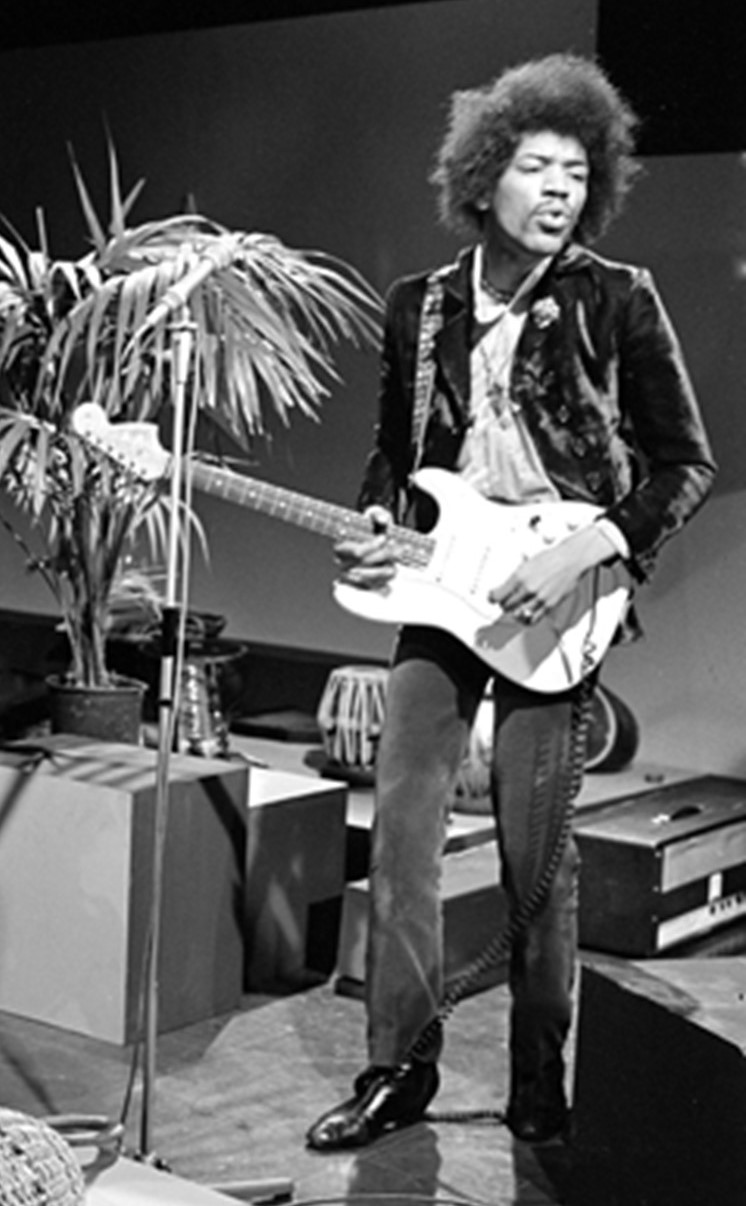
Photo: A. Vente (VPRO) / Beeld en Geluid, 1967, CC BY-SA 3.0 · Wikimedia Commons, 'HendrixHoepla1967-2.jpg' -- photograph by A. Vente (VPRO) of Jimi Hendrix performing on the Dutch television programme Hoepla, studio Vitus, Bussum, 10 November 1967, taken from the Netherlands Institute for Sound and Vision (Beeld en Geluid) wiki gallery and uploaded to Commons by User:Vysotsky on 12 October 2020 under CC BY-SA 3.0. Original 746 x 1206 pixels (SHA-1 18c61abbd710fae9999a3f25145102048b7ca1f7, 142791 bytes, matches the downloaded file); saved unchanged, never upscaled. Note: the institution's wiki page for the source image shows a 500 x 509 pixel version only, so the larger Commons crop's own derivation is not independently documented; the institution's wiki states its content is CC BY-SA unless otherwise stated and carries no conflicting notice. A Dutch Nationaal Archief / Anefo CC0 photograph of Hendrix was looked for in a Commons search and none was found. · CC BY-SA 3.0
음악가 · 현대
지미 헨드릭스
1942–1970
주요 업적 분야
아직 성격 매칭에 포함되지 않았습니다 — 기록된 근거가 성격 모델 전체를 다루기에는 충분하지 않습니다. 이 페이지의 다른 모든 내용은 자유롭게 확인하실 수 있습니다.
핵심 특성
주요 업적
그는 베이시스트 노엘 레딩, 드러머 미치 미첼과 함께 지미 헨드릭스 익스피리언스로 1967년 「Are You Experienced」와 「Axis: Bold as Love」, 1968년 「Electric Ladyland」를 녹음했다. 미국 의회도서관은 첫 앨범을 2005년 국립녹음등록부에 올렸다.
헨드릭스는 피드백과 디스토션을 전기기타 연주의 표현 수단으로 끌어올려 블루스에 즉흥 연주와 사이키델릭 사운드를 결합했다. 스미소니언 매거진은 피드백이 깨끗한 음만큼 쓸모 있다는 생각이 당시에는 급진적이었다고 평가한다.
1967년 몬터레이 팝 페스티벌 무대는 그가 미국에서 이름을 알린 계기였다. 록 명예의 전당은 이 밴드가 패닝, 백마스킹, 페이징 같은 스튜디오 기술을 받아들였다고 설명하며, 1992년 익스피리언스를 헌액하고 펑크, 글램, 메탈에 영향을 미쳤다고 평가한다.
삶의 장면들
「All Along the Watchtower」 녹음은 27테이크 안팎이 걸렸고, 엔지니어 에디 크레이머에 따르면 헨드릭스는 브라이언 존스의 피아노를 몇 테이크 만에 접게 했으며 데이브 메이슨의 리듬 기타 파트도 맞을 때까지 다그쳤다.
한 엔지니어의 이 증언은 원하는 소리를 얻기 위해 세션 시간을 아끼지 않은 음악가의 모습과 부합한다. 완벽주의
「Electric Ladyland」 녹음에서 크레이머는 방 곳곳에 마이크를 두고 헨드릭스가 연주하며 노래하는 소리를 함께 담아, 「Voodoo Child」에서 공간의 울림이 들린다.
엔지니어의 이 설명은 표준적인 배치 대신 새로운 녹음 방식을 시도한 스튜디오 작업과 부합한다. 실험 성향
전환점
1967년 6월 몬터레이 국제 팝 페스티벌은 그의 첫 대규모 미국 무대였고, 그를 잘 몰랐던 관객 앞에서 「Killing Floor」로 시작해 「Wild Thing」으로 끝난 이 공연이 그의 도약이 되었다.
이 공연은 기술이 탄탄한 기타리스트의 형성 중이던 스타일이 한꺼번에 많은 관객에게 닿은 순간과 부합한다. 숙련 지향
비슷한 인물
전체적인 프로필이 이 사람과 닮은 사람들이에요.


쿠사마 야요이

프란츠 카프카

제임스 조이스

볼프강 아마데우스 모차르트

마사 그레이엄
출처
- Jimi Hendrix (Q5928) -- verified live via the Wikidata API (2026-10-23): English label 'Jimi Hendrix', description 'American guitarist (1942-1970)', Korean label '지미 헨드릭스', born 27 November 1942, died 18 September 1970, citizenship United States. Orientation only; not used as support for any row.
- Rock and Roll Hall of Fame, 'The Jimi Hendrix Experience' inductee biography (rockhall.com), read in full: inducted 1992 in the Performer category, Neil Young as inductor; the trio of Hendrix, Noel Redding and Mitch Mitchell; the group expanded blues with feedback, extended improvisation and a fluid technique, blending roots music with avant-garde and psychedelic elements; it embraced studio technology (panning, backmasking, phasing); the albums Are You Experienced? (1967), Axis: Bold as Love (1967) and Electric Ladyland (1968); a prototype of the 'Purple Haze' lyrics, with Chas Chandler helping edit it; influences named (Muddy Waters, Sister Rosetta Tharpe, Curtis Mayfield, Bob Dylan, B.B. King and others) and artists influenced; quotations from Neil Young and critic David Fricke. CANONICAL SIGNIFICANCE SOURCE (with the Library of Congress essay). Hall-of-fame narrative, admiring; its dream-origin account of 'Purple Haze' is Hendrix's own and was not used.
- Bill Hart, ''Are You Experienced' -- The Jimi Hendrix Experience (1967)', essay for the Library of Congress National Recording Registry (album added 2005; guest essay, PDF on loc.gov), read in full: some reviewers at release recognised that Hendrix was changing the language of popular music; his lead style described as incendiary, jazzy and complex, inflected with distortion and nuance, delivered with casual ease, and a psychedelic edge tempered by three-minute pop songs; the power-trio format (with Noel Redding and Mitch Mitchell, assembled by Chas Chandler, who produced and managed) was not new, but Hendrix brought something extra; differing UK and US track lists; his 1967 Monterey Pop and later Woodstock appearances. CANONICAL SIGNIFICANCE SOURCE (with the Rock Hall page). Archive essay by an outside writer (the page states his views are not those of the Library); admiring and retrospective; its remarks on his early life and his sleeping habits were not used.
- Bobby Owsinski, 'Eddie Kramer On Recording Jimi Hendrix', ProSoundWeb, 19 June 2017 (excerpt from The Recording Engineer's Handbook), read in full: engineer Eddie Kramer on the All Along the Watchtower sessions (many takes, with take 27 the master; Brian Jones on piano around take 20-21, ended by Hendrix with 'No, I don't think so, Brian'), a live-in-the-room approach on Electric Ladyland (microphones everywhere, room resonance audible on Voodoo Child, Hendrix singing live as he played), bounce-down methods under four-track limits, stereo drums on Axis: Bold as Love, no time for rehearsal so arrangements were learned in the studio, and Hendrix directing the band directly (instructing Mitchell on the rhythm part and pressing Dave Mason on a second rhythm guitar part until it was right). Engineer's own account (admiring, one voice); used with the other Kramer pieces as a single perspective.
- Richard Buskin, 'Classic Tracks: Jimi Hendrix Experience -- All Along The Watchtower', Sound On Sound, November 2005, read in full (quotes only Eddie Kramer): the track began as Hendrix on acoustic guitar, Dave Mason on 12-string and Mitch Mitchell on drums at Olympic Studios in London, taking about 27 takes; Hendrix played bass himself after Noel Redding left; he loved Dylan's lyrics and carried Dylan's songbook, and his version with four guitar solos is far more dramatic than Dylan's sparer original, which Dylan later adopted; vocals and percussion overdubbed in New York, Kramer and Hendrix mixing together; Kramer says Hendrix hated being looked at while singing and often asked for more retakes, and that Chas Chandler's strictness about wasted time clashed with Hendrix's looser approach. Trade-press feature built on one engineer's testimony.
- Sage Audio, 'Eddie Kramer Provides a History of Electric Lady Studios' (sageaudio.com, undated, citing an interview with Mix magazine's website), read in full: Hendrix and his manager bought the property in 1970 and it nearly became a music club; Kramer, who had worked on every Hendrix album to that point, argued for a purely recording studio and worked with the architect on acoustics using London's Olympic Studios as the reference; two custom consoles modelled on the Record Plant console Hendrix used; Electric Ladyland was recorded before the studio existed. Engineer's retelling (one voice, undated, no named author); used for the studio's founding facts only.
- Amanda Petrusich, 'The Exotic Vest That Introduced America to Jimi Hendrix', Smithsonian magazine, December 2020, read in full: Hendrix's breakout set at the Monterey International Pop Festival in June 1967, his first major US appearance (booked on Paul McCartney's recommendation, with few in the crowd knowing him); his developing musical grammar built on tone-altering pedals and the then-radical idea that feedback and distortion could be as useful as a cleanly played note; the set opened with Killing Floor and closed with Wild Thing, with a critic quoted (David Fricke) and historian Holly George-Warren; quotes from a 1967 radio interview about dress and from a September 1970 interview (Keith Altman) in which he says he felt he was 'too loud visually' and wanted people to come to listen (self). Independent magazine feature with outside voices; the passage on his death and its cause was not used.
- Jordan Potter, 'Noel Redding explains why it was very hard to work with Jimi Hendrix', Far Out Magazine, 10 July 2024 (quoting a Rolling Stone interview with the bass player, original undated), read in full: Redding calls Hendrix a genius guitarist and writer but says he was hard to work with, describes studio sessions as 'chaos' and gigs as getting ridiculous, says audiences wanted the old standards while Hendrix wanted to play new material, and says he left after Hendrix told a reporter he planned to expand the trio without consulting the bandmates. Bandmate's critical account relayed by a music website; one-sided and retrospective; the 'split personality' remark and money passages were not used (mental-state characterisation and finances).
- Wikimedia Commons file page 'HendrixHoepla1967-2.jpg' (with the Commons API record) and the Netherlands Institute for Sound and Vision wiki file page for the source image (wiki.beeldengeluid.nl, 'Bestand:67455081-15 pos.png') -- checked for the portrait: photograph by A. Vente (VPRO) on the set of the Dutch television programme Hoepla, studio Vitus, Bussum, 10 November 1967; Commons licence CC BY-SA 3.0 with a Beeld en Geluid wiki own-source tag; the institution's wiki states its content is available under Creative Commons Attribution-ShareAlike unless otherwise stated and shows no conflicting copyright notice. Rights-basis pages; no person-specific claim rests on them.