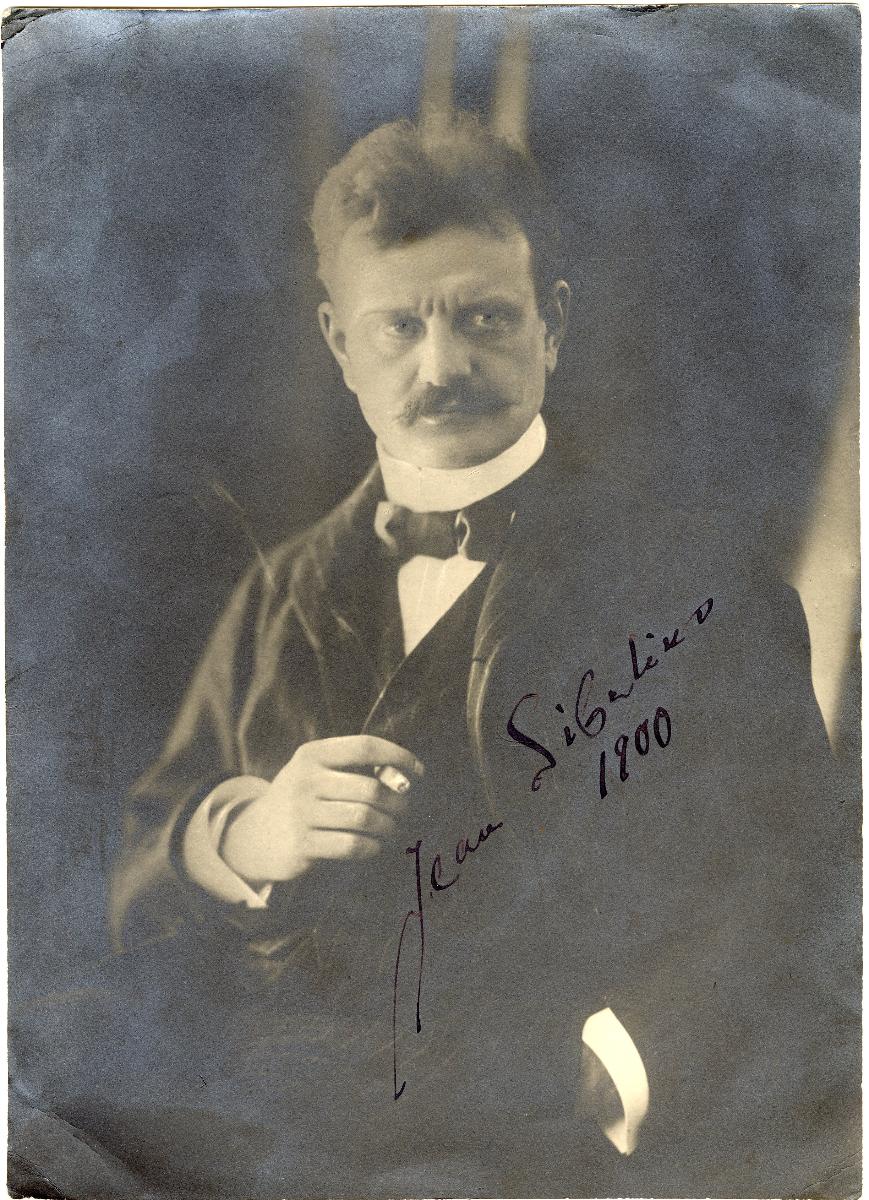

Daniel Nyblin, 1900, Sibelius-museon arkisto (Sibelius Museum archive), via Finna, CC BY 4.0 · Studio portrait photograph of Jean Sibelius, half-length, with a cigarette, signed and dated '1900' by the sitter, by the photographer Daniel Nyblin (1856-1923); Sibelius Museum archive (Sibelius-museon arkisto, Turku), photograph collection item SmF8990, 23.8 x 17.8 cm, Finna record sibelius.35F0F57B0A494426B695B501E1EB562B, digitised and published by the archive under CC BY 4.0 (creator credited as photographer, role 'valokuvaaja'). Rights basis: the live Finna record states CC BY 4.0 and asks for credit to the photographer, the collection and the organisation; independent of that licence, the photographer died in 1923 (Wikidata Q6019293 lists 1856-1923), so a studio photograph made in 1900 is in the public domain in Finland and in the United States by age, and the sitter's autograph and the archive's own title confirm the identity. The archive's conditions add that use of portraits of persons in marketing is not permitted without the sitter's consent (the sitter died in 1957) and ask that a copy of any print publication be sent to the museum. Original file as served by Finna in the 'large' size is 869 x 1200 pixels (the archive holds a higher-resolution original; no upscaling or cropping, file used as served). · CC BY 4.0 (Sibelius Museum archive); photograph also in the public domain by age (photographer died 1923)
작곡가 · 20세기
장 시벨리우스
1865–1957
주요 업적 분야
아직 성격 매칭에 포함되지 않았습니다 — 기록된 근거가 성격 모델 전체를 다루기에는 충분하지 않습니다. 이 페이지의 다른 모든 내용은 자유롭게 확인하실 수 있습니다.
핵심 특성
주요 업적
핀란드를 대표하는 작곡가이자 스칸디나비아에서 가장 이름난 교향곡 작곡가로, 1899년부터 1924년까지 7곡의 교향곡을 썼으며 브리태니커는 그의 업적이 무엇보다 탁월한 형식 장악력과 유기적 성장의 능력에 있다고 평가한다.
칼레발라에서 영감을 얻은 《쿨레르보 교향곡》(1892)이 큰 반향을 일으켰고, 《엔 사가》, 카렐리아 음악, 《투오넬라의 백조》와 함께 그를 핀란드 최고의 작곡가로 자리매김하게 했으며, 1897년 상원은 그에게 종신 연금을 의결했고 1899~1900년에는 《핀란디아》가 나왔다.
후기 교향곡들과 교향시 《타피올라》(1926)는 그의 최고작으로 꼽히며, 아도르노 같은 비평가들의 공격을 받고도 1980년대 말부터 평판이 회복되었고, 그의 형식 개념은 본 윌리엄스와 바버에서 이후 핀란드·프랑스·미국 작곡가들에 이르기까지 영향을 미쳤다.
삶의 장면들
1940년대에 그의 원고가 든 바구니가 아이놀라의 난로에 던져졌고, 부인은 그중 초기 《카렐리아 모음곡》을 확인할 수 있었으며, 1930년대 초 쿠세비츠키에게 약속했던 교향곡 8번도 함께 파기된 것으로 여겨진다.
이는 자신이 내놓을 작품에 매우 엄격한 기준을 적용했던 모습과 부합하지만, 원고를 태운 이유 자체는 기록되어 있지 않다. 완벽주의
교향곡 5번은 1915년 12월 그의 50번째 생일에 초연되었고, 1916년에 개정되었으며, 첫 두 악장이 하나로 합쳐지고 느린 악장이 확장된 1919년에야 최종본이 되었다.
이는 대작을 몇 해에 걸쳐 거듭 고쳐 가며 자신의 기준에 이를 때까지 다듬었던 모습과 부합한다. 끈기
전환점
법학 공부를 그만두고 베를린과 빈에서 수학한 그는 1890~91년 빈에서 칼레발라를 읽고 음악에 핀란드적 리듬을 찾기 시작했으며, 이어 쓴 《쿨레르보》가 1892년 초연에서 큰 반향을 일으켜 그를 핀란드 최고의 작곡가로 만들었다.
이는 의도적으로 수련한 뒤 그 기량을 자신만의 독자적 소재로 돌린 작곡가의 모습과 부합한다. 숙련 지향
비슷한 인물
전체적인 프로필이 이 사람과 닮은 사람들이에요.
출처
- Jean Sibelius (Q45682), verified live via the Wikidata API (2026-11-01): label 'Jean Sibelius', description 'Finnish composer (1865-1957)', born 1865-12-08, died 1957-09-20, Korean label 장 시벨리우스. Orientation only; not used as support for any row.
- Encyclopaedia Britannica, 'Jean Sibelius' (full article read). CANONICAL SIGNIFICANCE SOURCE: the most noted symphonic composer of Scandinavia; the Kullervo Symphony (1892) made him Finland's leading composer, the Finnish Senate voted him a life pension in 1897, Finlandia 1899-1900; his greatest works are the last three symphonies and Tapiola, after which he lapsed into a long silence; rumours of an eighth symphony were unfounded and no manuscripts survived his death; his achievement lies principally in his mastery of form and in the capacity for organic growth; 1930s vogue followed by a reaction in the next generation.
- 'The war and the destruction of the eighth symphony 1939-1945', from the English-language Jean Sibelius website at sibelius.klubi.fi (read in full, about 1,100 words; the page does not name an author, and the site is a commemorative biography site, so treated as an admiring biographical source). Dated statements from the composer to his secretary and son-in-law that a great work was under way (1943, February 1945); an August 1945 remark that he had 'completed' the symphony many times and burnt it once; the widow's testimony of a great burning at Ainola and that afterwards he seemed calmer. Passages on war, family and Nazi-era politics were read but are not scored.
- Sibelius website at sibelius.klubi.fi, three pages read in full: 'Stylistic development: main tendencies', 'Development of popularity' and 'Importance in the 21st century' (about 3,300 words together; unsigned commemorative biography site, admiring in tone but it also records the critical campaign against him). Covers the study years in Berlin and Vienna, the reworking of En Saga and the violin concerto into more concentrated versions, the Fifth Symphony (first performed 8 December 1915, revised 1916, not final until 1919), the one-movement Seventh Symphony and Tapiola, the 1930s partisans (Gray, Downes) and the later reaction (Adorno, Thomson, Leibowitz), and later influence on British, American, Finnish and French composers.
- Sudip Bose, 'The Sound of Silence: Jean Sibelius and the symphony that never was', The American Scholar (Phi Beta Kappa), 29 February 2016 (read in full, about 2,900 words). Essay on the lost Eighth Symphony: the long correspondence with Koussevitzky and Olin Downes, the repeated postponements 1930-1932, the burning of a basket of manuscripts in the 1940s, Mahler's reported dismissal of him as a purveyor of Scandinavian kitsch, and the claim that critics saw his language as old-fashioned. Remarks on his moods, diaries and drinking were read and are not used.
- Los Angeles Review of Books, review of Theodor Adorno, 'Orpheus in the Underworld: Essays on Music and Its Mediation' (2024), opening passage read (the section on Adorno's essay 'Strictures on Sibelius'; the rest of the long review is about Adorno). CRITICAL / COUNTER-VOICE: quotes Adorno's 1938 verdict that attempting something new with old and decayed means is absurd and that nothing is expressed, notes Virgil Thomson's reaction, and says the tone did not stop the canonization of Sibelius.
- The Christian Science Monitor, 'Our own landscapes' (2 February 1981; an opinion column on how critics disagree about Sibelius; read in full, about 1,700 words). CRITICAL / COUNTER-VOICE and reception: quotes David Ewen (1937) praising the symphonies, Virgil Thomson (1940-41) calling the Second Symphony 'vulgar, self-indulgent and provincial', and Harold Schonberg (1970) saying many professionals after the Second World War found him a dated bore. The author's personal recollections are not used.
- Mark Cartwright, 'Jean Sibelius', World History Encyclopedia, 8 June 2023 (read in full, about 1,600 words). Biographical overview: studies in Helsinki, Berlin and Vienna, the Kalevala-inspired Kullervo (1892), Finlandia revised in 1900 ('always something of a tinkerer'), the seven symphonies from 1899 to 1924, the Eighth Symphony said to have been destroyed in dissatisfaction, and no new published work in the last thirty years of his life; the composer described the symphony as requiring a 'severity of form and the profound logic' connecting all the motifs. Passages on drinking, debts, health and marriage were read and are not used.
- Sibelius Museum archive (Sibelius-museon arkisto, Turku), Finna record sibelius.35F0F57B0A494426B695B501E1EB562B, 'Jean Sibelius', photograph by Daniel Nyblin, 1900, signed and dated by the sitter, CC BY 4.0 (record read live through the Finna API; used for the portrait only, not for any trait row).