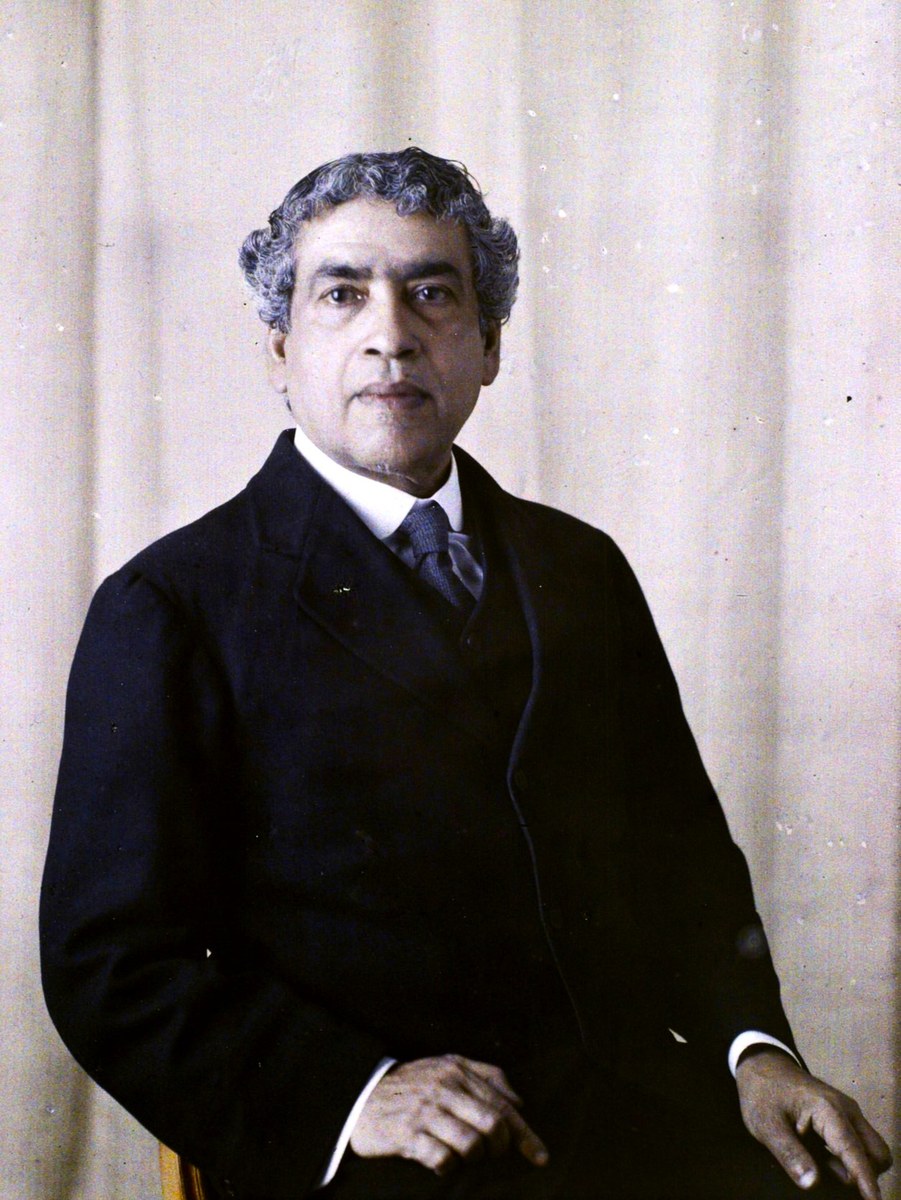

Georges Chevalier, 1920, Musee Albert-Kahn / Departement des Hauts-de-Seine, CC BY 4.0 · Autochrome portrait of Jagadish Chandra Bose taken on 15 July 1920 at the Albert Kahn property in Boulogne by Georges Chevalier; collection of the Departement des Hauts-de-Seine, musee Albert-Kahn, inventory A22267, whose record states the image is freely reusable under CC-BY-4.0; also on Wikimedia Commons as '1920 Jagadish Chandra Bose.jpg' (tagged CC BY-SA 4.0). Original 1254 x 1671 downscaled to 901 x 1200, colour-corrected by the Commons uploader. · CC BY 4.0 (as stated by the Albert-Kahn museum; Commons tags CC BY-SA 4.0)
물리학자 · 19세기
자가디시 찬드라 보스
1858–1937
주요 업적 분야
아직 성격 매칭에 포함되지 않았습니다 — 기록된 근거가 성격 모델 전체를 다루기에는 충분하지 않습니다. 이 페이지의 다른 모든 내용은 자유롭게 확인하실 수 있습니다.
핵심 특성
주요 업적
1895년 캘커타 프레지던시 칼리지에서 그는 벽을 통과하는 밀리미터파 전송을 시연했고, 코히러·송신기·안테나 등 여러 부품을 직접 제작했다. 이 업적은 IEEE 마일스톤으로 선정되었다.
물리학에서 식물생리학으로 옮겨 가 크레스코그래프 같은 정밀 기구로 식물의 생장과 반응을 기록했고, 생물과 무생물의 반응 사이에 뚜렷한 경계가 없다고 주장했다.
1917년 그는 캘커타에 연구 기관인 보스 연구소를 열었다.
삶의 장면들
1894년 연구를 시작하기로 결심했을 때 실험실이 없었지만, 숙련되지 않은 양철공의 도움을 받아 약 석 달 만에 첫 장비를 만들었다.
이는 시설을 기다리지 않고 임시변통으로 일을 진척시키는 태도와 부합한다. 자원 활용 성향
전환점
1900~1903년경 금속 수신기가 근육처럼 '피로'와 회복을 보인다는 것을 발견한 뒤, 그는 전파 물리학에서 생체 조직, 그리고 식물 연구로 옮겨 갔다.
이는 이상 현상을 따라 학문 분야의 경계를 넘나드는 태도와 부합한다. 분야 횡단성
비슷한 인물
전체적인 프로필이 이 사람과 닮은 사람들이에요.
출처
- Jagadish Chandra Bose (Q314267) -- verified live via the Wikidata API (2026-10-24): English label 'Jagadish Chandra Bose', description 'Bengali polymath, physicist, and biologist (1858-1937)', born 1858-11-30, died 1937-11-23, Korean label '자가디시 찬드라 보스', P18 image '1920 Jagadish Chandra Bose.jpg'. Orientation only; not used as support for any row.
- IEEE Milestone page 'First Millimeter-wave Communication Experiments by J.C. Bose, 1894-96' (Engineering and Technology History Wiki; dedicated 2012 in Kolkata), read in full. CANONICAL SIGNIFICANCE SOURCE: in 1895 at Presidency College, Calcutta, Bose demonstrated transmission and reception of 60 GHz waves over about 23 metres through two walls, ringing a bell and detonating gunpowder, and developed spark transmitter, coherer, dielectric lens, polarizer, horn antenna and diffraction grating. A professional-society honour: celebratory, with no discussion of priority disputes.
- Book review of Subrata Dasgupta, 'Jagadis Chandra Bose and the Indian Response to Western Science' (Oxford University Press, 1999), Indian Journal of Physiology and Pharmacology 44(4), 2000, pp. 513-516, read in full from the journal PDF. Summarises Dasgupta's three-phase assessment: the 'early Bose' as mainstream physicist (priority claims over radio telegraphy reflect parochial passions), the 'middle Bose' whose unity-of-life-and-nonlife thesis rested on a questionable assumption and was dismissed, and the 'late Bose' plant physiologist whose instruments won recognition but whose explanations went far beyond his data; some papers were 'archived' (rejected) by the Royal Society. Review of a biography, read instead of the book itself; a critical scholarly voice, partly sympathetic.
- Kapil Subramanian, 'Why JC Bose made George Bernard Shaw weep and inspired Tagore to call him Acharya' (Scroll.in, historian-of-science essay drawing on Dasgupta), read in full: Bose's 1895 Calcutta demonstration and Lodge's earlier proof of concept, the US patent for a galena coherer, a radio company asking him to hold papers until a patent deal, his move into physiology, priority disputes with Augustus Waller, disciplinary 'turf' resistance, speculation and spiritualist readings that discomforted scientists, and funding arranged by Tagore and R. C. Dutt through the Maharaja of Tripura. COUNTER-VOICE source: describes him as a figure on the margins of mainstream science.
- Kalyan Chatterjee, 'Jagadish Chandra Bose: Champion of East and West' (Live History India, 31 July 2021), read in full: Cambridge and London training, the 1894 turn to research with an untrained tinsmith and no laboratory (quoting Patrick Geddes's 1920 biography), millimetre waves and the spiral spring coherer, the Paris 1900 lecture on the line between living and non-living, optical pulse recorder and crescograph, hostility from physiologists, and the no-patent rule at the Bose Institute. Popular historical feature, admiring.
- New World Encyclopedia, 'Jagdish Chandra Bose' (read in full): papers communicated to the Royal Society by Lord Rayleigh in 1895, the coherer shown publicly without secrecy, his US patent of 1904 and later reluctance to patent, the unpublished Royal Society manuscript on the continuity of living and non-living matter and the resistance it met, the crescograph, the Bose Institute inaugurated in 1917, knighthood 1916 and Fellowship of the Royal Society 1920. Derivative encyclopedia entry with some celebratory wording; used for dates and the patent facts.
- Musee Albert-Kahn (Departement des Hauts-de-Seine) collection record for the autochrome 'Jagadish Chandra Bose', inventory A22267, operator Georges Chevalier, 15 July 1920, licence stated as freely reusable (CC-BY-4.0), and the Wikimedia Commons file page '1920 Jagadish Chandra Bose.jpg', checked for the portrait only.