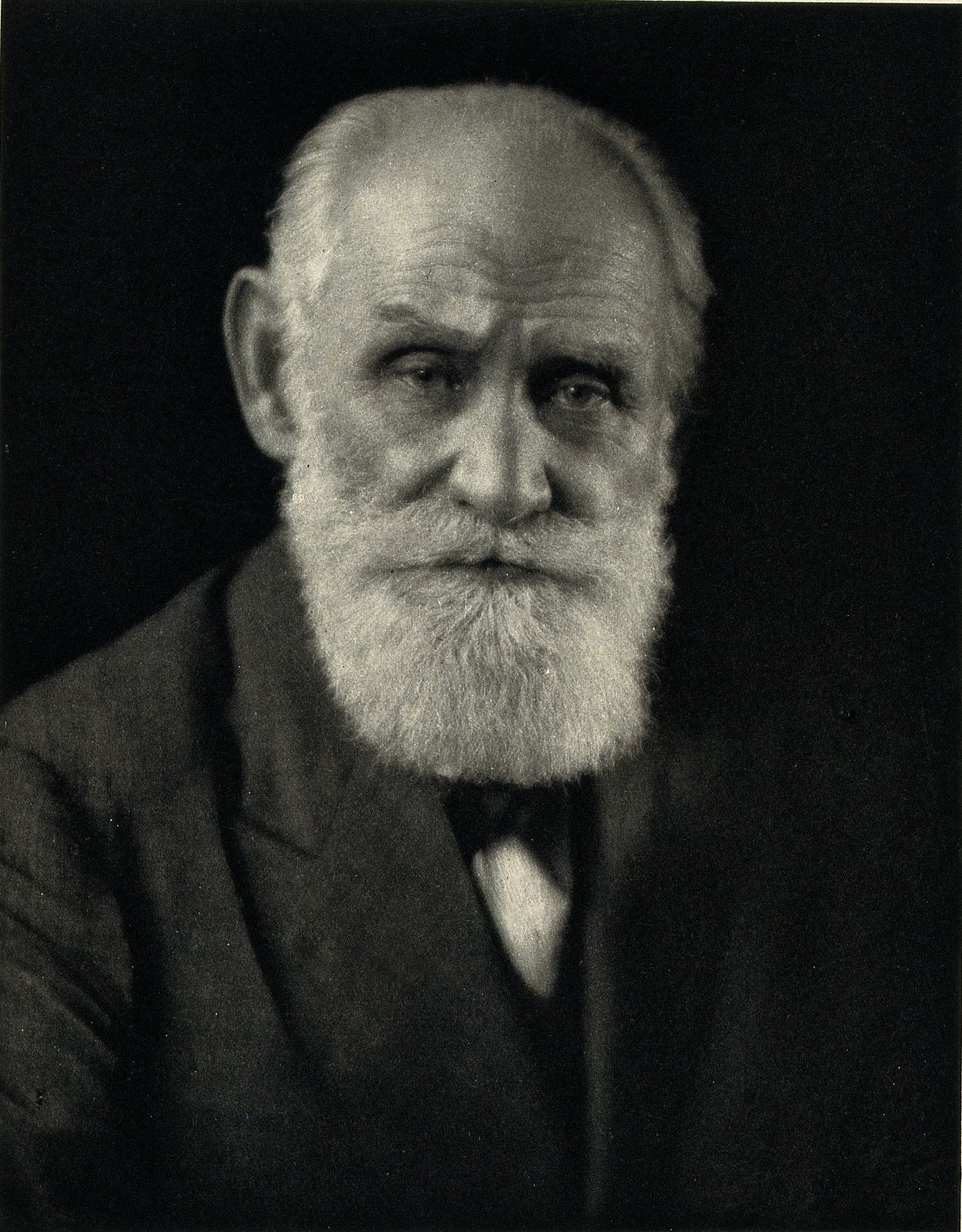

Ivan Petrovich Pavlov, photograph by Lafayette Ltd, photogravure by Emery Walker, Supplement to Nature, 3 Jan. 1925. Wellcome Collection (Public Domain Mark); cropped to the photograph and downscaled · Photogravure by Emery Walker after a photograph by Lafayette Ltd, issued as a Supplement to Nature, 3 January 1925; Wellcome Collection 13393i (ICV No 27467), via Wikimedia Commons · Public domain
핵심 특성
주요 업적
소화 생리학 연구로 1904년 노벨 생리학·의학상을 받았다. 시상 연설은 같은 동물을 오랜 기간 연구할 수 있게 한 그의 수술 기법을 특히 언급했다.
1902년부터 실험실의 연구를 개의 이른바 '정신적' 분비를 객관적으로 연구하는 쪽으로 돌렸다. 이것이 1936년 세상을 떠날 때까지 이어진 조건반사 연구다.
30년 넘게 상트페테르부르크의 실험의학연구소와 군의학아카데미에서 생리학 실험실을 이끌었다. 제자들의 기록에 따르면 한 번에 수십 명의 연구자가 그의 실험실을 거쳐 갔다.
삶의 장면들
제자 보리스 밥킨에 따르면, 1893~94년 무렵 파블로프가 신경을 보존한 분리 위낭 수술을 처음 시도했을 때 수술은 열아홉 번 실패했다. 스무 번째 개에서 성공했고, 이 과제를 맡은 학생은 학위논문을 마칠 수 있었다.
이 일화는 어려운 수술에서 실패가 거듭되어도 시도를 멈추지 않았다는 점에서, 이 프로필의 끈기 점수를 보여 주는 한 예다. 끈기
공동 연구자 V. V. 사비치의 회고에 따르면, 파블로프는 췌장 분비가 오로지 신경에 의해 조절된다는 실험실의 견해에 도전한 베일리스와 스탈링의 세크레틴 실험을 재현해 보라고 그에게 부탁했다. 눈앞에서 결과가 확인되자 파블로프는 30분쯤 자리를 비웠다가 돌아와 "물론 그들이 옳다"고 말했다.
이 일화는 이 프로필의 신념 수정 점수와 나란히 놓인다. 다만 밥킨이 파블로프가 생각을 바꾸기까지 많은 증거를 요구했다고도 기록하고 있어 점수는 중간 수준으로 두었다. 입장 수정 성향
전환점
1904년 12월 노벨 강연에서 파블로프는 수상 대상인 소화 연구만이 아니라 새로운 연구 방향에도 많은 시간을 할애했다. 그는 개의 '정신적' 타액 분비를 전적으로 객관적인 관점에서 다루기로 한 결정을 설명했다.
이 선택은 이 프로필의 독립적 사고 점수와 맞닿아 있다. 갠트는 셰링턴과 티거슈테트 같은 동료들이 뒤에 이 새 연구에 신중하라고 권했지만 그가 연구를 계속했다고 기록한다. 독립적 사고
비슷한 인물
전체적인 프로필이 이 사람과 닮은 사람들이에요.
출처
- Ivan Pavlov (English Wikipedia) -- orientation only; not used as support for any scored row. Korean Wikipedia title '이반 파블로프' confirmed via the Wikidata sitelink.
- Ivan Pavlov (Q42985) -- verified live via wbgetentities (2026-09-26): en label 'Ivan Pavlov', description 'Russian physiologist (1849–1936)', ko label '이반 파블로프', ru 'Иван Петрович Павлов', born 1849-09-14 (Julian; 1849-09-26 Gregorian), died 1936-02-27, citizenship Q34266 (Russian Empire), Q2305208, Q15180 (Soviet Union), P18 'Ivan Pavlov NLM3.jpg', kowiki '이반 파블로프'. Orientation only.
- B. P. Babkin, Pavlov: A Biography (University of Chicago Press, 1949), archive.org OCR full text (in.ernet.dli.2015.156540) -- STUDENT/INSIDER perspective: Babkin worked in Pavlov's laboratory 1902-12 (assistant at the Institute of Experimental Medicine) and knew him for 35 years; much is his own eyewitness, some is transmitted from V. V. Savich's 1924 article, N. J. Chistovich's 1904/1925 recollections, Mrs Pavlov's 1946 'Reminiscences', or Pavlov's own tellings (flagged as such where used). Admiring but openly critical in places (the Bechterev polemic, temper, the secretin 'chance' remark, lack of practical classes). Read: Introduction; ch. 2 (Botkin laboratory 1878-90, the thesis delay to 1883, the control-experiment episode, Chistovich's account); ch. 5 (pharmacology and physiology chairs 1890-95, teaching by demonstration, the Pashoutin ballot protest and reprimand); ch. 6 (Institute of Experimental Medicine, chronic 'physiological surgery', organisation of graduate work); ch. 7 (Babkin's own entry 1902); ch. 8 (indifference to rank, the Academy-conference operation, the Bechterev/Gorshkov/Spirtov controversy c.1906-09, Babkin present); ch. 9 (integrity, secretin, punctuality, Dr V. and Savich's intervention, the Pavlov pouch after nineteen failures c.1893-94, concentration); ch. 10 (testing of reported results, creative imagination, 'six months' rule for theories, training of newcomers, watching Babkin's test tubes 1902); ch. 11 (school, invitation to contradiction, laboratory-council proposal, temperament, Chistovich's forceps story); ch. 12 (attitude to co-workers, operations, the 1902 Thompson demonstration); ch. 13 (daily routine 1901-12 and later per Frolov/Logansky, Nobel 1904, the Nobel lecture topic, 1913 frictions). Ch. 3-4 (marriage and family life), 16-18 (politics, Bolsheviks, illnesses and death) deliberately NOT used.
- W. Horsley Gantt, 'Ivan P. Pavlov: A Biographical Sketch' (pp. 11-31) and translator's preface, in I. P. Pavlov, Lectures on Conditioned Reflexes, vol. 1, trans. W. H. Gantt with G. Volborth (New York: International Publishers, 1928; 1941 printing), archive.org OCR (in.ernet.dli.2015.190960) -- INSIDER/COLLABORATOR perspective: Gantt, an American physician, worked in Pavlov's Leningrad laboratory 1925-29 and writes partly from his own observation (1925-28) and partly from V. V. Savich's 1924 Russian sketch (quoted, and flagged as such where used), plus a 1922 statement by an unnamed assistant and a 1928 note by T. R. Elliott. Admiring. The translator's preface says the sketch was included without Pavlov's knowledge. Read in full: sections I-V (youth per Savich; the 1875 refusal to stay with Tsyon's successor; Pashootin conflict; Institute surgical department 1891; post-Nobel hostility; memory; operating speed; Savich's secretin verification; the 1923 claim and 1925 repudiation of inherited conditioned reflexes in mice; Sherrington's and Tigerstedt's 1912 discouragement of the conditioned-reflex work; punctuality during the Revolution; winter 1919-20 experiments by torchlight; daily routine; temperament). Also read Walter B. Cannon's two-page 'Introduction to the English Translation' (Sept. 1928) -- evaluative only, not used for any row.
- Y. P. Frolov, Pavlov and His School: The Theory of Conditioned Reflexes, trans. C. P. Dutt (London: Kegan Paul, 1937), archive.org OCR (in.ernet.dli.2015.158241) -- STUDENT/COLLABORATOR perspective: Frolov heard Pavlov's lectures from Sept. 1911, worked in his laboratory from c.1913-14 and later as his assistant at the Military-Medical Academy; published in the USSR shortly after Pavlov's death, admiring and with Soviet framing (which is ignored here). Independent of Babkin (an emigre) and Gantt. Read: Author's preface and ch. VIII 'Pavlov's Method of Work: His School' pp. 238-264 (his own recollections of the 1911 lectures, the right of students to interrupt, punctuality to the second; his first conditioned-reflex experiment with home-made Indian-ink screens; the 1919 winter -- operating by the light of wood splinters, cycling to the laboratory, the vegetable plot; the 1921 lecture on the qualities of a scientist; the 'Wednesdays'; assignment of problems; the rule that finished work was set aside for a year or two before printing; the 1917 book not published until 1926). Theory chapters I-VII not used for behavioural rows.
- K. A. H. Morner (Rector of the Karolinska Institute), Presentation Speech for the Nobel Prize in Physiology or Medicine 1904, 10 Dec. 1904, nobelprize.org -- INSTITUTIONAL perspective (the awarding body), read in full 2026-09-26: describes Pavlov's chronic-fistula technique (animals kept in good health and studied over long periods), the systematic series of experiments from his laboratory, and the findings on nervous control of gastric secretion. Used only as independent corroboration of the method, not for personality claims.
- I. P. Pavlov, Nobel Lecture 'Physiology of Digestion', 12 Dec. 1904 (English text), nobelprize.org -- SELF, one perspective, never sole support for a row. Read in full 2026-09-26: his own description of the surgical/chronic method (asepsis, post-operative care, 'modus vivendi' for the animals), acknowledgement of his laboratory co-workers, and the second half devoted to 'psychical' salivary secretion treated from an 'entirely objective point of view' (the first public statement of the conditioned-reflex programme).