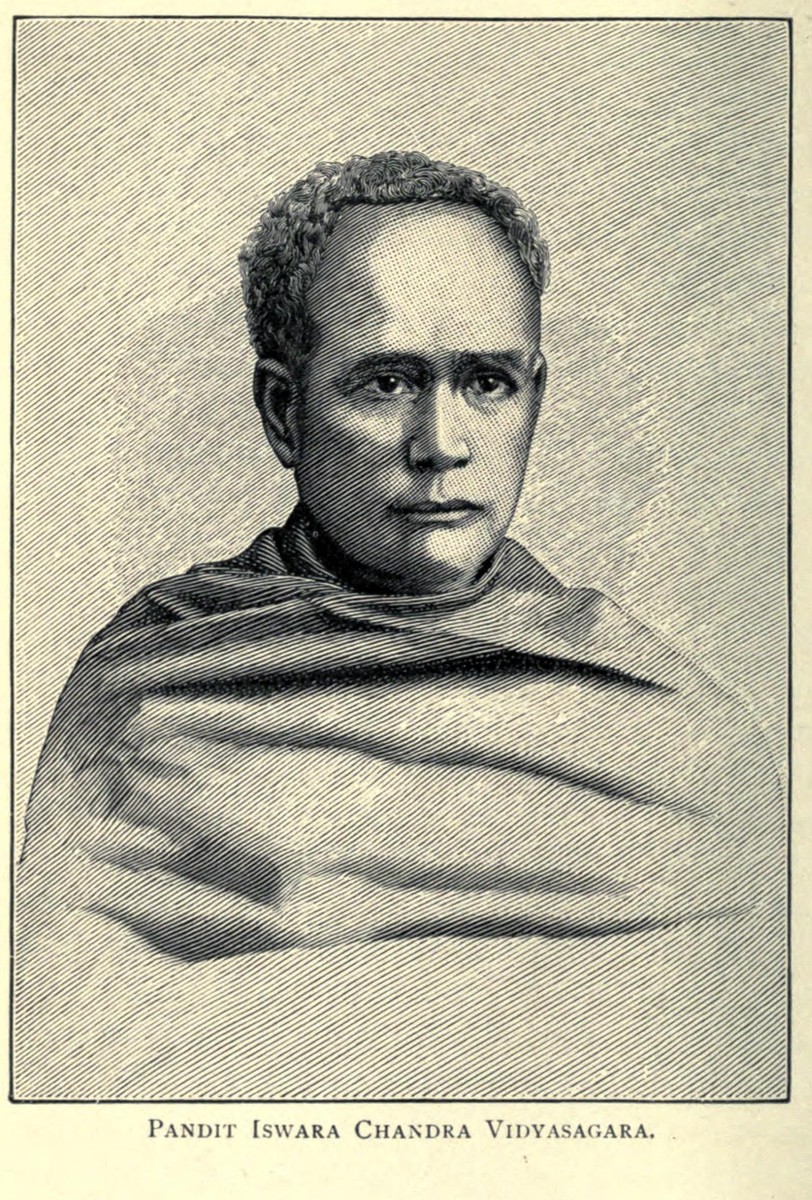
Pandit Iswara Chandra Vidyasagara, engraving in Sivanath Sastri, Ramtanu Lahiri, Brahman and Reformer, London, 1907. Internet Archive, University of California Libraries copy, public domain · Engraved portrait captioned 'PANDIT ISWARA CHANDRA VIDYASAGARA.', plate in Sivanath Sastri, 'Ramtanu Lahiri, Brahman and Reformer: A History of the Renaissance in Bengal' (London: Swan Sonnenschein, 1907), from the University of California Libraries copy digitised by the Internet Archive. The engraver and the photograph or drawing it was made from are not named in the book, so it is treated as a later engraved depiction made about sixteen years after his death, though it matches the same likeness printed in 1906 and 1911 publications. The file is a crop of the plate and its caption from the full-page scan (1360 x 2010), downscaled to 812 x 1200 with no upscaling. · Public domain (book published in London in 1907, before 1931; the archive's record gives NOT_IN_COPYRIGHT)
학자 · 19세기
이슈와르 찬드라 비디야사가르
1820–1891
영국령 인도 제국
주요 업적 분야
아직 성격 매칭에 포함되지 않았습니다 — 기록된 근거가 성격 모델 전체를 다루기에는 충분하지 않습니다. 이 페이지의 다른 모든 내용은 자유롭게 확인하실 수 있습니다.
핵심 특성
주요 업적
1851년부터 산스크리트 대학 교장으로서 모든 힌두교도에게 입학 문을 열고 소액의 수업료를 도입했으며, 영어를 필수 과목으로 삼고 문법과 수학을 산스크리트어뿐 아니라 벵골어와 영어로도 가르치게 했다.
벵골어 입문서 『바르나파리차이』와 벵골어로 쓴 산스크리트 문법서 등 모범적인 교과서를 썼고, 『베탈 판차빔샤티』와 『샤쿤탈라』 같은 작품으로 문학적 벵골어 산문을 만드는 데 기여한 것으로 평가받는다. 타고르는 그가 벵골어 산문의 아름다움을 확립했다고 보았다.
학교 장학관으로서 네 개 지역에 벵골어 모범학교 약 스무 곳과 교사 양성학교를 열었고, 자기 마을에는 대부분 사비로 학교를 세웠으며, 1864년 캘커타 메트로폴리탄 학원을 맡았다. 또한 산스크리트 경전에 근거해 힌두 과부의 재혼이 허용된다고 주장했다.
삶의 장면들
1851년 그는 카야스타 소년들도 산스크리트 대학에 받아들여야 한다고 교육위원회에 보고했다. 교수들이 그렇게 하면 종교가 더럽혀진다고 반대하자 그는 경전 구절로 반박하고 실패하면 사직하겠다고 말했으며, 당국은 이를 승인했다.
이는 자신이 이끄는 기관을 먼저 바꾸려 하고 반대에도 변화를 밀어붙인 태도와 일치한다. 선제적 행동력
1858년 9월 공교육 국장과 의견 차이를 빚은 끝에, 그는 사직서를 고쳐 달라는 국장의 요청을 일관성을 이유로 받아들이지 않았고, 월 500루피를 받던 관직에서 물러났다.
이는 좋은 보수의 관직보다 상관으로부터의 독립을 앞세운 태도와 일치한다. 자율성 욕구
전환점
1847년 산스크리트 대학을 떠났던 그는 1850년 12월 문학 교수로 돌아왔고 한 달 뒤 교장이 되었다. 이 직책은 조직 개편으로 새로 만들어졌으며, 그는 이를 통해 교과과정과 규칙을 고칠 권한을 얻었다.
이는 개혁을 주도할 수 있게 되자 같은 기관으로 돌아온 행보와 일치한다. 선제적 행동력
비슷한 인물
전체적인 프로필이 이 사람과 닮은 사람들이에요.
출처
- Ishwar Chandra Vidyasagar (Q964111), verified live via the Wikidata API (2026-11-05): English label 'Ishwar Chandra Vidyasagar', description 'Philosopher, academic, writer, translator, entrepreneur, social reformer and philanthropist (1820-1891)', birth 26 September 1820, death 29 July 1891, image Ishwarchandra Vidyasagar.jpg; no Korean label. Orientation only; not used as support for any row.
- Banglapedia (Asiatic Society of Bangladesh), 'Vidyasagar, Ishwar Chandra' (full entry read). CANONICAL SIGNIFICANCE SOURCE: Sanskrit scholar, writer, educationist and philanthropist; studied at Sanskrit College 1829-1841 and earned the title Vidyasagar by 1839; resigned the Assistant Secretary post in July 1847 after obstacles from the conservative secretary; returned in December 1850 and became Principal in January 1851, opened the college to all Hindus, introduced nominal fees, moved the weekly holiday to Sunday, made English compulsory and taught grammar and mathematics through Bangla and English as well as Sanskrit; as assistant inspector from 1855 opened Bangla schools in four districts (twenty in a couple of years), a normal school, and a village school almost entirely with his own money; opened thirty-four more girls' schools in 1857-58 until differences with the director of public instruction led him to resign; took over the Metropolitan Institution in 1864; his textbooks (Barnaparichay and others) ran dozens of editions, and he is credited with creating a literary Bangla prose, though 'some contemporary writers' called him little more than a translator, which the entry rejects. Also records his widow-remarriage writing and petitions (context only here; unscored). Reference work; its praise is retrospective and the entry differs from other sources on some dates (it gives the Widow Remarriage Act as 1857 where other sources say 1856), so no row depends on a date.
- EBSCO Research Starters, 'Iswar Chandra Vidyasagar' by Rane C. Chakravorty (2024; the whole entry read). An independent modern encyclopedia: studied about twelve and a half years at Sanskrit College, won prizes at every stage and was given the title Vidyasagar after a Hindu-law examination in 1839; as head of the Bengali department at Fort William College he studied English and Hindi privately; started his own press and book depository to print his books; as principal for eight years admitted all castes, made English compulsory and wrote new Sanskrit grammar textbooks; managed the Calcutta Training School from 1864; was honorary secretary of the Bethune School and as school inspector opened women's schools; 'refined the Bengali alphabet' in Baranaparichay; Tagore 'credited Vidyasagar with effectively establishing the beauty of Bengali prose'; notes that his campaigns against polygamy and for a higher age of consent were not achieved in his lifetime. Also calls him an atheist and an 'embodiment of compassion' (not used).
- Amiya P. Sen (historian), 'Remembering Iswarchandra Vidyasagar', Sahapedia (read in full). An independent historian's essay that combines praise with criticism: Tagore's 'Vidyasagar-charit' is described as the best commentary and portrays a man of effort, self-respect and self-determination unlike his contemporaries; Vidyasagar 'opposed state spending on traditional Hindu education' and urged Western learning, favoured Baconian thought; he was criticised by contemporaries such as Bankim Chandra Chattopadhyay for relying on scriptural sanctions for social legislation, and his later reputation has been contested (statue vandalism in 1970 and 2019). COUNTER-VOICE for the sources above. Short magazine-style essay; its characterisations are interpretive.
- Subal Chandra Mitra, 'Isvar Chandra Vidyasagar: A Story of His Life and Work' (Calcutta: New Bengal Press, 1902), with an introduction by R. C. Dutt, Internet Archive scan read in the parts on his Fort William College years, the Sanskrit College principalship (the 20 March 1851 report on admitting Kayastha boys, the professors' objections, his threat to resign), his resignation correspondence of 1857-58 (his own letters to the Director of Public Instruction and Lieutenant-Governor are reproduced) and the relief of the poor during a famine and scarcity in his home district (a Commissioner's letter of Government acknowledgment is reproduced). Early English biography by an admirer who says he does not gloss over shortcomings and draws on Behari Lal Sarkar's Bengali life; Dutt's introduction is a personal acquaintance's tribute; the book quotes C. E. Buckland, 'Bengal under the Lieutenant-Governors', on the 1858 conflict (read only as quoted). Admiring and anecdotal in places (anecdotes introduced by 'it is said' are not scored); the reproduced letters and reports are the strongest part.
- Sivanath Sastri, 'Ramtanu Lahiri, Brahman and Reformer: A History of the Renaissance in Bengal' (London: Swan Sonnenschein, 1907; translated from the Bengali; Internet Archive scan from the University of California Libraries, item ramtanulahiribra00sastiala, possible-copyright-status NOT_IN_COPYRIGHT). Portrait source only: the book contains a full-page engraved plate captioned 'PANDIT ISWARA CHANDRA VIDYASAGARA.' facing page 57; its text about Vidyasagar (a teacher at Fort William College who wrote Vetala-panchabinsati in 1847) is not used for any row.