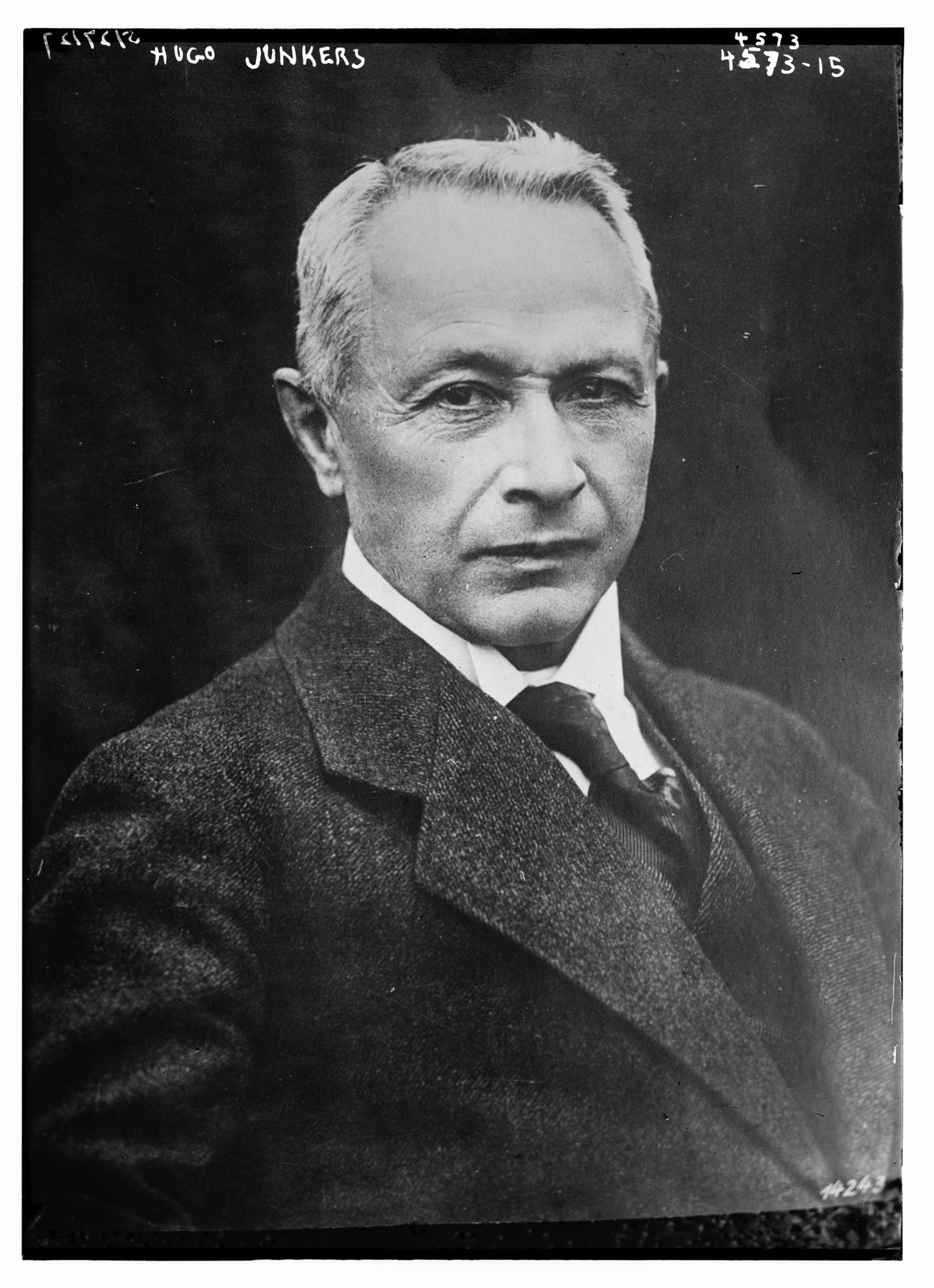

Bain News Service, 'Hugo Junkers', glass negative, between about 1915 and about 1920; Library of Congress Prints and Photographs Division, no known restrictions on publication · Library of Congress, Prints and Photographs Division, George Grantham Bain Collection (call number LC-B2- 4573-15; digital file LC-DIG-ggbain-26735), also on Wikimedia Commons as 'Hugo Junkers LCCN2014706903.tif' · Public domain
핵심 특성
주요 업적
융커스는 1909년부터 아헨의 동료 한스 라이스너(Hans Reissner)와 금속 날개 항공기를 함께 연구한 뒤, 1910년 지지 와이어 없이 두꺼운 단면의 외팔보 날개를 쓰는 전익기(날개만으로 이루어진 항공기)의 특허를 얻었다. 그의 회사가 만든 J 1은 1915년 12월에 처음 비행했다. 『신독일인명사전』은 이를 그의 첫 전금속제 항공기로 올리며 무게는 1,000kg을 조금 넘고 속도는 시속 170km였다고 적고, 한 지역사 포털은 세계 최초의 전금속제 항공기라고 부른다. 전시의 두랄루민 부족 때문에 기체는 철판으로 만들어졌고, '양철 당나귀'라는 뜻의 블레헤젤(Blechesel)이라는 별명이 붙었다.
1919년 그의 데사우 회사는 밀폐된 객실을 갖춘 4인승 전금속제 여객기 F 13을 만들었다. 『신독일인명사전』은 이 기종이 현대 여객기의 본질적인 특징을 두루 갖추었고 약 300대가 만들어졌으며 독일 민간 항공의 출발에 크게 기여했다고 적는다. 1921년 융커스는 항공 운송 부서를 세웠고, 이 부서는 융커스 루프트페어케어(Junkers Luftverkehr)가 되어 1926년 경쟁사와 합병해 도이체 루프트한자(Deutsche Luft Hansa)가 되었다.
Ju 52는 1930년 단발 기체로 처음 비행했고 1932년부터는 3발기 Ju 52/3m이 되어, 전 세계에서 '탄테 유(Tante Ju, 유 이모)'로 불렸다. 『신독일인명사전』은 이 기종을 승객 17명의 여객기이자 융커스의 개인적 주도에서 나온 마지막 항공기로, 1939년 이전 도이체 루프트한자의 표준 여객기였고 1940년대 초까지 세계에서 가장 많이 만들어진 여객기였다고 설명한다. 한 신문 기사는 1932년 이후 5,000대 가까이 만들어졌다고 집계한다.
항공기에 앞서 융커스는 데사우에서 가스 엔진을 연구했고, 1892년 빌헬름 폰 외헬호이저(Wilhelm von Oechelhaeuser)와 함께 수평형 2행정 대향 피스톤 가스 엔진의 특허를 냈다. 같은 해 가스의 발열량을 재는 열량계의 특허를 얻었고, 이를 바탕으로 가스 욕조용 온수기와 순간온수기를 개발했으며, 1895년 데사우에 융커스 운트 코(Junkers & Co.)를 세웠다. 그는 1908년 대향 피스톤 오일 엔진을 만들었고, 1923년 융커스 모토렌바우(Junkers Motorenbau)를 세웠으며, 1929년에는 최초의 디젤 항공기 엔진을 내놓았다. 온수기 사업의 수익은 이후 그의 연구를 뒷받침했다.
삶의 장면들
1916년 1월 11일 융커스는 J 1의 추가 개발 자금을 육군 항공 감독국에 요청했고, 전쟁부는 한 대에 2만 5천 마르크로 항공기 여섯 대를 더 주문했다. 그는 8월부터 10월까지 전쟁부에 긴 편지를 여러 통 보냈고, 10월 6일과 12월 19일에도 선금을 다시 요청했다. 전쟁부는 그의 항공기가 전선 투입이 가능해지면 주문하겠다고 답했다. 바이어스(Byers)는 1917년 초까지 그가 항공기 연구에 사재 150만 마르크 이상을 쏟아부었다고 기록한다. J 4 50대의 주문은 1917년 3월 20일에 나왔다.
답이 없는 상태에서 1년 넘게 요청을 되풀이하고 사재로 개발을 이어간 일은 끈기와 부합한다. 이 서술은 그 자신의 편지를 바탕으로 한 학술 연구 한 편에 의존한다. 끈기
1917년 10월 육군 관계자들이 융커스와 안토니 포커(Anthony Fokker)에게 합작회사 설립을 강요한 뒤, 융커스는 회사 운영을 맡겠다는 포커의 요구를 거부했고 특허 받은 날개 기술은 새 회사만 쓸 수 있다고 못박았다. 1918년 4월 그는 이사회가 연구 우선순위를 정하고 연구소 자금을 배분한다고 항의하는 편지를 항공대 감독관에게 쓰기 위해 초안을 작성했고, 연구소를 자기 회사로 다시 가져오겠다는 뜻을 적어 두었다. 합작회사는 1919년 4월 24일 공식 해산되었다.
자신의 연구와 그 자금에 대한 외부의 통제에 맞선 일은 강한 자율성 욕구와 부합한다. 바이어스는 육군 관계자들이 같은 태도를 존중이 부족한 것으로 보았다고도 전한다. 자율성 욕구
전환점
1932년 세계 경제 위기는 융커스의 기업군을 재정난에 빠뜨렸다. 그는 항공기와 엔진 공장을 지키기 위해 원래의 온수기 회사인 융커스 운트 코를 로베르트 보슈(Robert Bosch)에 팔았다. 1933년 10월 국가사회주의 정부는 그에게 항공기·엔진 회사 지분의 과반을 제국에 넘기고 경영에서 물러나도록 강제했다. 그는 남은 해를 금속 건축에 관한 개인 연구에 쏟다가 1935년에 세상을 떠났다.
자신의 연구를 뒷받침해 온 회사를 팔아 항공기·엔진 공장을 유지한 일은 임기응변의 자원 동원력과 부합한다. 1933년의 지분 이전은 하나의 사건으로 기록할 뿐 어떤 특성의 근거로도 삼지 않는다. 자원 활용 성향
비슷한 인물
전체적인 프로필이 이 사람과 닮은 사람들이에요.
출처
- Hugo Junkers (Q60363) -- verified live via Wikidata Special:EntityData (2026-10-08): en label 'Hugo Junkers', description 'German aviation pioneer (1859-1935)', born 3 Feb 1859, died 3 Feb 1935, citizenship Germany, GND 118776525, image 'Bundesarchiv Bild 146-2005-0007, Hugo Junkers.jpg'; no Korean label. Orientation only; not used as support for any row.
- Hugo Junkers -- English and German Wikipedia articles (raw wikitext), read as orientation only and to flag contested points (Reissner's share in the first all-metal aircraft; the circumstances of his last years); not used as support for any scored row.
- Gert Behrsing, 'Junkers, Hugo', Neue Deutsche Biographie 10 (1974), pp. 695-697, deutsche-biographie.de -- scholarly encyclopedia biography, read in full (career from the Aachen and Dessau gas-engine work, the 1892 calorimeter and opposed-piston engine, the 1895 firm, the Aachen chair, the 1910 thick-wing patent, J 1, F 13, the airline, Ju 52, the 1925-27 finance committee and the 1932 crisis). Written from archive material in the Deutsches Museum and standard older biographies; admiring of his technical record but dated and factual in tone.
- Richard Byers, 'An Unhappy Marriage: The Junkers-Fokker Merger', Journal of Historical Biography 3 (Spring 2008), pp. 1-30 (open access, University of the Fraser Valley) -- peer-reviewed scholarly article by a historian whose doctoral work was on Junkers, based on Junkers company correspondence, his diary notes and army-inspectorate files. Read in full: the J 1 years 1915-16, the financing letters, the December 1916 meeting with Fokker, the 1917 merger, the 1918 dispute over the research institute and the 1919 break-up. Independent of the company and of the family; also reports the army's unflattering view of him.
- Christoph Kaltscheuer, 'Hugo Junkers', Portal Rheinische Geschichte (Landschaftsverband Rheinland), published 2 September 2016, last changed 21 December 2021 -- regional-history biography, read in full: schooling and training, the engine station with Oechelhaeuser, the 1912 resignation from the Aachen chair after internal disputes over his research intensity, the post-1919 civil turn, the contacts with the Bauhaus, the 1932 sale of the heater firm.
- Archiv des Deutschen Museums, Munich, Findbuch FA 043 Junkers-Werke, Teilbestand Metall- und Hausbau (Juhaus), status 12 Oct 2023 -- archive finding aid whose introduction (read in full) summarises the company history, the products made during the 1921-22 aircraft-building ban, the systematic house-building research from 1926, and states that contacts with the Bauhaus did not lead to close cooperation in house building. The 1,300-plus file list was skimmed, not read.
- Ulrike Triebs, 'Hugo Junkers 1859-1935', LeMO (Lebendiges Museum Online), Deutsches Historisches Museum, Berlin, status 14 September 2014 -- dated institutional chronology, read in full: the 1910 patent, J 1, the Junkers-Fokker works, the air-traffic department of 1921, the attempts to work around the aircraft-building ban, the Bauhaus contacts, the tensions with senior staff before 1933.
- Sebastian Beck, 'Ein freier Geist' (150th birthday of Hugo Junkers), Sueddeutsche Zeitung, 2 Feb 2009 / online 17 May 2010 -- newspaper feature, read in full, built partly on interviews with his grandson Bernd Junkers, who manages the family papers; used only for the working-pattern details and the F 13 and company figures it states, with that family connection noted.
- 'Fokkers and Junkers', WarHistory.org, 16 September 2018 -- long web article read in full; a Fokker-centred account of the Berlin and Dessau negotiations of December 1916 to October 1917 and of the J 1 and J 4 aircraft. The page does not name its author or sources, so it is used only as a second, Fokker-side view of events that Byers also documents.
- Dr. Gasterstaedt (Junkers engineer), 'Development of the Junkers-Diesel Aircraft Engine', NACA Technical Memorandum No. 565 (Washington, May 1930), translated from Automobiltechnische Zeitschrift, 10 and 20 January 1930 -- company-insider technical paper, first pages read (the two-stroke principle chosen for the aircraft diesel); used only for what the engine was, not for any behaviour.
- Heidi Debschuetz, 'Hugo Junkers and the Aunt Ju', Technik Museum Sinsheim Speyer, museum story of 23 September 2025 -- short museum summary, read in full: the J 1 first flight of 12 December 1915, the F 13 altitude record of 13 September 1919, the Ju 52. Used for dates only.
- Wilhelm Exner Medal (Austrian Trade Association), 'Hugo Junkers', medallist of 1927 -- foundation biography page, read in full; honour recorded only, not used for any scored row.
- U.S. Centennial of Flight Commission, 'Hugo Junkers and His Company' (centennialofflight.net) -- short English-language overview, read in full; a US popular summary used only to cross-check the F 13, Luftverkehr and Ju 52 outline. Not used for any scored row.