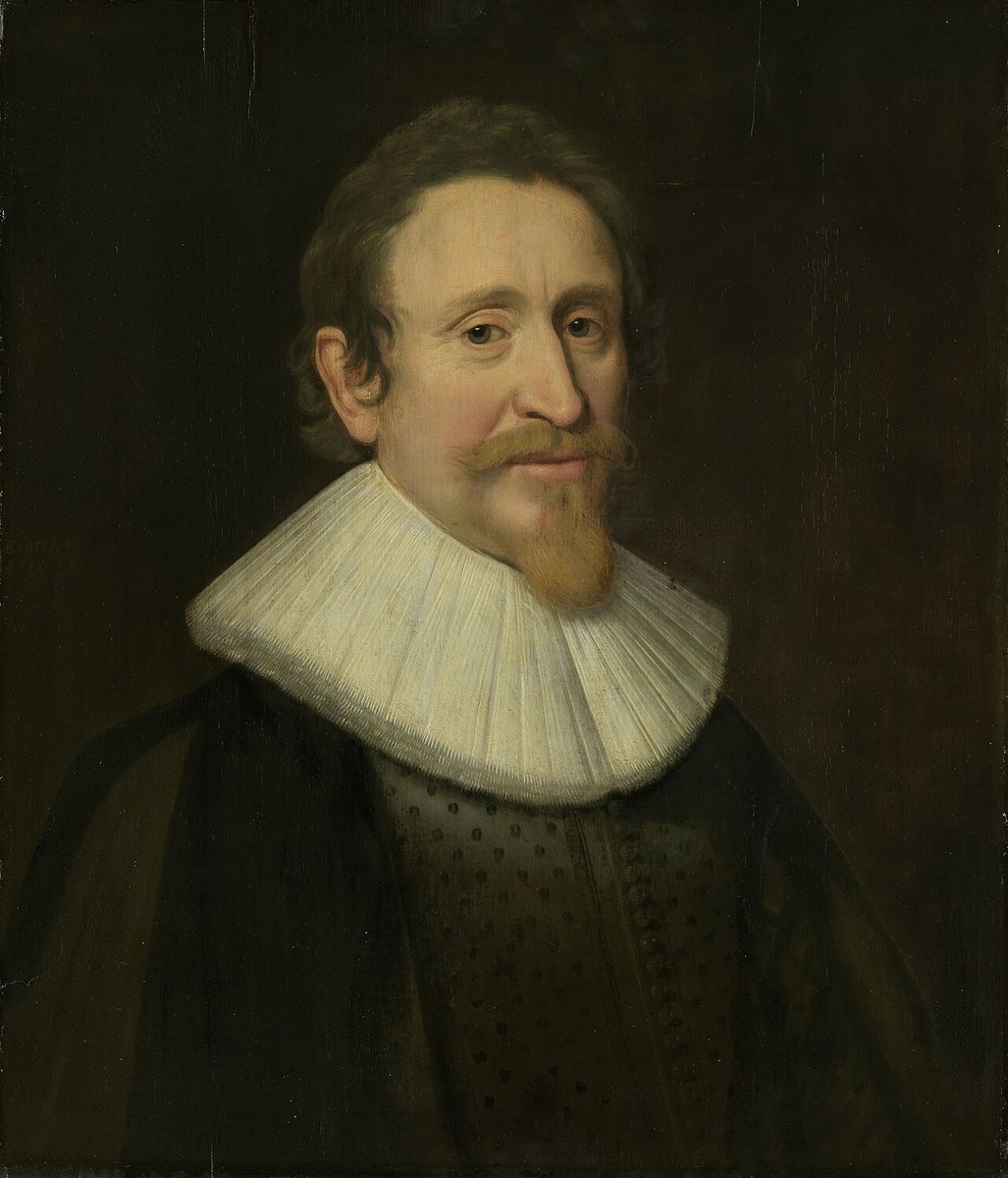
Workshop of Michiel Jansz van Mierevelt, 1631; Rijksmuseum, Amsterdam (public domain) · Rijksmuseum, Amsterdam, object SK-A-581, 'Portrait of Hugo de Groot (1583-1645)', oil on panel, workshop of Michiel Jansz van Mierevelt, inscribed with his age 48 and the year 1631. The museum's own page says he posed for Van Miereveld during a short return to the Republic and that this panel is one of the many copies of that portrait, so it is a workshop copy of a portrait made from a sitting, not the original sitting itself and is recorded as a historical depiction. The painter died in 1641, so the panel is public domain by age; the Rijksmuseum page has an empty copyright field and Wikimedia Commons records the museum's statement that its images are public domain or CC0 (Commons file 'Portret van Hugo de Groot (1583-1645) Rijksmuseum SK-A-581.jpeg', original 4862 x 5680). The saved file was produced by downscaling a 1280 x 1495 Commons rendering of that original to 1027 x 1200; nothing was upscaled. · Public domain
법학자 · 근세
휘호 그로티우스
1583–1645
주요 업적 분야
아직 성격 매칭에 포함되지 않았습니다 — 기록된 근거가 성격 모델 전체를 다루기에는 충분하지 않습니다. 이 페이지의 다른 모든 내용은 자유롭게 확인하실 수 있습니다.
핵심 특성
주요 업적
1625년 파리에서 『전쟁과 평화의 법』을 출간해 자연법에 바탕을 둔 국가 간 법의 일반 이론을 세웠다. 브리태니커는 이 책을 국제법 발전에 대한 가장 위대한 기여의 하나로 평가한다.
나포 전리품에 관한 의뢰 저작의 한 장을 따로 낸 『자유해론』(1609)에서 바다는 모든 나라에 열려 있다고 주장했다. 영국의 존 셀던은 이에 비판적으로 답하는 글을 냈다.
아라토스와 마르티아누스 카펠라의 교감 편집, 밀턴이 높이 평가한 희곡 『추방당한 아담』, 네덜란드 독립 전쟁사, 널리 읽힌 기독교 변호서를 비롯한 신학 저술까지 여러 분야에 걸쳐 글을 썼다.
삶의 장면들
『전쟁과 평화의 법』에서 신이 없다 해도 자연법은 유효하다고 주장해 어떤 신앙을 가진 사람에게도 적용되게 했으나, 세속적 논거만으로 설득되지 않는 통치자를 위해 종교적 논거와 효용 논거를 덧붙였다.
이는 법의 근거를 교파의 권위 밖에서 찾으려는 태도와 일치하지만, 이 시도가 얼마나 독창적이었는지는 학자들 사이에 논쟁이 있다. 독립적 사고
네덜란드 동인도회사의 요청으로 포르투갈 선박 나포를 변호하는 긴 논고를 썼고, 그중 한 장이 『자유해론』으로 출간되어 널리 재간행되었다. 스탠퍼드 철학 백과사전은 이 글에 선전의 성격이 있었다고 지적한다.
이는 의뢰인을 위한 능숙한 법률 변론과 일치하며, 그 목적에 대해서는 비판도 있다. 설득력
전환점
1621년 네덜란드를 떠나 파리에 정착한 그는 그곳에서 『전쟁과 평화의 법』을 집필해 1625년에 출간했고, 그의 명성은 대부분 이 책에 기대고 있다.
이는 상황이 크게 바뀐 뒤에도 학문적 작업을 이어 간 것과 일치한다. 끈기
비슷한 인물
전체적인 프로필이 이 사람과 닮은 사람들이에요.
출처
- Hugo Grotius (Q154959) -- verified live via the Wikidata API (2026-10-26): English label 'Hugo Grotius', description 'Dutch jurist and scholar (1583-1645)', born 1583-04-10, died 1645-08-28, Korean label present, P18 image the Rijksmuseum portrait SK-A-581. Orientation only; not used as support for any row.
- Encyclopaedia Britannica, 'Hugo Grotius', written by Yasuaki Onuma (Professor Emeritus of International Law, University of Tokyo), updated September 2026, read in full: precocious childhood (Latin elegies at eight, Leiden at eleven, pupil of Scaliger), his editions of Martianus Capella and Aratus, the play Adamus Exul admired by Milton, the Annals of the Low Countries (published 1657), the 1604-1609 work for the Dutch East India Company that became Mare Liberum, his offices, the 1618 sentence and 1621 escape (context), De Jure Belli ac Pacis (1625) built on natural law independent of religion, with a layered structure of secular, religious and utility arguments, and its description as one of the greatest contributions to international law. CANONICAL SIGNIFICANCE SOURCE. Reference article by a specialist; admiring in tone, and it treats the political struggle as context only.
- Jon Miller, 'Hugo Grotius', Stanford Encyclopedia of Philosophy (plato.stanford.edu, 2021 revision), the life, works and originality sections read in full: his early learning, his legal practice and offices, imprisonment and escape (context), the output of some five dozen book-length works, De iure praedae commissioned around 1603 by the Dutch East India Company with an acknowledged propagandistic aim and its Chapter Twelve published as Mare Liberum, answered critically by John Selden, the 1625 De iure belli ac pacis and its later editions that added references, the scholarly dispute over his originality (Irwin: 'no pioneer' in ethics; Schneewind and d'Entreves crediting method; Kingsbury and Roberts on systematic reassembling of practice), his lasting influence, and the apocryphal last words. Scholarly encyclopaedia entry that cites critical literature (Tuck, van Ittersum), though those works were not opened.
- Rijksmuseum, object page and catalogue entry SK-A-581, 'Portrait of Hugo de Groot (1583-1645)', workshop of Michiel Jansz van Mierevelt, 1631, oil on panel 63 x 55 cm, inscribed 'Aetatis 48 / Ao 1631', read in full: the museum summarises his Mare liberum (1607) and De iure belli ac pacis and states that during a short return to the Republic he posed for Van Miereveld and that this is one of many copies of that portrait; the 'Copyright' field is empty. Used for the portrait basis and a brief orientation; not used for scoring.
- Peace Palace Library (The Hague), review note on Henk Nellen, 'Hugo Grotius: A Lifelong Struggle for Peace in Church and State, 1583-1645' (Rens Steenhard, 3 September 2020), read in full, and the library's Grotius collection history page on the IALL website (opening sections read): describes him as the most famous humanist scholar of the Dutch Golden Age with influential works on the laws of war and peace, Dutch history and church unification, notes that Mare liberum gave the Dutch East India Company a ready justification for a trading empire, that his letters form the basis of Nellen's biography (Nellen co-edited the last five volumes of the correspondence), and that the library holds the largest Grotius collection with about 150 editions of De iure belli ac pacis. Institutional library notes; Nellen's biography itself was not opened.