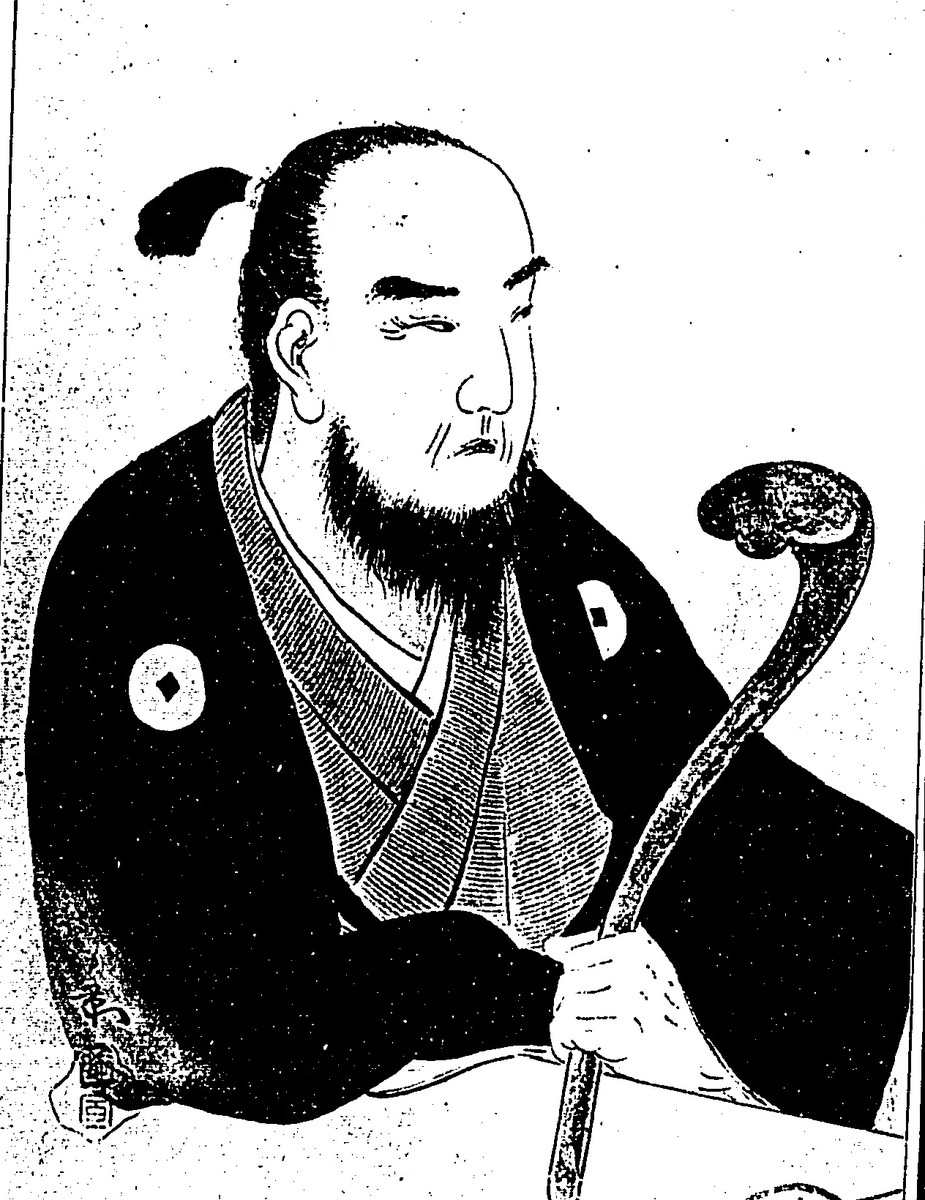
Anonymous illustration in Kakurin Yashi, Hiraga Gennai (Kobunkan, Tokyo, 1899); digitised by the National Diet Library, Japan (https://dl.ndl.go.jp/pid/888008) · Printed plate captioned 'Portrait of Hiraga Gennai' (Hiraga Gennai shozo) in Kakurin Yashi, Hiraga Gennai (Tokyo: Kobunkan, 1899), as digitised by the National Diet Library (NDL Digital Collections item 888008, IIIF canvas R0000003). It is a line-and-halftone print of a seated man in a dark robe holding a long curved fungus-shaped staff, with a small artist's seal at the lower left that cannot be read; the draughtsman is not named in the metadata. The scan of the book spread (3802 x 2929 pixels) carries library ownership stamps, which were left out by cropping to the picture only (1264 x 1640 pixels), then reduced to 925 x 1200 pixels; no upscaling, no retouching. · Public domain (National Diet Library item-level Public Domain Mark; a Japanese book published in 1899, before 1931)
발명가 · 근세
히라가 겐나이
1728–1780
주요 업적 분야
아직 성격 매칭에 포함되지 않았습니다 — 기록된 근거가 성격 모델 전체를 다루기에는 충분하지 않습니다. 이 페이지의 다른 모든 내용은 자유롭게 확인하실 수 있습니다.
핵심 특성
주요 업적
사누키 출신의 에도 시대 본초학자로, 스승 다무라 란스이와 함께 1757년부터 물산회를 열었고(1762년 물산회에는 30여 개 지방에서 1,300점이 넘는 물품이 모였다) 1763년 여섯 권의 『물류품척』을 엮었다.
석면으로 불에 타지 않는 천(화완포)을 만들었고, 수입된 정전기 발생기(에레키테루)의 수리를 1776년에 마쳤으며 이는 2025년 IEEE 마일스톤으로 인정받았다. 또 오다노 나오타케에게 서양화 기법을 가르쳤다고 전해지며 그의 일파가 아키타파가 되었다.
풍자 소설과 인형극 대본도 썼지만 지치부·다다·아키타의 광산 사업은 실패했고 막부 당국의 인정을 받지 못했다. 친구 스기타 겐파쿠는 그를 '비상한 사람'이라 불렀다.
삶의 장면들
그는 스승 다무라 란스이와 1757년 첫 물산회를 열었고 약 6년 동안 다섯 차례 개최했다. 1762년 물산회에는 30여 개 지방에서 1,300점이 넘는 물품이 모였고, 그는 360점을 가려 『물류품척』(1763)에 엮었다.
이는 혼자 수집하는 데 그치지 않고 공동의 작업을 조직하고 출판한 사람의 면모와 일치한다. 선제적 행동력
그는 1770년경 나가사키에서 파손된 수입 정전기 발생기를 입수해 스스로 '7년'이라 부른 기간을 들여 1776년 11월 수리를 마쳤는데, IEEE 신청자들은 그가 정전기에 대해 단편적인 지식만 가졌다고 본다. 복제품은 부유층에게 치료 기구로 선보였으나 후원자를 얻지 못했다.
이는 이론적 이해보다 앞서 수입 기구를 오랫동안 직접 시험하고 고친 모습과 일치한다. 실험 성향
전환점
1754년 그는 다카마쓰번의 직책을 내려놓았고 1756년 에도로 올라가 다무라 란스이에게 배웠으며, 안정된 세습 직책 대신 주인 없는 낭인의 삶을 택했다.
이는 안정된 지위를 자유로운 연구와 맞바꾸려 한 태도와 일치하며, 나중에 인정과 후원을 얻지 못하는 대가가 따랐다. 위험 감수
비슷한 인물
전체적인 프로필이 이 사람과 닮은 사람들이에요.
출처
- Hiraga Gennai (Q968242), verified live via the Wikidata API (2026-11-05): English label 'Hiraga Gennai', description 'Japanese pharmacologist and writer (1728-1780)', Korean label 히라가 겐나이, Japanese label 平賀源内, born 1728-01-01 (year precision), died 1780-01-24, citizenship Japan, several occupations. Orientation only; not used as support for any row.
- Kotobank (dictionary aggregator), entries 'Hiraga Gennai' from Shogakukan Daijisen, Nihon Kokugo Daijiten, Nipponica, Heibonsha's World Encyclopedia and Mypedia, Britannica Concise, Yamakawa's history dictionary, Nihon Jinmei Daijiten and Obunsha's history dictionary (Japanese), read in full. CANONICAL SIGNIFICANCE SOURCE: the reference works agree that he was an Edo-period herbalist (honzo scholar), inventor and comic writer from Sanuki who studied under Tamura Ransui, held product fairs from 1757 (the 1762 fair drew over 1,300 items from more than 30 provinces) and compiled the Butsurui Hinshitsu (1763), made fire-resistant asbestos cloth, a thermometer and a copy of the imported electrostatic machine (erekiteru, 1776), painted in Western style and taught it to Odano Naotake (the Akita school), and wrote satirical fiction and a puppet play; they also record that his Chichibu, Tada and Akita mining ventures failed (Heibonsha, Yamakawa: a 'mountebank' reputation), that the erekiteru found no patrons (Nipponica), that he sought but did not obtain an official post, that he was imprisoned in 1779 after a fatal incident and died there, and that the authorities never recognised him (Nipponica, Mypedia).
- National Diet Library, 'Nichiran' exhibition column on Hiraga Gennai (Japanese), read in full: the Library presents him as one aspect of how Dutch learning was absorbed, an entrepreneur and popular-fiction writer who tried to use Western knowledge for society at large; it records his product exhibitions with Tamura Ransui, the Butsurui Hinshitsu (1763, six volumes, 360 selected items with some Dutch names), the asbestos-cloth treatise (1765) and the restoration of the erekiteru, that he hardly understood Dutch but collected European natural-history illustrations and met the head of the Dutch trading post, that his insect pictures were copied by Shiba Kokan, that his enterprises were not understood by the public and his life deteriorated, and that his friend Sugita Genpaku called him 'an extraordinary person'.
- Agency for Cultural Affairs (Japan), Cultural Heritage Online, record 'Portrait of a Western Woman' (Seiyo Fujinzu, attributed to Hiraga Gennai; Kobe City Museum), read: calls him a theoretical leader of Western-style painting, records that in 1773 at the Ani copper mine in Akita he reportedly taught Western painting methods to Odano Naotake and Satake Shozan, calls this his only known oil painting while stating that the attribution is traditional and needs careful examination because no other works are confirmed as his, and summarises his career (domain medicine attendant, herbal medicine in Edo, product fairs, erekiteru and asbestos cloth, popular fiction).
- IEEE Milestones record 'Elekiteru: First Electrostatic Generator in Japan, 1776' (dedicated 22 March 2025 at the Hiraga Gennai Memorial Museum, Kagawa; ETHW wiki page, first 100,000 characters read, the last 37,000 not read): the citation and proposers' history say he obtained a damaged imported device in Nagasaki about 1770, probably from a Dutch interpreter, and completed the repair in November 1776 (he wrote 'seven years', the proposers adopt six), that his knowledge of static electricity was only fragmentary, that demonstrations inspired Japan's first generation of electricity researchers, and that the surviving devices are attributed to him through family lore; it flags its own limits (the proposers' own translations, calendar conversion, the 'first in Japan' claim resting on the literature consulted, internal inconsistencies). An engineering-society award body, so an admiring commemorative voice with candid caveats.
- Lapham's Quarterly, contributor profile 'Hiraga Gennai' (no author named), read: a short English magazine note that he gave up his samurai inheritance to become a masterless retainer, moved to Edo in 1756 for botanical research, engineering and satirical writing, was called the 'Japanese Da Vinci', felt his inventions went unrecognised, and killed a disciple and died in prison of tetanus a month later. Brief, popular and uncited; used only as a cross-check of the outline.
- National Diet Library Digital Collections, Kakurin Yashi, Hiraga Gennai (Tokyo: Kobunkan, 1899; item 888008), item-level Public Domain Mark in its IIIF manifest; the plate printed near the front of the book is captioned 'Portrait of Hiraga Gennai'. Opened for the portrait only; the book text was not read.