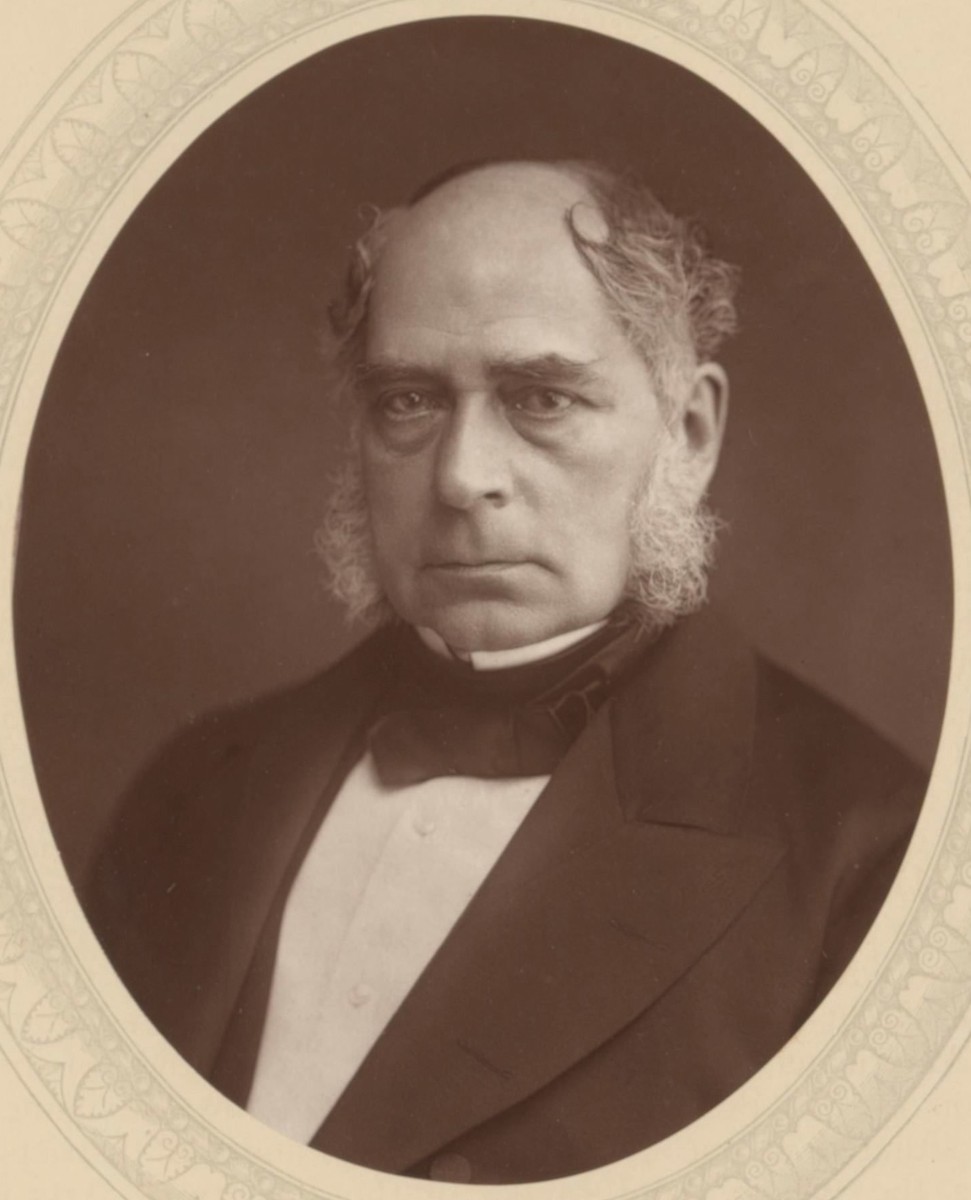
Lock & Whitfield (photographer), 'Sir Henry Bessemer', Woodbury print in 'Men of Mark', c. 1876 - in or before 1881. Rijksmuseum, Amsterdam, RP-F-2001-7-235E-29 (Public Domain). Cropped and downscaled. · Photographic portrait of Sir Henry Bessemer by the London studio Lock & Whitfield (named on the print), reproduced by the Woodbury photomechanical process as a plate in the portrait volume 'Men of Mark' (text by Thompson Cooper), page 29, held by the Rijksmuseum, Amsterdam (object number RP-F-2001-7-235E-29, 'Portret van Henry Bessemer'), dated by the museum c. 1876 - in or before 1881. The printed caption under the plate and the facing biography name the sitter. The file is the portrait oval cropped from the museum's double-page scan (7162 x 4570 pixels; crop 1440 x 1780) and downscaled to 971 x 1200 with no upscaling. · Public Domain Mark 1.0 and CC0 as stated in the Rijksmuseum's own item record; the photograph was made and published in London in the 1870s (public domain by age)
발명가 · 19세기
헨리 베서머
1813–1898
주요 업적 분야
아직 성격 매칭에 포함되지 않았습니다 — 기록된 근거가 성격 모델 전체를 다루기에는 충분하지 않습니다. 이 페이지의 다른 모든 내용은 자유롭게 확인하실 수 있습니다.
핵심 특성
주요 업적
1856년 발표한 전로(轉爐) 제강법으로, 용선(鎔銑)에 공기를 불어 넣어 강철을 대량 생산하게 한 영국의 기술자이자 발명가이다. 한 자료는 강철 값이 톤당 약 50~60파운드에서 6~7파운드로 떨어졌다고 전한다. 이 공정이 안정적으로 작동하려면 머셋의 스피겔아이젠 첨가와, 인이 많은 철을 위한 길크리스트·토머스의 염기성 내벽이 뒤따라야 했다.
초기 사용권자들이 이 공정을 제대로 작동시키지 못하자 1859년 셰필드에 자신의 제강 회사를 세웠고 이후 공정 사용권을 더 널리 내주었으며, 제강 특허 사용료로 100만 파운드 넘게 벌었다.
청동 분말 제조 기계와 위조 방지용 인지 스탬프에서 설탕·유리 공정에 이르기까지 약 120건의 특허 명세서를 남긴 다작의 발명가이다. 1871~73년 철강협회(Iron and Steel Institute) 회장을 지냈고 1879년 기사 작위와 왕립학회 회원 자격을 받았으며, 협회의 베서머 금메달에 이름을 남겼다.
삶의 장면들
본인의 설명에 따르면, 사용권을 산 제철업자들이 이 공정을 작동시키지 못하자 그는 사용권을 되사고, 언론에서 논쟁하는 대신 셰필드의 자기 공장에서 상업적으로 입증하기로 했다.
이는 공개적인 좌절 앞에서 물러서지 않고 공정을 계속 발전시킨 발명가의 면모와 일치한다. 끈기
로버트 머셋의 대리인이 망간 특허의 사용권을 요구하자 베서머는 이를 거부하고 법정에서 가려 보자고 응수했으며, 이후 연 300파운드의 연금을 지급했는데, 과학박물관 블로그는 번거로운 소송을 피하려는 뜻이었을 수 있다고 본다.
이는 우선권 분쟁에 정면으로 맞서면서도 필요할 때는 평화를 사들인 사람의 면모와 일치한다. 갈등 감내
전환점
1856년 공정을 발표한 뒤 사용권자들이 좋은 강철을 얻지 못하자, 그는 사용권을 파는 데서 직접 강철을 만드는 쪽으로 옮겨 1859년 셰필드에 헨리 베서머 앤드 컴퍼니를 세웠다.
이는 특허 아이디어를 남에게 맡기지 않고 실제 가동되는 사업으로 만든 발명가의 면모와 일치한다. 기회 감지
비슷한 인물
전체적인 프로필이 이 사람과 닮은 사람들이에요.
출처
- Henry Bessemer (Q310201), verified live via the Wikidata API (2026-11-04): English label 'Henry Bessemer', description 'British engineer (1813-1898)', Korean label 헨리 베서머, born 19 January 1813, died 15 March 1898, citizenship United Kingdom. Orientation only; not used as support for any row.
- Institute of Materials, Minerals and Mining (IOM3), 'Steel heroes' guide (1 February 2019), entry on Sir Henry Bessemer 1813-1898, read in full. CANONICAL SIGNIFICANCE SOURCE: his main contribution was the Bessemer process, the discovery after about ten years of experiments that blowing a blast of air through molten pig iron converts it to steel, which increased steel production 200-fold and cut its price by a factor of 12; royalties from the steelmaking patents exceeded 1 million pounds; he was President of the Iron and Steel Institute 1871-3, instituted the Bessemer Gold Medal in 1873, was knighted and elected FRS in 1879; the specifications of his 120 inventions fill 9 volumes. The same page profiles Mushet (spiegeleisen, 1848 experiments; Bessemer Gold Medal 1876) and Thomas and Gilchrist (basic lining to reduce phosphorus) as the people who fixed the process. Institutional guide by the professional body of the industry; celebratory in tone but it names Bessemer's co-contributors.
- Sue Mossman, Science Museum Group blog, 'Onward Ever - Sir Henry Bessemer 19.1.1813 - 15.3.1898' (19 January 2013), read in full: his motto summed up one who faced and overcame obstacles; early fortune from a mechanised bronze-powder process kept secret by employing his three brothers-in-law; he presented the steel method to the British Association on 24 August 1856 ('The Manufacture of Iron without fuel') and later said he should have waited until the process was reliable; early poor-quality steel because of phosphorus in the ore, later resolved by Sidney Gilchrist Thomas; Robert Mushet's carbon-control improvements, which Bessemer rejected as claims while agreeing to pay Mushet 300 pounds a year, 'perhaps to avoid troublesome litigation'; difficulty winning acceptance in Britain from the War Office and Admiralty; in 1878 he wrote to The Times and the whole cabinet about his 1833 stamp invention; knighted 1879. Museum curator's blog; sympathetic but it records his setbacks and the Mushet payment.
- Claudia Flavell-While, 'Henry Bessemer - Man of Steel', The Chemical Engineer (1 November 2010), read in full: Bessemer had at least 117 patents spanning iron, steel, sugar, glass and ordnance; his steel work began with the Crimean War artillery problem; an observation that pig iron left in the air blast turned to steel led him to blow air through molten iron even though his foundry workers said the air would cool it; the process was patented in 1855 but ironmasters initially failed to get good steel; Mushet's spiegeleisen addition was the easier fix (first licensed 1865 to Dowlais); he set up Henry Bessemer and Company in Sheffield in 1859; William Kelly had made a similar discovery in the USA; phosphorus was solved by Gilchrist Thomas in 1879; the price of steel fell from 50-60 to 6-7 pounds a tonne. Trade-magazine feature by an IChemE editor; admiring but it records the failures and the other contributors.
- Grace's Guide to British Industrial History, 'Henry Bessemer' page, which reproduces two 1898 obituaries (Institution of Mechanical Engineers and a trade-press obituary) and editorial notes on his autobiography and telescope, read in full for the relevant passages: born 19 January 1813 at Charlton; inventions from a stamp against forgery (1832, knighthood only 46 years later in 1879) and bronze powder (secret kept for forty years) to type-casting, plate-glass rolling, continuous brakes and a repeating gun; the steel process was the result of more than ten years of labour and 'many disheartening failures'; royalties well over a million pounds; his patents were never overturned and he admitted the value of Mushet's spiegeleisen process while the Mushet patents had lapsed in 1859; in later life he made reflecting telescopes. Contemporary obituaries, written by his own professional community, so admiring.
- Dictionary of National Biography (1909) entry on Robert Forester Mushet, reproduced on the Today in Science History site, read in full: the independent counter-voice. Mushet found that adding spiegeleisen to air-blown metal made cast steel and patented it in 1856; his patents lapsed in 1859 through an unpaid stamp duty; the text records that the degree of validity of Mushet's claim is hard to determine because 'the reticence of both parties'; that Bessemer paid Mushet an annuity of 300 pounds for some years but 'invariably refused to pay him royalty', challenged him to bring an action for infringement, and Mushet declined; Mushet himself wrote that Bessemer would probably have made the discovery sooner or later; the Iron and Steel Institute gave Mushet its Bessemer Medal in 1876 with the founder's approval. Published in 1909 for the Dictionary of National Biography; independent of Bessemer, though it quotes both men and a trade writer who argued Bessemer had virtually solved the manganese problem already.
- Henry Bessemer, 'Sir Henry Bessemer, F.R.S.: An Autobiography' (London: Offices of Engineering, 1905), Internet Archive scan, read in the passages on his entry into metallurgy, the first licences to Dowlais and others, the failure of the licensees and his repurchase of the licences, the Sheffield works, the Mushet dispute and the 300 pounds annual payment. SELF-REPORT: his own account, written near the end of his life and defensive on priority and on Mushet; used only where corroborated or labelled as his own account. Not read in full (about 1,000,000 characters); chapters on the saloon steamship, telescope and later inventions were not read.