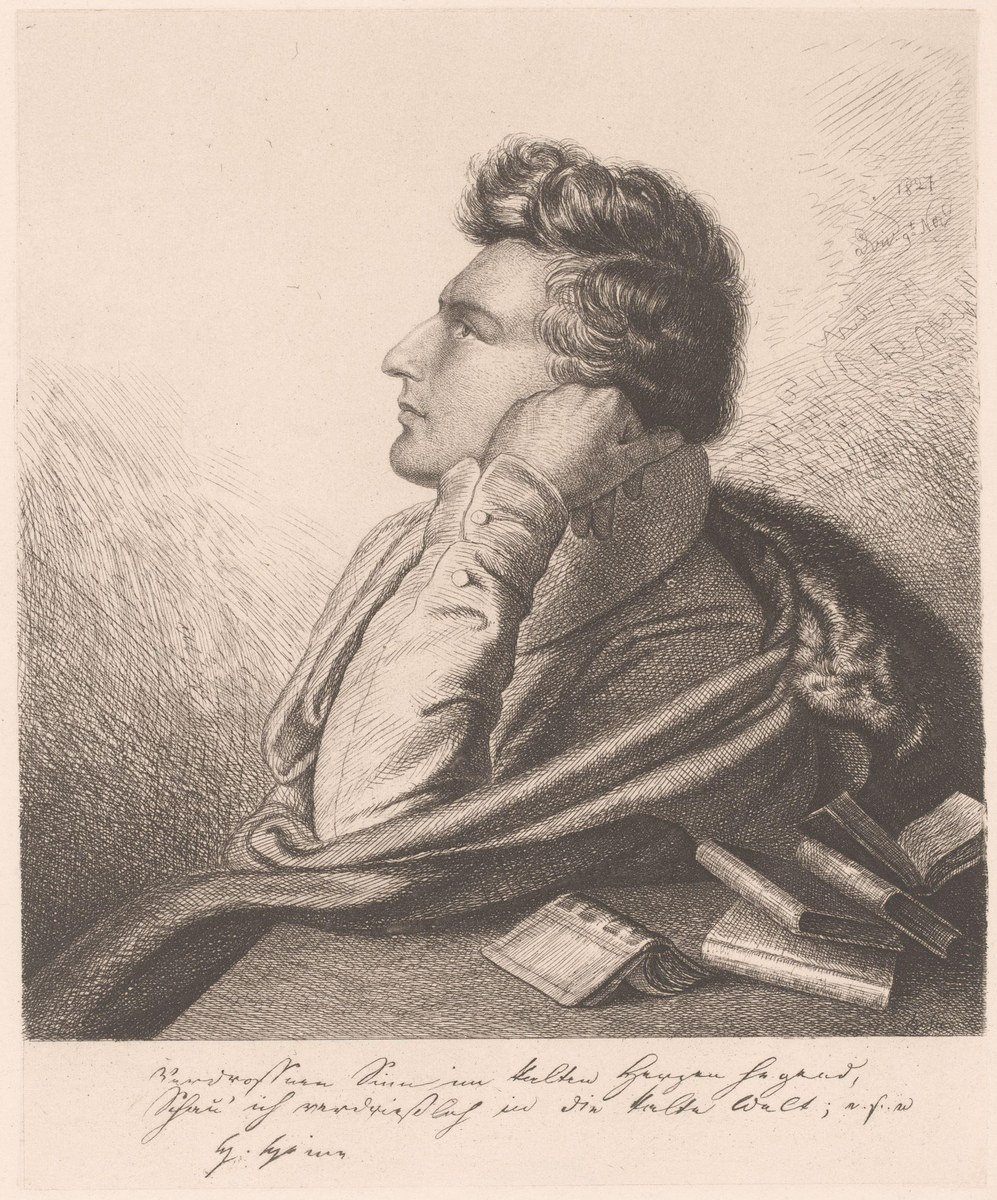

Ludwig Emil Grimm, 'Portret van Heinrich Heine', 1827, etching, Rijksmuseum, Amsterdam (RP-P-1974-50), public domain · Etching of Heinrich Heine by Ludwig Emil Grimm, dated 9 November 1827, with two handwritten lines of Heine's verse signed 'H. Heine' under the plate; Rijksmuseum, Amsterdam (RP-P-1974-50, purchased with the support of the F.G. Waller-Fonds). The museum scan (3852 x 4402 pixels) was cropped to the plate and handwritten caption and downscaled once to 997 x 1200 pixels; nothing was upscaled. · Public domain (Rijksmuseum Public Domain Mark; 1827 etching by an artist who died in 1863)
시인 · 19세기
하인리히 하이네
1797–1856
주요 업적 분야
아직 성격 매칭에 포함되지 않았습니다 — 기록된 근거가 성격 모델 전체를 다루기에는 충분하지 않습니다. 이 페이지의 다른 모든 내용은 자유롭게 확인하실 수 있습니다.
핵심 특성
주요 업적
《노래의 책》(1827)은 낭만주의 시의 관습을 아이러니하게 비틀어 도시적인 감각으로 바꾸어 놓았고, 제프리 새먼스에 따르면 이 시집의 시들은 수많은 곡으로 작곡되어 세상에 퍼졌다.
《여행 그림》(1826~31)은 산문과 시, 허구화한 자서전, 사회 비평을 한데 엮어 라루스 백과사전이 새로운 종류의 장르라고 부르는 글쓰기를 만들어 냈고, 그의 명성을 세웠다.
1831년부터 파리에서 프랑스 독자를 위해 독일 문학과 종교, 철학에 관한 글을 썼고, 시집 《로만체로》(1851)를 펴냈는데, 시 재단은 이 시집의 서정시를 그의 가장 뛰어난 시로 꼽는다.
삶의 장면들
파리의 동료 독일 작가 루트비히 뵈르네와 다툰 뒤 1841년 9월 뵈르네의 친구와 결투를 벌였고, 뵈르네가 죽은 직후 그를 풍자한 책을 펴냈다. 출판사 연표에는 하이네가 거부한 제목이 그대로 쓰였다고 기록되어 있다.
이 일화는 문학적 다툼을 글로, 심지어 결투로까지 끌고 가는 태도와 그에 따른 평판의 대가를 보여 준다. 갈등 감내
1835년 독일 연방은 그의 저작을 금지했으나, 같은 해 독일의 종교와 철학의 역사에 관한 글이 실린 《살롱》 제2권이 나왔고, 그는 평생 파리에서 계속 책을 냈다.
이는 금지 조치 아래에서도 출판을 멈추지 않고 이어 간 태도와 부합한다. 끈기
전환점
1831년 함부르크에서 생계를 꾸리지 못한 그는 파리로 옮겨 남은 생을 그곳에서 보냈고, 아우크스부르크 《알게마이네 차이퉁》의 통신원이 되었으며 《두 세계 평론》 같은 프랑스 정기간행물에도 글을 썼다.
이는 첫 진로가 막히자 나라와 독자층을 바꾸는 태도와 부합한다. 적응력
비슷한 인물
전체적인 프로필이 이 사람과 닮은 사람들이에요.
출처
- Heinrich Heine (Q44403), verified live via the Wikidata API (2026-11-06): label 'Heinrich Heine', description 'German poet, writer and literary critic (1797-1856)', born 13 December 1797, died 17 February 1856, Korean label 하인리히 하이네. Orientation only; not used as support for any row.
- Jeffrey L. Sammons, 'Heine, Heinrich', in Encyclopedia of Modern Europe: Europe 1789-1914 (Gale), reproduced on Encyclopedia.com (entry read in full, about 1,100 words). CANONICAL SIGNIFICANCE SOURCE: by a leading Heine biographer; covers Buch der Lieder (1827), the Reisebilder (1826-31), the move to Paris in 1831, the essays on France and Germany, the Neue Gedichte and the satirical epics of 1844 and 1847, the late Romanzero (1851) and the reception history, including a frank statement that his career was a series of quarrels, some caused by his own poor judgment.
- Poetry Foundation, 'Heinrich Heine' poet biography (read in full, about 600 words). US poetry institution's account: studies, baptism for career reasons, Buch der Lieder, Reisebilder, the Paris years, the 1835 ban on his works in the German states and the Romanzero and last poems, which it counts among the finest he wrote.
- Larousse, 'Heinrich Heine ou Henri Heine', Encyclopedie (French-language entry read in full, about 3,000 words, quoting his letters of 1827-1833). Independent French account: early studies and patrons, the Reisebilder as a new mixed prose-and-verse genre, his break with Goethe's aesthetic, the Munich and Italian years, the move to Paris in May 1831, his French literary friendships and periodicals, his distancing from the Young Germany group, the quarrel with Ludwig Borne and the 1841 duel.
- Suhrkamp Verlag, 'Heinrich Heine' year-by-year chronology (PDF, about 1,200 words, read in full). German publisher's dated timeline: failed business 1818-19, university studies and a duel-related suspension, first book 1821, baptism and doctorate 1825, first meeting with the publisher Julius Campe 1826, the 1827 and 1835 bans, the failed Hamburg career and the move to Paris in 1831, the correspondent work for the Augsburg Allgemeine Zeitung, the 1840 and 1843 arrangements with Campe, the Platen attacks of 1829 and the pamphlet on Menzel.
- Harald Loch, 'Aus einem Dichterleben', Judische Allgemeine, 16 February 2006 (review essay on new Heine literature read in full, about 700 words). Independent critical press assessment on the 150th anniversary of his death: calls him full of contradictions, notes both his fight against censorship and his compromising concessions to it, his two duel challenges, his reputation as one of the inventors of the feuilleton, and the long dispute before the Dusseldorf university took his name in 1988.
- The Paris Review, 'Against Heine', Karl Kraus's 1910 essay 'Heine and the Consequences' in Jonathan Franzen's translation with Franzen's introduction (introduction and opening pages of the essay read, about 4,000 words). COUNTER-VOICE: Kraus's hostile polemic against Heine's style and influence, framed by Franzen, who also sets out Heine's fame, wit and Paris 'exile'; used as critical context and not scored as a trait.
- Heinrich Heine, 'Autobiographical Sketch' (letter written in Paris, 15 January 1835, first published in the Revue de Paris, translated for the Marxists Internet Archive; read in full, about 1,200 words). SELF-REPORT: his own account of his schooling, studies, doctorate, early publications, his autumns by the North Sea, his omissions from the French edition and the range of genres he tried; used only for documented facts and never as sole support for a row.
- Rijksmuseum, Amsterdam, 'Portret van Heinrich Heine' by Ludwig Emil Grimm, etching dated 9 November 1827 (object RP-P-1974-50; collection page and linked-art record read in full, Public Domain Mark stated at item level). Holder record for the portrait.