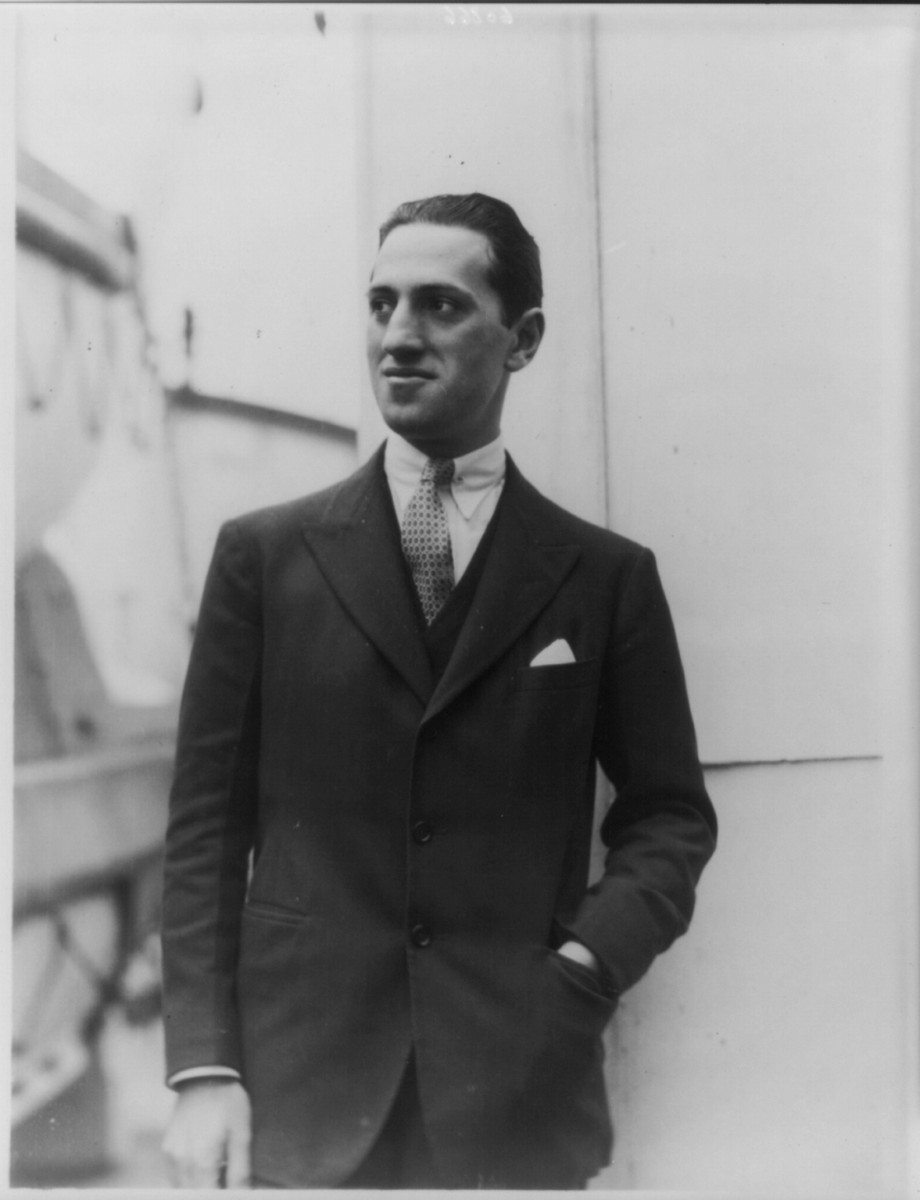
Photo: Bain News Service (photographer not named), undated, Library of Congress, Prints and Photographs Division (LC-USZ62-60866), downscaled from the original · Library of Congress, Prints and Photographs Division, George Grantham Bain Collection, item 2005678096 ('[George Gershwin, 1898-1937, half-length portrait, standing, facing left]', 1 photographic print, call number BIOG FILE [item] [P&P], reproduction number LC-USZ62-60866; 'Photo by Bain News Service'; undated -- the record gives no date and says it contains unverified, old data from caption card), taken from the Library's master TIFF (1177 x 1536 pixels, grayscale), the same pixel size as the Wikimedia Commons file 'George Gershwin, 1898-1937, half-length portrait, standing, facing left LCCN2005678096.jpg'. Rights: the item's Rights Advisory reads 'No known restrictions on publication', and the Library's Prints & Photographs rights statement for the Bain collection (last revised November 2015) reads 'There are no known copyright restrictions on the photographs in the George Grantham Bain Collection. Publicity rights may apply.' The photographer is not named (Bain News Service is the agency). The whole frame was kept (no crop) and downscaled once from 1177 x 1536 to 920 x 1200 (never upscaled); a handwritten negative number is visible at the top edge. · No known restrictions on publication
작곡가 · 20세기
조지 거슈윈
1898–1937
주요 업적 분야
아직 성격 매칭에 포함되지 않았습니다 — 기록된 근거가 성격 모델 전체를 다루기에는 충분하지 않습니다. 이 페이지의 다른 모든 내용은 자유롭게 확인하실 수 있습니다.
핵심 특성
주요 업적
거슈윈은 재즈의 어법을 연주회장으로 가져왔다. 〈랩소디 인 블루〉는 1924년 2월 12일 에올리언 홀에서 폴 화이트먼의 '현대 음악의 실험' 공연으로 초연되었고, 거슈윈이 직접 피아노를 쳤으며 관현악 편곡은 퍼디 그로페가 맡았다. 미국 의회도서관 국립녹음등재부(National Recording Registry)에 실린 해설은 이 곡을 어쩌면 지금까지 쓰인 가장 유명한 미국 클래식 작품일 것이라고 소개한다. 이어 그는 월터 담로시의 뉴욕 심포니 협회를 위해 〈피아노 협주곡 바장조〉를 작곡하고 관현악 편곡까지 직접 했으며(1925년 12월 3일 카네기 홀 초연), 1928년에는 〈파리의 아메리카인〉이 뒤를 이었다.
연주회용 작품과 나란히 거슈윈은 브로드웨이를 대표하는 작곡가이기도 했다. 그는 형 아이라 거슈윈과 다른 작사가들과 함께 〈I Got Rhythm〉, 〈Embraceable You〉, 〈The Man I Love〉 같은 노래를 만들었고, 미국 의회도서관 큐레이터는 두 형제가 미국 대중가요의 가장 훌륭한 곡들 가운데 상당수를 썼다고 말한다. 두 사람의 작품을 처음으로 학술 비평판으로 만들고 있는 미시간 대학교는 이들이 함께 쓴 브로드웨이·할리우드 뮤지컬 스코어가 스물네 편이 넘는다고 소개한다.
〈포기와 베스〉(1935)는 찰스턴의 흑인 공동체를 그린 듀보스 헤이워드의 이야기를 바탕으로 한 그의 오페라로, 대본은 듀보스와 도로시 헤이워드가 썼고 미시간 대학교 편집진에 따르면 아이라도 중요한 기여를 했다. 거슈윈은 1933~1934년 찰스턴 일대에서 현지 조사를 했는데 여기에는 제임스 아일랜드의 걸라(Gullah) 공동체 방문도 포함되어 있었고, 이를 바탕으로 작품을 쓴 뒤 관현악 편곡도 직접 했다. 초연 당시 평단의 반응은 엇갈렸지만 1985년 메트로폴리탄 오페라의 레퍼토리에 올랐으며, 흑인의 삶을 다룬 방식은 첫 시즌부터 논쟁이 되어 1935년 듀크 엘링턴도 이 작품의 음악을 비판했다.
삶의 장면들
1924년 1월 초 뉴욕 트리뷴은 거슈윈이 2월 12일 폴 화이트먼의 연주회를 위해 '재즈 협주곡'을 쓰고 있다는 짧은 기사를 실었다. 화이트먼은 몇 달 전에 이미 작곡을 부탁했지만, 거슈윈은 브로드웨이 뮤지컬 작업에 몰두하느라 이 의뢰를 잊고 있었다. 그는 이 곡을 두 대의 피아노를 위한 악보로 작곡했고, 화이트먼 악단의 편곡자 퍼디 그로페가 한 쪽씩 완성되는 대로 관현악으로 편곡했다.
정해진 마감에 맞춰 빠르게 작업한 모습과 일치하지만, 관현악 편곡은 그로페가 맡았고 해설문도 거슈윈이 이 의뢰를 잊고 있었다고 전하므로 작업 속도에는 늦은 출발이 일부 반영되어 있다. 실행 속도
1934년 6월 거슈윈은 〈포기와 베스〉 작업을 위해 찰스턴 인근의 폴리 아일랜드로 갔다. 현지 조사를 고집했던 듀보스 헤이워드는 그를 이웃한 제임스 아일랜드의 걸라 공동체로 데려갔고, 두 사람은 학교와 교회를 찾아다니며 흑인 영가와 '샤우팅'(shouting)이라 불리는 춤을 들었다. 헤이워드는 훗날 거슈윈에게 그것이 탐험이라기보다 귀향에 가까웠다고 적었다.
자신이 끌어다 쓰려는 음악을 현장에서 직접 접하려 한 작곡가의 모습과 일치하지만, 이 여행은 헤이워드가 공동 작업의 조건으로 요구한 것이었고 완성된 오페라에 대해 듀크 엘링턴은 1935년에 흑인 음악의 어법을 쓰지 않았다고 비판했다. 호기심
전환점
초기 음악에서 거슈윈은 가수, 편곡자, 제작자가 각자 손볼 수 있도록 기본적인 음악의 뼈대만 내놓았고, 〈랩소디 인 블루〉의 관현악 편곡도 퍼디 그로페가 맡았다. 1925년 4월 월터 담로시는 뉴욕 심포니 협회를 위해 피아노 협주곡을 작곡하고 관현악 편곡과 연주까지 맡아 달라고 의뢰했다. 1925년 12월 3일 카네기 홀에서 초연된 〈피아노 협주곡 바장조〉는 그가 처음으로 직접 관현악 편곡을 한 대규모 작품이었고, 이후의 연주회용 작품들과 〈포기와 베스〉도 그가 직접 편곡했다.
이전에는 남에게 맡기던 기술을 스스로 맡기 시작한 작곡가의 모습과 일치하지만, 같은 편집진은 그의 자필 악보에서 세부 표기를 꼼꼼히 적는 일에 대한 조급함도 발견한다. 숙련 지향
비슷한 인물
전체적인 프로필이 이 사람과 닮은 사람들이에요.
출처
- George Gershwin (Q123829) -- verified live via the Wikidata API (2026-10-16): English label 'George Gershwin', description 'American composer and pianist (1898-1937)', Korean label present, instance of human, born 26 September 1898, died 11 July 1937, citizenship United States. Orientation only; not used as support for any row.
- Raymond A. White (curator of the George and Ira Gershwin Collection), 'The Gershwin Legacy: Library Celebrates Contributions of George and Ira', Library of Congress Information Bulletin, September 1998 -- CANONICAL SIGNIFICANCE SOURCE: the Library's curator calls Gershwin one of America's most important composers who, alone and with his brother Ira, wrote many of the finest American popular songs and orchestral pieces, names the Library's Music Division the premier institution for Gershwin studies and its collection the world's preeminent body of primary sources on the brothers, and describes the holdings: the full score of Porgy and Bess (which he says conveys Gershwin's care in making the opera and the importance he attached to it), the manuscripts of Rhapsody in Blue, An American in Paris, Concerto in F and Porgy and Bess given in 1953 from their mother's estate, song manuscripts with erasures and corrections, his harmony exercises and eight sketchbooks, scrapbooks (seven devoted to Porgy and Bess) and the Theatre Guild's Porgy and Bess files. Institutional article by the collection's own curator, admiring but factual in tone. Read in full.
- Helen Dalrymple, ''S Wonderful: The Gershwins Come Alive in Symposium', Library of Congress Information Bulletin, April 1998 -- the Library's report on its March 1998 symposium 'The Gershwins and Their World' (the opening of the George and Ira Gershwin Room): pianist and historian Artis Wodehouse on the 140 piano rolls Gershwin made between 1915 and 1925 and the influence of black and Spanish rhythms on them; the original Bess, Anne Wiggins Brown, on her audition for him and the 1935 production; the composer David Raksin and other speakers on how much George enjoyed helping young musicians; and sessions on his 1928 meeting with Alban Berg in Paris and on other musical influences. Press-office report of other people's recollections and papers, with friends and relatives among the speakers and admiring in tone; used only as supporting evidence. Read in full; the passage on a Washington theatre's whites-only audience policy was not used (an audience-access dispute, politics-adjacent and unscored).
- Jim Farrington (Head of Public Services, Sibley Music Library, Eastman School of Music; guest essay), ''Rhapsody in Blue'--George Gershwin, piano; Paul Whiteman Orchestra (1924)', Library of Congress National Recording Registry essay (added to the Registry in 2002) -- an independent librarian-scholar's essay hosted by the Library: a 4 January 1924 New York Tribune item announcing a 'jazz concerto' by Gershwin for Paul Whiteman's 12 February concert 'An Experiment in Modern Music' at Aeolian Hall, a commission that had slipped his mind while he worked on a Broadway musical; the rushed schedule and Whiteman's arranger Ferde Grofe orchestrating from Gershwin's two-piano score page by page as it was finished; the clarinet glissando that Ross Gorman improvised in rehearsal, to Gershwin's delight; the mixed press, quoting Lawrence Gilman's hostile New York Tribune notice (which still concedes the 'rich inventiveness of the rhythms') and Leonard Bernstein's 1955 verdict that the Rhapsody is a string of separate paragraphs with inspired themes; the 1924 and 1927 recordings, the essay's finding that the million-seller claim is unsupported, and Gershwin's unhappiness with Whiteman's conducting in 1927 (Nathaniel Shilkret conducted instead). It calls the work arguably the most famous piece of American classical music ever written. Independent, with a hostile voice and a mixed verdict; the views are the author's, as the Library's own disclaimer says. Read in full.
- University of Michigan School of Music, Theatre & Dance, 'Gershwin Centennial Celebration' concert program, 26 January 2025 (program notes by the editors of the George and Ira Gershwin Critical Edition, including Timothy Freeze, volume editor, on the Concerto in F) -- scholarly notes on the brothers' 1924-25 seasons: four Gershwin shows opening in 1924, the most of any year of his life, and three musicals plus the Concerto in F in 1925; Walter Damrosch's April 1925 commission to compose, orchestrate and perform a piano concerto for the New York Symphony Society; the 3 December 1925 Carnegie Hall premiere as Gershwin's debut as pianist, composer and creator of score-oriented works, since in his earlier music he had supplied only the basic musical shape for singers, arrangers and producers to adapt and Rhapsody in Blue was arranged by Ferde Grofe; the Concerto as the first major work he orchestrated, as he did all his later concert works and Porgy and Bess; the editor's finding that his manuscripts show impatience with notating fine detail (pitches and rhythms careful, tempo, articulation and dynamics inconsistent) and that he routinely modified details in later performances; and Ira's crucial contributions to Porgy and Bess. Scholarly editors working with the Gershwin estates: admiring of the music but critical of the manuscripts. Read the introduction and the Concerto in F note in full; the rest of the program (notes on Ira, on Robert Russell Bennett and on the other 1925 shows) was searched by keyword only.
- University of Michigan News, 'U-M to become epicenter of research on music of George & Ira Gershwin', 14 September 2013 -- the university's release announcing its partnership with the Gershwin estates to prepare the first critical edition of the works (the Gershwin Initiative): it lists the works to be edited (Porgy and Bess, Rhapsody in Blue, An American in Paris, Concerto in F, Cuban Overture and scores the brothers wrote for more than two dozen Broadway and Hollywood musicals), says the scores of Porgy and Bess and Rhapsody in Blue circulate in problematic editions, and has project leaders describe the music as lying at the crossroads of blues, jazz, popular song, the Broadway stage and the Western European tradition. Institutional promotional release with quotations from the estates' trustees (promotional; their superlatives are not repeated as fact); the sentence on his death was not used. Read in full.
- David Zax, 'Summertime for George Gershwin', Smithsonian Institution's Air & Space magazine website (a Smithsonian-magazine feature; the page shows no publication date) -- a feature drawing on Gershwin's letters, DuBose Heyward's recollections and biographers: Gershwin read the novel Porgy in 1926 and wrote to Heyward about setting it; Heyward insisted on fieldwork among the Gullah community of the Charleston area; short stops in Charleston in December 1933 and January 1934 and a New York Herald Tribune report that he had become an eager student of Negro music; the June 1934 stay on Folly Island, with Heyward taking him to the schools and churches of neighbouring James Island to hear spirituals and the dance called shouting; slow progress over the winter and spring followed by several months of heightened productivity; contemporary critics divided and a disappointingly brief first run; the Metropolitan Opera repertory in 1985; and the long debate over the opera's treatment of race (Harry Belafonte and Sidney Poitier declining the 1959 film). Journalistic feature with a non-hagiographic tone. Read in full; the passages on his social life, courtship and holiday habits were not used, nor was a linked article about a supposed attention disorder, and a July trip to a cabin church service (placed in North Carolina in the text, unlike the rest of the trip) was not used.
- Joseph Horowitz, 'The Gershwin Moment (continued)', josephhorowitz.com (the post reprints the author's review of Larry Starr's George Gershwin, Yale University Press, written for the Times Literary Supplement; the page shows no date) -- a cultural historian's essay-review that gathers judgments of Gershwin: Arnold Schoenberg's eulogy, Jascha Heifetz's remarks and recordings, Fritz Reiner's Porgy and Bess synthesis, Ravel and Shostakovich on one side, and on the other the tone of American critics (Aaron Copland's 1937 remark that Gershwin was serious up to a point, Virgil Thomson's review of Porgy and Bess as crooked folklore and halfway opera, a dismissive 1980 New Grove entry); and Starr's argument that Gershwin never evinced a divided allegiance between art and popular music, with Ira Gershwin's remark that George wrote some of his best hits after the Great American Opera. Advocate's essay (the author champions a new Gershwin), used for its record of the counter-voices and for the range claim, never alone; a critic's prejudiced remark about Jewish immigrants quoted in it was not used. Read in full.
- Edward Morrow, 'Duke Ellington on Gershwin's "Porgy"', New Theatre, vol. 2 no. 12, December 1935 (reprinted at Revolution's Newsstand, 27 May 2023) -- a 1935 interview in which Duke Ellington, then an established bandleader and composer, gives his view of Porgy and Bess: grand music, but not fitting the mood and spirit of the story and not using the Negro musical idiom, borrowing from everyone from Liszt to a kazoo band, with the hurricane passages as the one place the music worked and the characterisation weak elsewhere; he also claims, unverified, that passages of Rhapsody in Blue came from an earlier song. A peer composer's critique of the work and the strongest counter-voice read. It appeared in a Communist Party-supported magazine whose interviewer adds his own political commentary, including the phrase 'lamp-black Negroisms', which in the reprinted text is the interviewer's wording and not Ellington's; that framing is not used or scored. Read in full.
- Arnold Schoenberg Center, Vienna, 'VR05: Tribute to George Gershwin' (spoken tribute recorded 12 July 1937, with the Center's transcription) -- a one-minute tribute on Gershwin's death: music was for him the air he breathed, he was a great composer whose work benefited a national American music and also contributed to the music of the whole world, and Schoenberg lost a friend. A peer composer's tribute on his death, admiring and retrospective, about his music and not his conduct. Read in full (about 100 words).
- Kennedy Center, 'George Gershwin' artist biography -- the national performing-arts centre's short biography: Tin Pan Alley song plugger and piano-roll maker, first big hit Swanee (1917), twenty-two Broadway shows with Ira and other lyricists in the 1920s and early 1930s, the concert works commissioned through Paul Whiteman (Rhapsody in Blue, 1924) and Walter Damrosch (the piano concerto, 1925), An American in Paris (1928), Porgy and Bess written with Ira and DuBose and Dorothy Heyward and received with mixed reviews, and film scores for Fred Astaire after Porgy and Bess. Institutional biography, neutral in tone; its sentence saying that Whiteman's concerts first presented An American in Paris was not used (the premiere is not described in the other sources read) and the passages on his illness and death were not used. Read in full.
- New York Public Library Archives & Manuscripts, 'Joseph Schillinger papers' finding aid (biographical note and scope-and-arrangement text) -- the library's finding aid for the theorist and teacher's papers: Schillinger taught a system of composition that reduced musical elements, rhythm in particular, to mathematical relationships; his students included George Gershwin, Tommy Dorsey and Oscar Levant; the papers include extensive correspondence with students, with Gershwin's correspondence held by the Library of Congress and reproductions of Gershwin letters in the correspondence series. Archival description, neutral; it confirms the teacher-student relationship but gives no dates or content of the lessons, and the container list was not read.
- Library of Congress, Prints and Photographs Division, item record 2005678096, '[George Gershwin, 1898-1937, half-length portrait, standing, facing left]' (George Grantham Bain Collection; 1 photographic print; call number BIOG FILE [item] [P&P]; reproduction number LC-USZ62-60866) -- checked for the portrait's rights: the record gives the Rights Advisory 'No known restrictions on publication', notes 'Photo by Bain News Service', says it 'contains unverified, old data from caption card' and records no date; the Library's Prints & Photographs rights statement for the Bain collection (read from its rights-statements research guide, last revised November 2015) says there are no known copyright restrictions on the photographs in the George Grantham Bain Collection and that publicity rights may apply, with the credit line 'Library of Congress, Prints & Photographs Division' plus the reproduction number. The record was read through the Library's JSON interface and the master TIFF (1177 x 1536 pixels) downloaded from the Library's storage service. Not used for any scoring.
- Wikimedia Commons file page 'George Gershwin, 1898-1937, half-length portrait, standing, facing left LCCN2005678096.jpg' -- checked through the Commons API (file metadata and categories) for the portrait's file and licence tags: George Grantham Bain Collection, from the Library of Congress (digital ID cph.3a42852), uploaded 2018, 1177 x 1536 pixels, tagged public domain (PD-Bain, 'PD US no notice', 'Library of Congress - no known copyright restrictions'), with the tag's own note that it does not by itself indicate copyright status. Not used for any scoring.